



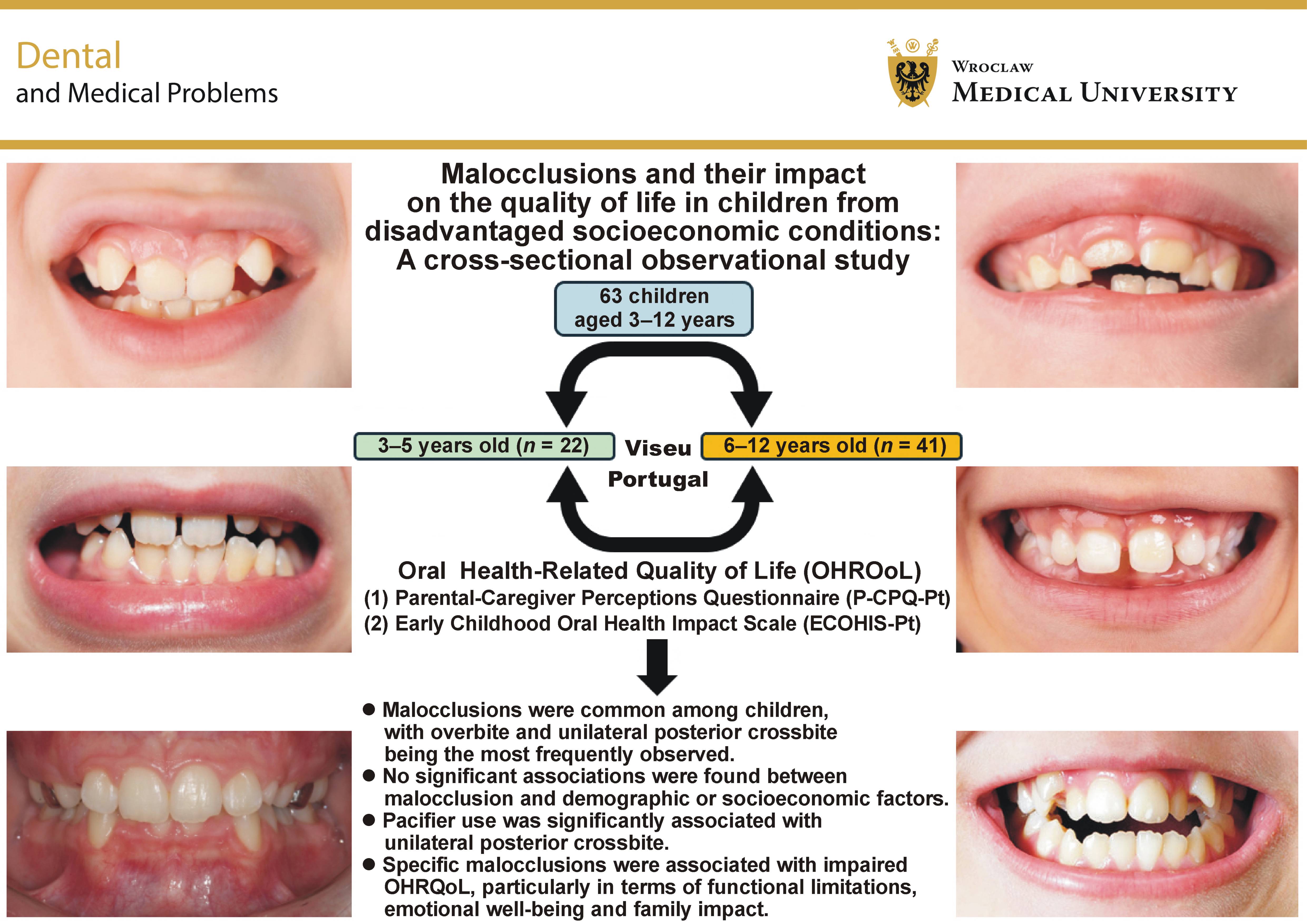
Abstract
Background. Malocclusion is characterized by dental and facial alterations that may impair the proper functioning of the stomatognathic system. Its prevalence and characteristics vary across populations, and are associated with socioeconomic conditions and deleterious oral habits.
Objectives. This study investigated the prevalence of malocclusion and its associations with sociodemographic characteristics, deleterious oral habits, and oral health-related quality of life (OHRQoL) among Portuguese children.
Material and methods. Children aged 3–12 years who participated in the “Ser Criança” project were included in the study. Sociodemographic data, deleterious oral habits and OHRQoL were assessed using the Early Childhood Oral Health Impact Scale – Portuguese version (ECOHIS-Pt) instruments or Parental-Caregiver Perceptions Questionnaire – Portuguese version (P-CPQ-Pt), as appropriate. Clinical data were obtained through the direct examination of the children. The malocclusions assessed included: (1) anterior open bite; (2) overbite; (3) overjet; (4) anterior crossbite; and (5) unilateral and bilateral posterior crossbite. Descriptive analyses and group comparisons were performed using Pearson's χ2 test and the independent-samples t test, with statistical significance set at p < 0.05.
Results. A total of 63 children were included in the study. Most were female, aged 6–12 years, and came from families with an income above the minimum wage. Pacifier use and bottle-feeding were the most prevalent deleterious oral habits. Overbite and unilateral posterior crossbite were the most frequently observed malocclusions. Among children aged 3–5 years, anterior open bite was associated with OHRQoL. In the 6–12-year-old group, malocclusions such as overbite, anterior crossbite and unilateral posterior crossbite showed significant associations with OHRQoL.
Conclusions. Malocclusions were moderately prevalent among the children, with overbite and unilateral posterior crossbite being the most common. No significant associations were found between malocclusion and sex, age or family income. However, pacifier use was significantly associated with unilateral posterior crossbite. Regarding the relationships between malocclusion and OHRQoL, anterior open bite in the 3–5-year-old group was associated with the family impact subscale. Among children aged 6–12 years, significant associations were found between: (1) overbite and the functional limitations and family impact subscales; (2) anterior crossbite and the functional limitations and emotional well-being subscales; and (3) unilateral posterior crossbite and the emotional well-being subscale.
Keywords: malocclusion, epidemiology, quality of life, oral health, questionnaires
Introduction
Smile esthetics play a significant role in an individual’s life, influencing psychological well-being and social interactions. The visual appeal of a smile is often associated with perceived attractiveness, which, in turn, can affect self-esteem and self-confidence.1, 2 Research indicates that individuals with malocclusion may experience social discrimination or diminished self-esteem, potentially compromising their overall oral health-related quality of life (OHRQoL).3, 4 Malocclusion, characterized by improper tooth alignment, can lead to functional difficulties and esthetic concerns, prompting individuals to seek orthodontic treatment to improve their appearance and quality of life (QoL).5, 6, 7, 8
The Index of Orthodontic Treatment Need (IOTN) is a standardized index used to assess the need for orthodontic treatment, providing a structured approach to identifying individuals who would benefit most from orthodontic care.8 The IOTN incorporates esthetic and clinical components, offering insight into the relationship between dental esthetics and treatment need.8 Other factors indicating an increased need for orthodontic treatment include functional impairment and the psychological effects of dental esthetics. Furthermore, malocclusion has been reported to affect not only oral functions, such as chewing and speech, but also psychosocial well-being, thereby increasing the perceived need for orthodontic treatment.8, 9
Further studies have shown that sociodemographic variables, including age, sex and socioeconomic status, may influence the perception of malocclusion and the perceived need for orthodontic treatment.8 Adolescents often experience greater pressure to conform to societal expectations regarding physical appearance, making esthetic considerations an important factor in their treatment decisions.10 Thus, the relationship between orthodontic treatment, smile esthetics, and overall life satisfaction represents an important area of investigation, as these factors may collectively influence public health and individual health-related behaviors.8
Malocclusion is characterized by dental and facial alterations that may impair the proper functioning of the stomatognathic system, and may necessitate orthodontic treatment.11 According to the World Health Organization (WHO), malocclusion is considered the 3rd most prevalent oral health problem worldwide, following dental caries and periodontal disease.12 Studies conducted worldwide have investigated the prevalence of malocclusion and occlusal trauma across different populations and settings.13, 14
A systematic review reported that Angle’s Class I is the most prevalent malocclusion worldwide, with prevalence estimates ranging from 31% to 96.6%.15 Angle’s Class II has a global average prevalence of 19.6%, although considerable variation has been observed across populations, with estimates ranging from 1.6% to 63%. In contrast, Angle’s Class III is less common, with a global average prevalence of 5.9% and estimates ranging from 0.7% to 19.9%.15 The distribution of malocclusion classes also varies considerably across geographical regions. Class I malocclusion and anterior open bite are more prevalent in Africa, whereas Class II malocclusion is more common among Caucasian populations, particularly in Europe.15, 16 These findings highlight the geographical variation in the prevalence and distribution of malocclusion across different populations.
Oral health-related quality of life is a multidimensional concept that subjectively assesses the impact of oral health on functional and emotional well-being, expectations, satisfaction with care, and self-perception. This biopsychosocial approach has gained prominence in pediatric dentistry and orthodontics, recognizing that dental treatment extends beyond the management of oral conditions to encompass patients’ overall well-being.17 The impact of malocclusion on the OHRQoL of children and adolescents has been investigated in recent studies.18 Understanding this relationship requires acknowledging that malocclusion affects not only patients’ physical condition, but also their subjective perception of oral health and well-being.19, 20
Therefore, contemporary dentistry extends beyond the traditional paradigm focused solely on oral diseases to embrace a broader biopsychosocial perspective that considers the patient’s overall well-being. Another systematic review examined the association between malocclusion, orthodontic treatment need and OHRQoL, identifying a modest and variable relationship among these factors.21 The findings highlight the importance of standardized assessment methods in improving the consistency of results and facilitating comparisons across studies.
In this context, 2 validated instruments, the Portuguese versions of the Parental-Caregiver Perceptions Questionnaire (P-CPQ-Pt) and the Early Childhood Oral Health Impact Scale (ECOHIS-Pt), have been used to assess OHRQoL in Portuguese-speaking populations. The P-CPQ-Pt is a parent-reported questionnaire designed to assess the perceived impact of oral health conditions on children aged 6–12 years, covering domains such as oral symptoms, functional limitations, emotional well-being, social well-being, and family impact. The ECOHIS-Pt, in contrast, is designed for younger children, typically under 6 years of age, and comprises both child and family impact sections, addressing the effects of oral health conditions on children’s daily lives, as well as the emotional and financial burden on their caregivers. Both instruments have been culturally adapted and linguistically validated for use in Portugal, supporting reliable and contextually appropriate assessments of the impact of oral health on QoL. Their application provides a more comprehensive understanding of how oral health affects children’s QoL, thereby supporting the development of targeted public health interventions and treatment strategies.
Malocclusion varies considerably across populations, and is associated with socioeconomic conditions and deleterious oral habits.22, 23 The prevalence of malocclusion highlights the need to strengthen oral health literacy.24, 25 Effective oral health education can empower families to recognize dental problems at an early stage and seek appropriate treatment, thereby helping to reduce socioeconomic disparities in children’s access to oral healthcare and promoting their overall well-being.
Thus, the present study aimed to address a gap in the literature by investigating the prevalence of malocclusion among children from low socioeconomic backgrounds. Additionally, it examined the associations between sociodemographic characteristics and OHRQoL, with the aim of informing the development of effective strategies to promote oral health in this population.
Material and methods
This observational study was conducted between June 2022 and January 2023, and followed the Strengthening the Reporting of Observational Studies in Epidemiology (STROBE) guidelines. The study was approved by the Ethics Committee of the Catholic University of Portugal, Viseu, Portugal (No. 30/2019). This project involved a collaboration between the Faculty of Dental Medicine of the Catholic University of Portugal, Viseu, Portugal, and the Social, Educational and Cultural Association of Viseu, Portugal. The partnership aimed to promote oral health and oral health literacy among disadvantaged populations in Portugal. The collaboration was formalized through a cooperation protocol between the institutions.
Eligibility criteria
Participants were selected using a convenience sampling method based on the availability and accessibility of the families participating in the social project “Ser Criança”. The project was established through a partnership between the Faculty of Dental Medicine of the Catholic University of Portugal, Viseu, Portugal, and the Social, Educational and Cultural Association of Viseu, Portugal, and targeted populations experiencing socioeconomic disadvantage. Eligible families were characterized by an annual household income at or slightly above the minimum wage, regardless of whether they accessed public schools or community centers.
Healthy children in either the primary dentition stage (3–5 years of age) or the mixed dentition stage (6–12 years of age), regardless of sex, were eligible for inclusion, provided that their parents or legal guardians provided written informed consent to participate. Children with severe systemic or cognitive impairment, significant behavioral difficulties, or those who refused to participate or undergo clinical examinations were excluded. Children whose parents or legal guardians did not provide written informed consent or who were not fluent in Portuguese were also excluded.
Data collection
Data collection was conducted by a single experienced clinician and researcher, in the presence of the interviewees and before the children’s clinical examinations. Sociodemographic data, including name, age, sex, and family income, were recorded, together with information on non-nutritive sucking habits, such as thumb-sucking, pacifier use and bottle-feeding, among others.
Oral health-related quality of life was assessed using 2 adapted and validated instruments – P-CPQ-Pt and ECOHIS-Pt, the latter designed for preschool-aged children.26, 27, 28 Both instruments were adapted in a study by Ferreira.29 The adaptations included modifications to the response scales to better reflect the cultural context of the study population and ensure an appropriate assessment of the impact of oral health on children’s QoL.
The P-CPQ-Pt includes 2 global questions asking parents to rate their child’s oral health: “How do you evaluate the health of your child’s teeth, lips, jaws, and mouth?” (response options: “excellent”; “very good”; “good”; “fair”; and “poor”) and “To what extent is your child’s well-being affected by the condition of their teeth, lips, mouth, and jaws?” (response options: “not at all”; “very little”; “some”; “a lot”; and “very much”).
The P-CPQ-Pt consists of 47 items divided into 5 subscales: oral symptoms (6 items); functional limitations (8 items); emotional well-being (8 items); social well-being (11 items); and family impact (14 items). The questions refer to the frequency of events experienced by the child during the previous 3 months. Responses are recorded using a 5-point Likert-type scale: “never” (score 0); “once or twice” (score 1); “sometimes” (score 2); “often” (score 3); and “nearly every day” (score 4). The total score is calculated by summing the response codes, with possible scores ranging from 0 to 188.
The ECOHIS-Pt comprises 2 sections: the child impact section, consisting of 9 items addressing the impact of dental problems and dental treatment on children’s daily activities and well-being; and the family impact section, consisting of 4 items evaluating the impact of children’s dental problems and treatment on family members. The response options are “never/hardly ever”, “occasionally/often/very often”, and “don’t know”.
The child impact section:
– How often has your child experienced pain in the teeth, mouth, or jaws because of dental problems or dental treatment?
– How often has your child had difficulty drinking hot or cold beverages because of dental problems or dental treatment?
– How often has your child had difficulty eating certain foods because of dental problems or dental treatment?
– How often has your child had difficulty pronouncing words because of dental problems or dental treatment?
– How often has your child missed preschool, daycare or school because of dental problems or dental treatment?
– How often has your child had difficulty sleeping because of dental problems or dental treatment?
– How often has your child been irritable or frustrated because of dental problems or dental treatment?
– How often has your child avoided smiling or laughing because of dental problems or dental treatment?
– How often has your child avoided talking because of dental problems or dental treatment?
The family impact section:
– How often have you or another family member felt upset because of your child’s dental problems or dental treatment?
– How often have you or another family member felt guilty because of your child’s dental problems or dental treatment?
– How often have you or another family member taken time off work because of your child’s dental problems or dental treatment?
– How often have your child’s dental problems or dental treatment had a financial impact on your family?
Responses to the ECOHIS-Pt are coded as follows: 0 (“never”); 1 (“hardly ever”); 2 (“occasionally”); 3 (“often”); 4 (“very often”); and 5 (“don’t know”). The total scores were calculated by summing the response codes separately for child impact and family impact sections, yielding possible score ranges of 9–45 and 4–20, respectively.
Following data collection from the parents/legal guardians and the assessment of oral health literacy among the children, clinical examinations of the oral cavity were performed. The examinations were conducted individually in adapted rooms, with the children positioned in a supine position on appropriate examination tables. The examiners used personal protective equipment (PPE) and clinical examination instruments, including a flashlight (Orascoptic Spark TruColor™ Cordless Headlight System; Orascoptic, Madison, USA), wooden spatulas, disposable clinical kits, and gauze compresses. Each child was examined by a single operator, assisted by a recorder who documented the type of dentition and the presence or absence of malocclusions. The same assessment criteria were applied to children with primary and mixed dentition. The evaluation of occlusal parameters followed the protocols described by Baume et al.30 and Bjoerk et al.31
The investigated malocclusions included: (1) anterior open bite; (2) overbite, characterized by excessive vertical overlap of the upper incisors over the lower incisors; (3) overjet; (4) anterior crossbite; and (5) unilateral or bilateral posterior crossbite. Each condition was recorded dichotomously as present or absent.
The Baume classification was used to describe the morphology of the primary dental arches according to the presence or absence of interdental spacing.30 Two arch types were identified: Type I, characterized by open or spaced primary dental arches (physiological spacing); and Type II, characterized by closed or non-spaced dental arches. Although this classification is not a conventional index for assessing malocclusion severity or orthodontic treatment need, it provides valuable information about early occlusal development and potential risk factors for crowding in the permanent dentition.
Bjoerk et al. classified dental anomalies into 2 main categories: (a) dental anomalies, including tooth anomalies, abnormal eruption and the misalignment of individual teeth; and (b) occlusal anomalies, involving deviations in the positional relationships between the upper and lower dental arches in the 3 spatial planes.31 These classifications provide a framework for identifying dental and occlusal deviations, and assessing their potential implications for subsequent occlusal development.
When conditions requiring urgent intervention were identified during the clinical examination, such as the reported pain or signs of infection, the child was promptly referred to the Department of Pediatric Dentistry at the Catholic University of Portugal, Viseu, Portugal, for appropriate treatment.
Occlusion was also assessed by examining the molar relationship, which was classified according to Angle’s classification as follows: Class I, in which the mesiobuccal cusp of the maxillary first permanent molar aligns with the buccal groove of the mandibular first permanent molar; Class II, in which the mesiobuccal cusp of the maxillary first permanent molar is positioned anteriorly to the buccal groove of the mandibular first permanent molar; and Class III, in which the mesiobuccal cusp of the maxillary first permanent molar is positioned posteriorly to the buccal groove of the mandibular first permanent molar.
In the primary dentition, the sagittal relationship between the second primary molars was classified according to the terminal plane relationship as follows: (1) a flush terminal plane, in which the distal surfaces of the maxillary and mandibular second primary molars are aligned in the same vertical plane; (2) a mesial step, in which the distal surface of the mandibular second primary molar is positioned mesially to that of the maxillary second primary molar; and (3) a distal step, in which the distal surface of the mandibular second primary molar is positioned distally to that of the maxillary second primary molar.
The dental arch form was assessed visually, and classified as either non-spaced arches, characterized by the absence of significant spacing between the anterior teeth, or spaced arches, characterized by the presence of interdental spaces or diastemas between the anterior teeth.
Statistical analysis
The data were organized and tabulated for subsequent statistical analysis using IBM SPSS Statistics, v. 28.0.1.0 (IBM Corp., Armonk, USA). Descriptive statistics included the calculation of absolute and relative frequencies for the variables under study. Inferential analyses were performed using Pearson’s χ2 test to compare proportions, and examine the associations between malocclusion, sociodemographic characteristics and deleterious oral habits. Additionally, the mean scores for the subscales and total scores of the P-CPQ-Pt and ECOHIS-Pt instruments were calculated to assess the association between malocclusion and OHRQoL. Group comparisons were performed using the independent-samples t test, with statistical significance set at 5% (p < 0.05).
Results
A total of 74 children, accompanied by their guardians, initially participated in a structured educational intervention focused on oral health literacy, and were subsequently screened for eligibility for the study. Following the initial data screening, 11 children were excluded – 6 did not meet the age criteria, 1 declined to undergo the examination, and 4 due to incomplete or incorrectly completed OHRQoL instruments. This resulted in a final sample of 63 children.
Most participants were female (n = 36; 57.1%), while 27 were male (42.9%). The predominant age group was 6–12 years (n = 41; 65.1%; mean age: 9.07 years), whereas 34.9% of the participants were aged 3–5 years (n = 22; mean age: 4.05 years). Regarding family income, 62.0% reported earnings above the minimum wage, while 30.1% reported income at or below the minimum wage. Income information was not provided by 7.9% of the participants.
Data on oral habits revealed that pacifier use and bottle-feeding were the most prevalent, each reported in more than 25% of the sample. Thumb-sucking was reported by more than 20% of the children. Of the total sample, 32 children were in the deciduous dentition stage and 31 were in the mixed dentition stage. Among children with deciduous dentition, Baume’s Type I arch and a mesial step molar relationship were the most common findings, whereas Angle’s Class I was predominant among those with mixed dentition. In the overall sample (N = 63), overbite and unilateral posterior crossbite were the most frequently observed malocclusions.
Among children with deciduous dentition (n = 32), the terminal plane relationships were distributed as follows: a flush terminal plane in 6 children (18.8%); a mesial step in 21 children (65.6%); and a distal step in 5 children (15.6%). Regarding the arch form, 28 children (87.5%) had open arches with spacing (Baume’s Type I), whereas 4 children (12.5%) had closed arches without spacing (Baume’s Type II).
Among children with mixed dentition (n = 31), the molar relationships, according to Angle’s classification, were distributed as follows: Class I in 17 children (54.8%); Class II in 10 children (32.3%); and Class III in 4 children (12.9%). Regarding the arch form, 17 children (54.8%) had open arches with spacing, while 14 (45.2%) had closed arches without spacing.
Table 1 presents the OHRQoL scores of children aged 3–5 years (n = 22), assessed using the ECOHIS-Pt, which indicated good QoL in this age group. Among children aged 6–12 years (n = 41), the mean subscale scores were also close to the minimum values, indicating good QoL, as shown in Table 2.
The analysis of the associations between malocclusion and other variables revealed no statistically significant differences according to sex, age, or family income, as shown in Table 3. However, a history of pacifier use was significantly associated with the presence of unilateral posterior crossbite (p = 0.047), as shown in Table 4.
When evaluating the associations between OHRQoL and malocclusion (Table 5), anterior open bite in children aged 3–5 years was associated with the family impact subscale. Among children aged 6–12 years, overbite was associated with the functional limitations and family impact subscales, whereas anterior crossbite was associated with the functional limitations and emotional well-being subscales. Additionally, unilateral posterior crossbite was associated with the emotional well-being subscale.
Discussion
Although several studies have assessed the Portuguese population,14, 32, 33 the present study specifically investigated the prevalence of malocclusions among Portuguese children. The findings revealed a moderate overall prevalence, with no significant associations with demographic, socioeconomic, or deleterious oral habit variables. However, specific associations with OHRQoL were identified, particularly among preschool- and school-aged children.
The most frequently observed malocclusions in the deciduous and mixed dentition stages were overbite and unilateral posterior crossbite, affecting a considerable proportion of the children assessed. The prevalence of Class II malocclusion was moderate and consistent with the global estimates reported by Alhammadi et al., who found prevalences of 23% in mixed dentition and 19.56% in permanent dentition.22 These figures fall within the range reported across different populations. However, the prevalence observed in the present study was slightly lower than the global average reported for Caucasian populations, in which Class II malocclusion is more prevalent, as described by Cenzato et al.23 Overall, these findings are consistent with the international distribution of malocclusions, in which Class I is the most prevalent, followed by Class II and Class III.
This study contributes to a better understanding of occlusal characteristics in Portuguese children and highlights the importance of considering specific QoL-related factors when planning orthodontic interventions.34 It also provides evidence that variations in malocclusion prevalence may be attributed to differences in population demographics and the assessment criteria employed.35 No significant associations were found between malocclusion and the demographic or socioeconomic characteristics of the participants (p > 0.05), which is consistent with previous research indicating that malocclusion affects children regardless of sex, age, the educational level, or family income.36 Although this association was not confirmed in the present study, the literature suggests that unfavorable demographic and socioeconomic conditions may contribute to the development of deleterious oral habits, potentially compromising OHRQoL.36, 37
Oral health literacy plays a crucial role in promoting effective oral health practices, particularly in socioeconomically vulnerable communities. Collaboration between universities and communities is essential for implementing educational programs and epidemiological screenings aimed at identifying and reducing oral health disparities. These initiatives not only improve knowledge on dental prevention and treatment, but also strengthen community ties by providing targeted and accessible health services.38 Epidemiological screenings generate reliable data on the prevalence of oral conditions, enabling health authorities to develop and implement effective interventions to improve oral health and overall well-being.39
The prevalence of deleterious oral habits, including pacifier use, bottle-feeding and thumb-sucking, was investigated in this study, and was found to vary across different age groups and populations. Previous studies have demonstrated associations between these habits and certain malocclusions. For example, a systematic review found that pacifier-sucking was associated with the development of anterior open bite and posterior crossbite, indicating a potential impact on orofacial structures.40 Additionally, research has shown that prolonged pacifier use and thumb-sucking are associated with malocclusions such as anterior open bite and increased overjet.39 However, in the present study, despite variations in the prevalence of oral habits, no significant associations between these habits and specific malocclusions were identified, except for the association between pacifier use and unilateral posterior crossbite. This finding should be interpreted in light of the literature, which highlights the need for further well-designed studies to conclusively evaluate the effects of non-nutritive oral habits on occlusal characteristics.40
Oral health-related quality of life in children, assessed using the P-CPQ and ECOHIS instruments validated for the Portuguese language, revealed significant associations between malocclusions and functional limitations, emotional well-being and family impact, particularly in cases of anterior malocclusions. These findings highlight the potential importance of early orthodontic assessment and intervention in improving children’s oral health and overall QoL, as well as that of their families.
Another useful instrument that was not employed in the present study is the Malocclusion Impact Questionnaire (MIQ), which was specifically developed and validated to assess the impact of malocclusion on the QoL of children and adolescents. Research has highlighted the need for malocclusion-specific assessment tools, as generic OHRQoL measures may fail to capture the unique challenges experienced by individuals with malocclusion.41, 42 The MIQ was developed through qualitative research that prioritized the perspectives of the affected individuals, allowing the inclusion of items that reflect the experiences and concerns of young patients in the UK and other cultural contexts.41, 42, 43 Therefore, the MIQ may be a valuable instrument to consider in future studies.
In Brazil, studies have reported a high prevalence of malocclusion, with environmental factors, including socioeconomic status and oral habits, playing an important role.44 Evidence suggests that children from lower socioeconomic backgrounds have a higher prevalence of malocclusion, with Class II and Class III malocclusions being particularly common in these populations.44, 45 Studies involving Brazilian preschool children have shown that, although malocclusion is highly prevalent, it is not necessarily significantly associated with children’s OHRQoL. However, other studies have reported that severe malocclusions negatively affect QoL, highlighting the need for targeted oral health interventions in socioeconomically vulnerable populations.46
Evidence from Portugal also contributes to this discussion, as studies have demonstrated an association between socioeconomic factors and malocclusion prevalence.47 Portuguese children from lower socioeconomic backgrounds presented poorer oral health outcomes, potentially resulting in worse OHRQoL.47 The consequences of malocclusion may also extend to psychosocial well-being, further emphasizing the importance of systematic public health initiatives aimed at reducing these disparities.45
In Zambia, studies have reported a high prevalence of malocclusion among children, reflecting the patterns observed in other European countries and suggesting possible geographical variations associated with socioeconomic factors.48 Importantly, the study identified significant associations between malocclusion severity and several health-related QoL measures, reinforcing the need for further research into these relationships.48 Children with more severe malocclusions reported greater negative impacts on their QoL, consistent with findings from studies conducted in Brazil, which have also highlighted concerns regarding inadequate access to dental care among lower socioeconomic groups.45
Systematic reviews have further emphasized that malocclusion prevalence across different countries is influenced by environmental and behavioral factors, including access to dental care and deleterious oral habits, which may be more prevalent in socioeconomically disadvantaged populations.49, 50 Understanding the complex relationships between socioeconomic status, malocclusion prevalence, and QoL is therefore essential for developing targeted public health strategies and reducing oral health inequalities.
Limitations
This study has several limitations. First, its observational design did not include any therapeutic interventions. Second, the sample size was relatively small, as the inclusion of participants depended on the voluntary participation of children enrolled in the social project. The limited sample size raises concerns regarding the generalizability of the findings, which should therefore be interpreted with caution. Furthermore, the study was geographically restricted to Viseu, Portugal, and did not include larger and more densely populated cities, such as Porto and Lisbon, limiting the representativeness of the sample.
Another important limitation was the delay in study implementation. Although approval to initiate the study was obtained in late 2019, the COVID-19 pandemic postponed its implementation until 2022–2023. The pandemic also generated widespread insecurity among the target population, with families primarily seeking dental care for urgent needs, further hindering participant recruitment and study progress.32
Despite these limitations, particularly the use of a convenience sample, the findings provide valuable information to guide future intervention strategies. They highlight the need for an integrated approach that considers not only the correction of malocclusions, but also the broader range of factors influencing children’s QoL.
Conclusions
Within the limitations of this study, malocclusions were found to be prevalent among the children, with overbite and unilateral posterior crossbite being the most frequently observed. No significant associations were found between malocclusion and sex, age or family income. However, pacifier use was significantly associated with unilateral posterior crossbite. Regarding the associations between QoL and malocclusion, anterior open bite in children aged 3–5 years was associated with the family impact subscale. Among children aged 6–12 years, the following associations were identified: (1) overbite with the functional limitations and family impact subscales; (2) anterior crossbite with the functional limitations and emotional well-being subscales; and (3) unilateral posterior crossbite with the emotional well-being subscale.
Ethics approval and consent to participate
The study was approved by the Ethics Committee of the Catholic University of Portugal, Viseu, Portugal (No. 30/2019). This project involved a collaboration between the Faculty of Dental Medicine of the Catholic University of Portugal, Viseu, Portugal, and the Social, Educational and Cultural Association of Viseu, Portugal. All parents/caregivers signed the informed consent form.
Data availability
The datasets supporting the findings of the current study are available from the corresponding author on reasonable request.
Consent for publication
Not applicable.
Use of AI and AI-assisted technologies
Not applicable.