



Abstract
Magnetic resonance-guided focused ultrasound (MRgFUS) represents a conceptual shift in functional neurosurgery by integrating non-invasive precision lesioning and potential neuromodulation within a single, circuit-based platform for refractory neuropsychiatric disorders, although its clinical implementation requires controlled evidence, refined patient selection, and careful consideration of ethical and social perceptions.
Keywords: MRgFUS, functional neurosurgery, deep brain stimulation, neuropsychiatric disorders
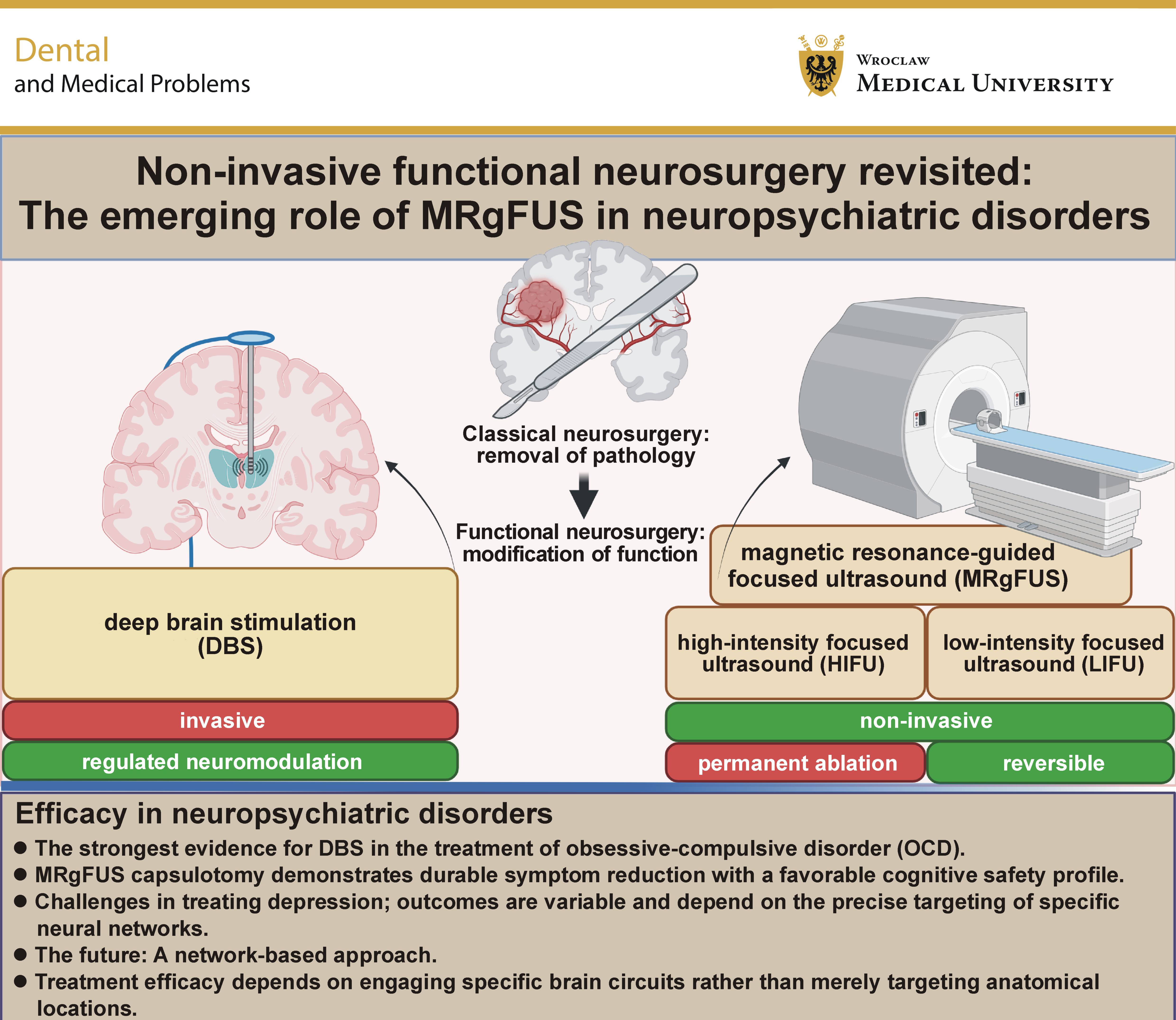
Classical neurosurgery is fundamentally oriented toward removing or neutralizing pathological substrates that exert mechanical or hemodynamic effects on the nervous system. The therapeutic objective is primarily the restoration of structural integrity and physiological flow dynamics, for example through tumor resection, hematoma evacuation or aneurysm clipping. In contrast, functional neurosurgery represents a distinct conceptual framework. Rather than eliminating the pathological substrate itself, it aims to modify the way neural circuits operate. The therapeutic target is often a dysfunctional circuit rather than a mass lesion requiring removal. Clinical benefits are achieved by modulating aberrant activity within specific circuits, often without directly removing or otherwise eliminating the underlying anatomical substrate.
This distinction reflects a broader conceptual shift in neuroscience from localizationist to network-based models. Within this framework, functional neurosurgery has become an established standard of care for selected neurological disorders, most notably Parkinson’s disease, essential tremor and dystonia. In these conditions, the modulation of well-characterized motor circuits can produce robust and reproducible clinical benefits.
At the same time, the field is rapidly expanding beyond its classical neurological indications. Advanced clinical investigations, including phase II–III studies, are exploring its potential in treatment-resistant depression, chronic pain syndromes, Tourette syndrome, and spasmodic dysphonia, with the emerging data also regarding Alzheimer’s disease. In parallel, a growing body of preclinical and early-phase clinical research is extending the scope of functional neurosurgery into psychiatric and neurobehavioral domains, including schizophrenia, addiction, tinnitus, disorders of consciousness, obesity and anorexia nervosa, and Huntington’s disease.1 The frequent overlap among pain, sleep disturbances and mental health symptoms further underscores the need for the interdisciplinary assessment and management of patients with complex neuropsychiatric conditions.2, 3, 4
These indications highlight the expanding interface between functional neurosurgery and psychiatry, providing the foundation for what is now termed interventional neuropsychiatry. The evolution of functional neurosurgery has been driven by successive technological advances, each seeking to optimize the balance between precision, invasiveness and reversibility.
Early stereotactic lesioning techniques, such as radiofrequency ablation (RFA), offered simplicity and cost-effectiveness, but at the expense of irreversibility and the need for invasive surgical access. The introduction of deep brain stimulation (DBS) marked a paradigm shift toward adjustable and partially reversible neuromodulation, with the additional advantages of bilateral applicability and a strong evidence base. However, these benefits come with the burden of hardware implantation, infection risk and long-term device management. More recent approaches, such as laser interstitial thermal therapy (LITT), have improved intraoperative precision through magnetic resonance imaging (MRI)-based thermometry, yet remain invasive and resource-intensive.
A key advantage of DBS, particularly in Parkinson’s disease, is the possibility of intraoperative neurophysiological recording, including microelectrode recording (MER), which enables real-time functional target verification and the refinement of lead placement. This electrophysiological feedback has historically been considered an important contributor to the precision of DBS targeting and, potentially, to its clinical efficacy in well-characterized motor circuits. In contrast, magnetic resonance-guided focused ultrasound (MRgFUS) combines focused ultrasound energy with MRI-based anatomical targeting and treatment monitoring, but does not provide intraoperative neuronal recording. In its clinically established ablative form, MRgFUS uses high-intensity focused ultrasound (HIFU) to induce focal tissue heating and coagulative necrosis. Magnetic resonance imaging provides high-resolution anatomical guidance and quantitative thermometry, enabling controlled energy delivery while limiting the exposure of the surrounding tissues.
The clinical relevance of intraoperative electrophysiological mapping in neuropsychiatric interventions remains uncertain. Unlike movement disorders, in which well-characterized electrophysiological signatures can inform target localization, psychiatric disorders involve distributed and heterogeneous network dysfunction, and validated intraoperative biomarkers of treatment-relevant circuit engagement are currently lacking. Moreover, MER is not consistently incorporated into DBS procedures for psychiatric indications, and there is currently no clear evidence that its use improves clinical outcomes in this setting. However, this does not imply that intraoperative neurophysiology has no potential value. Advances in physiology-guided neuromodulation, closed-loop stimulation and adaptive DBS may make electrophysiological recordings increasingly relevant for identifying pathological network states, refining targets and personalizing treatment. The absence of intraoperative neuronal recording in MRgFUS should therefore be regarded as a potential limitation, although its clinical significance has yet to be established.
In light of these considerations, technologies that do not rely on intraoperative electrophysiology, such as MRgFUS, may be particularly well suited to certain network-based neuropsychiatric interventions. By enabling incisionless, image-guided energy delivery, MRgFUS combines the spatial precision of stereotactic techniques with a fundamentally non-invasive approach. Real-time MRI thermometry enables continuous monitoring of tissue temperature and the control of energy delivery, while immediate clinical feedback, such as tremor suppression, can provide the functional confirmation of target engagement during the procedure.
Focused ultrasound has 2 conceptually distinct applications in functional neurosurgery, although they are currently at different stages of development. As noted above, HIFU is already used clinically to create precise, irreversible thermal lesions through focal heating and coagulative necrosis. By contrast, low-intensity focused ultrasound (LIFU) uses lower-intensity, typically pulsed sonication to produce predominantly mechanical neuromodulatory effects while minimizing tissue heating, and remains largely investigational. The reversible and non-ablative effects of LIFU make it an attractive potential research tool for transiently perturbing candidate neural networks and assessing their therapeutic relevance before irreversible lesioning is considered. This application should, however, be clearly distinguished from the current clinical use of ablative HIFU. The use of LIFU for neuromodulation and target validation will require standardized stimulation protocols, reproducible biomarkers of circuit engagement, and demonstration of efficacy and safety in controlled clinical studies.5
The emerging clinical evidence increasingly supports the feasibility and therapeutic potential of MRgFUS in neuropsychiatric disorders. Early proof-of-concept studies in treatment-refractory obsessive-compulsive disorder (OCD) demonstrated that bilateral MRgFUS capsulotomy can achieve meaningful symptom reduction, with improvement in OCD, depression and anxiety symptoms, and an overall favorable safety profile, notably without the evidence of persistent neurocognitive impairment.6, 7 These findings are further supported by subsequent studies reporting sustained clinical benefits without significant cognitive deterioration, with some patients even demonstrating improvement in specific domains of executive function.8
More recent prospective data extend these observations, indicating that MRgFUS capsulotomy maintains a favorable safety profile over long-term follow-up, with clinically meaningful response rates, particularly in OCD, although outcomes in major depressive disorder (MDD) appear more variable, and may depend on lesion location and the extent of network engagement.9 This greater variability may partly reflect the marked clinical and neurobiological heterogeneity of MDD, which may encompass distinct depressive biotypes characterized by different patterns of network dysfunction and, consequently, different optimal therapeutic targets. Importantly, the emerging connectomic analyses suggest that treatment efficacy is closely related to the precise engagement of specific fronto-striatal networks, reinforcing the concept of a network-targeted intervention rather than purely anatomical lesioning.10
From a broader perspective, MRgFUS may offer potential advantages by avoiding surgical incisions, implanted hardware, and some of the complications associated with open procedures. However, its overall risk–benefit ratio and cost-effectiveness remain uncertain, and cannot be generalized across healthcare settings. These assessments depend on procedural and infrastructure costs, the choice of comparator treatment, reimbursement structures, the complication and retreatment rates, and the durability of clinical benefits. Long-term comparative and health-economic studies are therefore needed before firm conclusions can be drawn.11
Importantly, the strength of evidence differs substantially across these indications. Among the psychiatric applications of MRgFUS, OCD currently has the most developed clinical evidence, including prospective studies of ablative capsulotomy. Evidence for MDD is more limited and outcomes appear more variable, whereas reports regarding addiction remain preliminary. For schizophrenia, obesity, anorexia nervosa, tinnitus, and several other neurobehavioral conditions, the available evidence is still sparse and largely limited to preclinical studies, feasibility investigations, or early proof-of-concept reports. These indications should therefore be regarded as being at different stages of clinical development rather than as comparable emerging applications.
Despite these encouraging results, the current evidence remains limited. Most studies of MRgFUS in psychiatric disorders have included small and highly selected patient populations, and have been conducted at only a few specialized centers. Many were uncontrolled, open-label or proof-of-concept studies. The studies also differ in patient selection, treatment targets, lesion location and size, outcome measures, and follow-up duration, which makes direct comparisons difficult. Large, multicenter randomized controlled trials (RCTs) are still lacking for most psychiatric indications. Magnetic resonance-guided focused ultrasound should therefore be viewed as promising but still investigational treatment rather than an established option in neuropsychiatric care.
Taken together, the available studies suggest that MRgFUS may become a useful platform for circuit-based interventions in selected neuropsychiatric disorders. However, the evidence remains preliminary, and larger controlled studies are needed to establish its safety, clinical effectiveness, the durability of treatment effects, and generalizability.
Against this historical and technological backdrop, the broader focused ultrasound platform represents more than a technical refinement, encompassing both the established ablative applications and the emerging approaches to non-ablative neuromodulation. Although the feasibility of MRgFUS has been demonstrated for selected indications, important questions remain regarding efficacy, the durability of benefits, optimal targeting, patient selection, and comparative effectiveness. Particular attention should also be paid to its social perception in light of the historical legacy of psychosurgery, including lobotomy, which may continue to shape attitudes toward the emerging neuropsychiatric interventions.
Ethics approval and consent to participate
Not applicable.
Data availability
Not applicable.
Consent for publication
Not applicable.
Use of AI and AI-assisted technologies
During the preparation of this manuscript, the authors used ChatGPT (OpenAI) for English-language editing and to assist in drafting and refining the summary. The authors reviewed and edited all AI-assisted content and take full responsibility for the final content of the manuscript.