Abstract
Background. Zirconia, or stabilized zirconium oxide (ZrO2), is a widely used dental ceramic for full-coverage crowns owing to its favorable biological and esthetic properties. Upon cooling after high-temperature sintering, zirconia undergoes a tetragonal-to-monoclinic phase transformation, which causes volume expansion and brittleness. Adhesive cementation (AC) is crucial for the clinical performance of zirconia restorations, enhancing their retention, marginal adaptation and fracture resistance, thereby contributing to their suitability for dental restorations.
Objectives. The aim of the present study was to evaluate how different kinds of surface treatment affect the shear bond strength (SBS) of zirconia, to analyze the influence of various luting agents on the SBS of zirconia, and to investigate the effect of simulated aging through water storage on the SBS of zirconia.
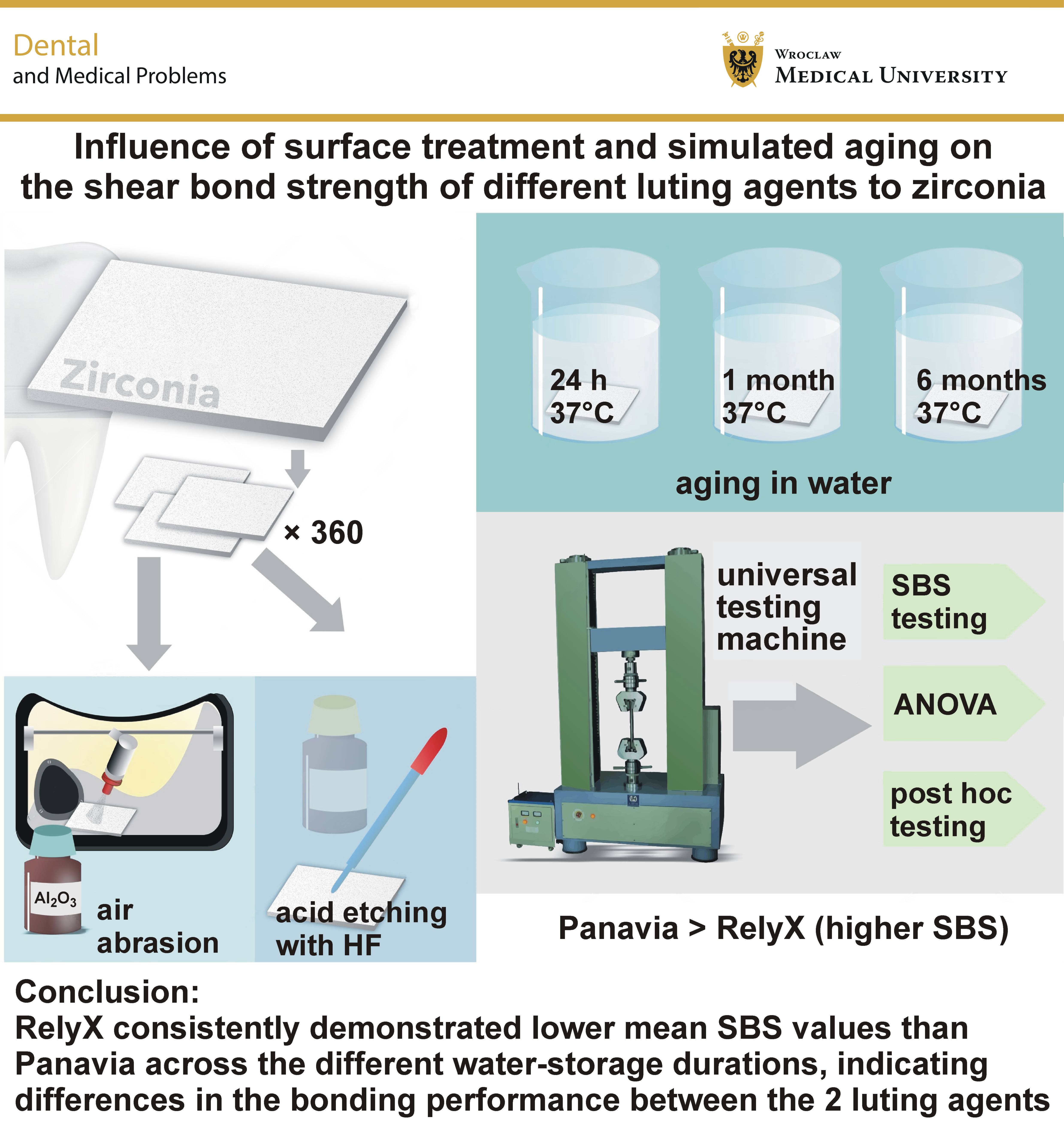
Material and methods. An experimental study design was used to assess the impact of 2 luting agents (RelyX™ Unicem and Panavia™ F 2.0), different surface treatment methods (STMs) and variable water-storage durations (1day (1D), 1 month (1M) and 6 months (6M)) on the SBS of zirconia.
Results. The study revealed that RelyX consistently showed lower mean SBS values than Panavia across the different water-storage durations. For instance, in group 1 at 1D, the mean SBS for RelyX was 17.12 ±0.71 MPa as compared to 21.76 ±2.81 MPa for Panavia. ANOVA indicated significant differences in SBS between RelyX and Panavia in each group (group 1: F = 13.892; p < 0.000). Post-hoc tests confirmed significant differences in the mean SBS across the different aging durations. Overall, the findings provide comprehensive statistical evidence regarding the performance of the 2 dental luting agents under different surface treatment and aging conditions.
Conclusions. RelyX consistently demonstrated lower mean SBS values than Panavia across the different water-storage durations, indicating differences in their bonding performance. Statistical analyses confirmed significant differences in SBS between the 2 luting agents.
Keywords: dental materials, zirconia, surface treatment, shear bond strength, luting agents
Introduction
Zirconia, or stabilized zirconium oxide (ZrO2), is a high-strength dental ceramic widely recognized for its excellent fracture toughness and biocompatibility. Its tetragonal phase, stabilized by a small addition of yttria, enhances its mechanical properties and dimensional stability, making it an ideal material for dental prosthetics.1, 2, 3
Although zirconia inherently possesses high fracture toughness, the manner in which the tooth is prepared remains crucial in influencing stress distribution within the crown–tooth complex. A well-performed tooth preparation reduces the risk of fracture and enhances the mechanical retention of the zirconia crown, particularly in posterior regions, where greater occlusal forces are exerted.4 Until recently, zirconia ceramic crowns were fabricated similarly to metal-ceramic crowns, with an external layer of sintered porcelain and an internal zirconia core. This combination was intended to provide the crown with improved esthetic appearance as well as enhanced mechanical strength.5, 6, 7
Fractures of veneering porcelain pose significant challenges in fixed dental prostheses, primarily due to compatibility issues between the zirconia framework and the veneering material. In recent years, monolithic zirconia has emerged as an alternative to veneered zirconia restorations. This innovative approach involves the fabrication of full-contour zirconia restorations using a dental computer-aided design/computer-aided manufacturing (CAD/CAM) system, thereby eliminating the complications associated with the bonding of zirconia and veneering porcelain.
Despite this progress, it is important to recognize that monolithic zirconia may not provide the same esthetic outcomes as zirconia cores veneered with porcelain. This difference may be attributed to the relatively uniform color and limited optical properties of monolithic zirconia crowns, which can result in a less natural and esthetically pleasing appearance.8
The prosthetic fabrication of zirconia has evolved from traditional layering techniques to advanced CAD/CAM processes. These methods not only ensure precise anatomical conformity and improved esthetic outcomes, but also significantly reduce the potential for manual errors.9 The present study specifically focuses on CAD/CAM-fabricated restorations, given their increasing prevalence in clinical applications and their relevance to the evaluation of surface treatment and bonding efficiency.
Cementation is crucial to the clinical effectiveness of ceramic restorations. Zirconia ceramics can benefit from adhesive cementation (AC), which may improve retention, marginal adaptation and fracture resistance. The use of zirconia and resin cements may also permit more conservative tooth preparation while reducing the risk of restoration failure. Various surface treatment and bonding strategies have been proposed to achieve a strong and durable bond between zirconia and resin cements. These include incorporating phosphate-modified monomers, such as 10-methacryloyloxydecyl dihydrogen phosphate (MDP), into resin cement; air abrasion, performed either in the laboratory or chairside, using 30- or 110-micrometer silica-coated aluminum oxide particles; the use of zirconate-coupling primers, tetraethoxysilane flame-treatment devices, organofunctional silanes, laser irradiation, silicon vapor-phase deposition, and selective infiltration etching.7, 10, 11
Despite the availability of various surface treatment methods (STMs) aimed at enhancing the strength of bond to ZrO2, conflicting results persist, primarily due to variations in bond-strength testing methodologies.
Due to its chemical inertness and lack of a silica-rich glassy phase, establishing an effective bond between zirconia and resin cements remains challenging, rendering conventional acid-etching methods less effective. Achieving a strong and durable resin–zirconia bond generally requires a comprehensive approach combining chemical and micromechanical surface pretreatment.12 Acid etching can increase the wettability and surface area of silica-containing ceramics by altering their surface energy and bonding potential. However, unlike silica-based ceramics, zirconia has a highly crystalline, silica-free microstructure that is resistant to conventional acid etching. Consequently, acid etching produces limited topographical changes on the zirconia surface, and is generally insufficient to achieve a strong and durable bond with a resin cement.13
Alternatively, acid-resistant ceramics can be air-abraded with aluminum oxide particles to produce surface irregularities and enhance micromechanical retention. However, research suggests that although air-abraded zirconia ceramics may initially improve bonding with certain luting agents, this bond may not remain stable during prolonged storage in artificial saliva or thermocycling in water. This instability may be attributed to limited chemical interaction between the treated zirconia surface and certain luting agents, as well as to the degradation of the resin–zirconia interface under aging conditions. In summary, acid etching may not produce substantial topographical alterations in highly crystalline ceramics, while air abrasion can initially enhance bonding through micromechanical retention, but may not provide sufficient long-term bond durability when used alone.14
To improve resin bonding to metal and highly crystalline ceramics, various silica-coating systems were initially introduced as experimental surface treatment techniques. Notable systems, such as Rocatec, CoJet and Silicoater MD, have demonstrated adequate bond strength in various studies. Monolithic zirconia crowns can benefit from resin-based cements, particularly when enhanced retention and bonding are required; however, achieving a durable bond remains challenging because of the inert, silica-free nature of zirconia. Air abrasion is commonly recommended to enhance micromechanical retention, while resin-based cements can provide additional chemical interaction when functional monomers are incorporated. Despite the high strength and fracture toughness of zirconia, the properties and durability of the resin cement are also important for maintaining adequate support and long-term stability of the ceramic restoration.15
The study specifically employed RelyX™ Unicem and Panavia™ F 2.0, selected for their distinct adhesive formulations and widespread clinical use. RelyX Unicem, a self-adhesive resin cement, is characterized by the ease of use and favorable initial bond strength, making it suitable for a broad range of clinical indications. Panavia F 2.0, a resin cement used in conjunction with an adhesive primer, was selected for its high bond durability and effectiveness under moist conditions. These properties make both cements suitable for evaluating the effects of different STMs and aging conditions, providing insights into their performance under varied clinical scenarios.16
The present study aimed to assess the effects of 2 luting agents, different STMs and variable water-storage durations on the shear bond strength (SBS) of zirconia.
Surface preparation techniques, such as air abrasion, selective etching, and the application of functional primers, can play an important role in enhancing the bond strength between zirconia and resin cements. These treatment modalities can improve micromechanical interlocking and promote chemical interaction at the zirconia–resin cement interface, thereby contributing to bond durability. The present study explores different surface treatment protocols to determine their effects on the SBS of various luting agents to zirconia, an aspect that is critical to the long-term clinical success of ceramic restorations.
Hypotheses
The following hypotheses were tested:
– null hypothesis 1: Different STMs do not significantly affect the SBS of zirconia;
– null hypothesis 2: Different types of resin cement do not significantly affect the SBS of zirconia;
– null hypothesis 3: Artificial aging through water storage does not significantly affect the SBS of zirconia.
Material and methods
Methodology
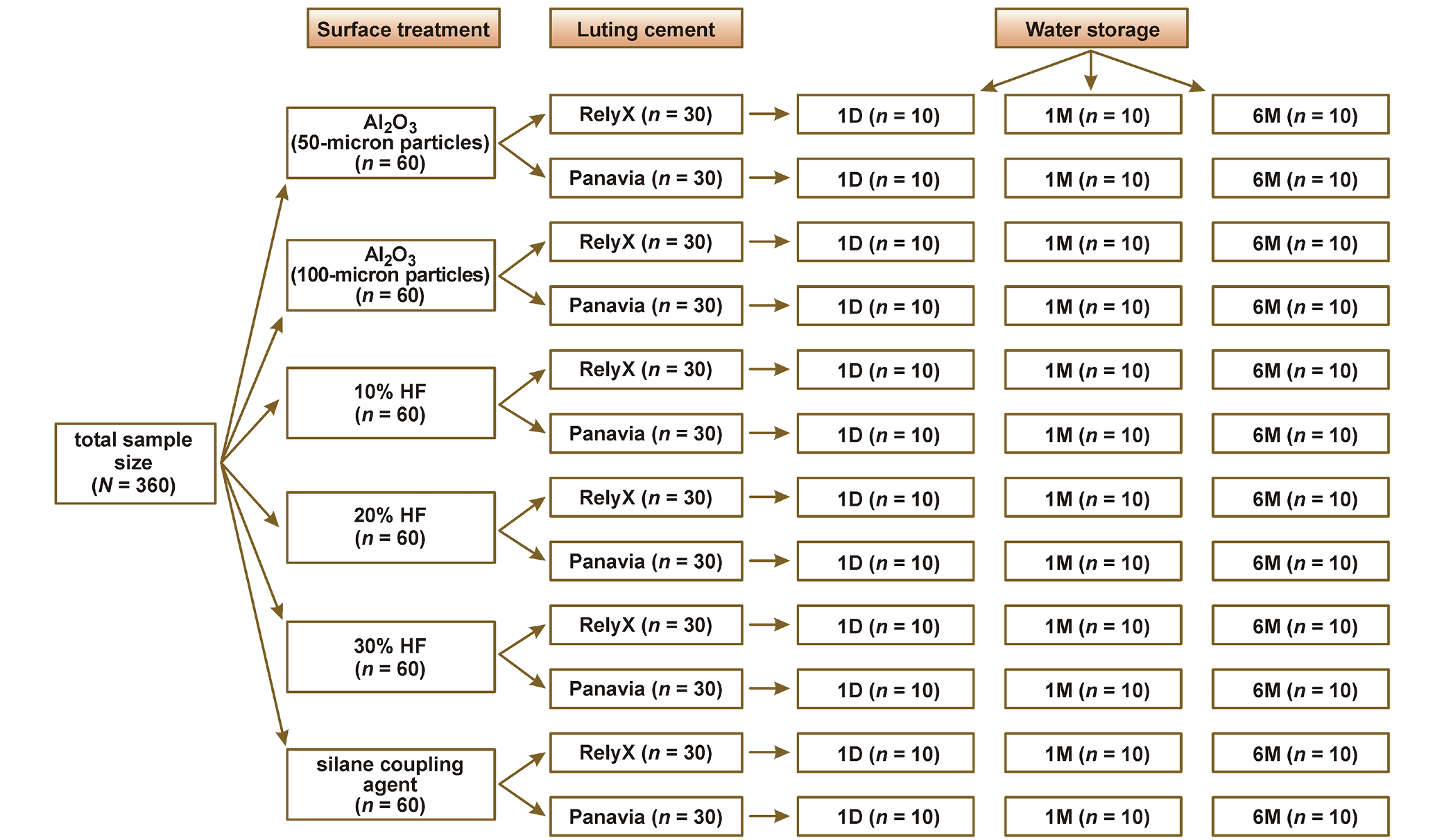
Each zirconia block was sectioned into specimens measuring 10 mm × 4 mm × 2 mm, using an EM-DC2 die-cutting machine (Aixin Medical Equipment, Tianjin, China). The sp ecimens were then sintered and polished. This uniform rectangular shape was selected to standardize the testing area and ensure the consistent application of the surface treatment and bonding procedures across all specimens. The specimens were randomly divided into 6 groups, each of which received specific surface treatment before bonding with the luting cement (Figure 1).
Surface treatment groups
The zirconia specimens were divided into 6 distinct groups, each subjected to a different surface treatment protocol to evaluate its effect on bond strength:
– group 1: Air abrasion using 50-micrometer alumina (Al2O3) particles at a pressure of 3.5 bar, a working distance of 10 mm, and a blasting time of 15 s;
– group 2: Air abrasion using 100-micrometer Al2O3 particles under the same conditions as group 1;
– group 3: Immersion in 10% hydrofluoric acid (HF) at 60°C for 60 min, followed by rinsing with deionized water and air-drying;
– group 4: Immersion in 20% HF under the same conditions as group 3;
– group 5: Immersion in 30% HF under the same conditions as groups 3 and 4;
– group 6: Combination treatment consisting of air abrasion with 110-micrometer Al2O3 particles at 3.5 bar for 10 s, followed by immersion in 30% HF at 60°C for 60 min and subsequent silanization.
A total of 360 specimens were prepared and equally distributed among the 6 surface treatment groups. Each group comprised 30 specimens for RelyX Unicem and 30 specimens for Panavia F 2.0, resulting in 180 specimens for each type of resin cement.
Bonding of zirconia specimens with resin cement blocks
Of the 360 specimens prepared, 120 specimens – 60 bonded with RelyX Unicem and 60 with Panavia F 2.0 – underwent immediate testing to assess the initial bond strength. The remaining 240 specimens were allocated for extended testing following different water-storage durations to evaluate the effects of aging on bond strength. Prior to bonding, the specimens were cleaned and primed according to the respective surface treatment protocols. Bonding was performed at room temperature under a constant load of 75 N.
Water storage
Following the bonding procedure, the specimens were immersed in distilled water according to the following storage periods:
– category 1: Specimens were immersed in distilled water for 24 h (1 day –1D) to assess the initial bond strength following water exposure;
– category 2: Specimens were stored in distilled water for 1 month (1M), with weekly water changes, to assess the intermediate-term stability of the bond;
– category 3: Specimens were stored in distilled water for 6 months (6M), with weekly water changes, to assess the long-term durability and performance of the bonded interface.
Shear bond strength testing
Shear bond strength was evaluated using a universal testing machine (UTM) at a crosshead speed of 1 mm/min. The maximum load recorded at the time of debonding was measured in kilograms (kg), converted to newtons (N), and then divided by the bonding area to calculate SBS, expressed in megapascals (MPa).
Results
In a comparative analysis of the RelyX and Panavia dental cements, the mean SBS values and standard deviations (M ±SD) were assessed across 6 groups at 3 water-storage durations – 1D, 1M and 6M. Overall, the results indicated a tendency toward decreased SBS with prolonged water storage, although the pattern varied among the groups and luting agents (Table 1).
Specimens in category 1 generally showed the highest SBS values, whereas those in categories 2 and 3 exhibited greater reductions following prolonged water storage. In group 1, the mean SBS for RelyX decreased from 17.12 ±0.71 MPa at 1D to 8.54 ±6.42 MPa at 6M, while for Panavia, the values decreased from 21.76 ±2.81 MPa to 7.10 ±2.80 MPa. Group 2 showed a different pattern, with RelyX reaching its highest mean value at 1M (24.47 ±2.95 MPa), whereas Panavia exhibited its highest mean value at 1D (32.41 ±10.04 MPa). Groups 3, 4, 5, and 6 generally demonstrated decreasing SBS values with prolonged water storage. For example, in Group 4, the mean SBS for RelyX decreased from 18.58 ±3.49 MPa at 1D to 9.92 ±5.18 MPa at 6M, while Panavia decreased from 20.52 ±2.36 MPa to 8.06 ±4.73 MPa). Overall, these findings suggest differences in the stability and bonding performance of the 2 luting agents under different water-storage conditions.
Table 2 summarizes differences in SBS among the 2 luting agents, STMs and aging conditions. It provides a comparative assessment of the performance of RelyX and Panavia under the various experimental conditions and illustrates the effect of prolonged water storage on bond strength.
Table 3 presents the results of the post hoc tests evaluating differences in SBS between zirconia specimens bonded with the 2 luting agents, RelyX and Panavia, across the different aging durations. In group 1, significant mean differences in SBS were observed with regard to 1D, 1M and 6M, indicating significant differences for the 2 luting agents at nearly all tested durations (except 1M vs. 6M for RelyX). In group 2, a significant difference emerged at 6M vs. 1D for Panavia, suggesting differences in bond performance following prolonged aging. In group 3, significant differences in SBS were observed with regard to all 3 aging durations (1D, 1M and 6M). Similarly, Groups 4 and 6 demonstrated significant mean differences across all tested durations. Group 5 also showed significant differences at 1D vs. 1M and 6M. Overall, these findings underscore the significant impact of simulated aging on the performance of Relyx and Panavia when applied to zirconia, providing valuable insights for their clinical application.
Table 4 presents a statistical comparison of groups 1–6 under different water-storage conditions. In group 1, a significant difference was observed at 1D (p < 0.001; t = −5.063), with a mean difference of −4.64 and a standard error (SE) of 0.92, a trend consistent at a duration of 1M, but not sustained at 6M (p = 0.465), where the direction reversed. Group 2 showed a highly significant difference at 1M (p < 0.001; t = 0.295), with a mean difference of 1.51 and SE = 5.10, whereas differences at 1D and 6M were not statistically significant. Group 3 demonstrated a significant difference at 1M (p = 0.005; t = 3.240), with a mean difference of 3.88 and SE = 1.20, while no significant differences were observed at 1D or 6M. In Group 4, a highly significant difference was observed at 1M (p < 0.001; t = 5.114), with a mean difference of 5.74 and SE = 1.12, whereas differences at 1D and 6M were not significant. Group 5 showed a significant difference at 1D (p = 0.010; t = −3.177), with a mean difference of −3.06 and SE = 0.96, with similar significant differences observed at 1M and 6M. Finally, Group 6 showed no statistically significant difference at 1D, 1M or 6M. Overall, these findings provide insights into the comparative performance of these dental cements across different conditions.
Discussion
The outcomes of this study provide important insights into the application of zirconia in dental prosthetics, highlighting the crucial role of surface treatment in the longevity and performance of zirconia-based restorations. Acid-etched surfaces demonstrated higher bond strength under the experimental conditions, suggesting the potential for more effective and durable adhesive techniques in clinical practice. These findings underscore the importance of appropriate surface preparation in optimizing the mechanical properties of zirconia restorations, which are often subjected to substantial mechanical stress and wear over time.
The superior bond strength observed with the acid-etching treatment compared with air abrasion in the present study is consistent with findings reported in other studies.14, 17, 18, 19 Collectively, these findings suggest that acid treatment may enhance the surface characteristics of zirconia and promote improved interaction with resin cements under certain experimental conditions. This may contribute to greater bond durability and potentially reduce the risk of restoration failure. Further research is warranted to establish standardized and clinically validated surface treatment protocols to incorporate acid etching more broadly, thus enhancing the overall success rates of zirconia restorations.
Moreover, the observed decrease in bond strength over time, particularly following prolonged water storage, highlights an important area for improvement in dental cement formulations. Both RelyX and Panavia demonstrated reductions in bond strength under the aging conditions evaluated, which may have implications for the long-term performance of zirconia restorations. This degradation presents an important challenge in adhesive dentistry and underscores the need for further research into more durable bonding systems capable of maintaining stable adhesion under prolonged exposure to the challenging conditions encountered in the oral environment.19, 20, 21, 22, 23, 24
Furthermore, the findings regarding the differential performance of the various luting agents and surface treatment modalities under simulated aging conditions provide valuable insights into the potential long-term performance of zirconia restorations. Dental practitioners and materials scientists should consider these variables when selecting and developing restorative materials, respectively. Such considerations are important for advancing patient care through the use of materials and bonding protocols that provide greater resistance to degradation over time.18, 20, 21, 24, 25
Additionally, the differences observed among the tested groups warrant further investigation into how specific surface modifications influence micromechanical retention and chemical interaction at the zirconia–resin cement interface. A better understanding of these mechanisms may help optimize surface treatment protocols and improve the bonding performance and long-term stability of zirconia-based restorations.14, 15, 26, 27, 28
Our findings support further consideration of surface treatment and cementation protocols in the clinical management of zirconia restorations. By providing empirical evidence on the behavior of different luting agents and surface treatment modalities under the tested aging conditions, this study contributes to a better understanding of zirconia–resin cement interaction and may help guide the refinement of bonding protocols. Further clinical research is warranted to determine whether these findings translate into improved long-term durability and reliability of zirconia restorations.
Limitations
While this study provides valuable insights into the bond strength of zirconia following specific surface treatment and cementation protocols, its laboratory setting limits the direct extrapolation of the findings to clinical scenarios. The use of water storage to simulate aging, although useful for preliminary assessment, may not fully reproduce the complex biological, chemical, thermal, and mechanical conditions present in the oral environment or capture long-term clinical outcomes. Additionally, mechanical testing was performed under controlled uniaxial loading, which does not fully represent the complex and multidirectional stresses experienced by dental restorations in vivo. Further research incorporating longer-term clinical follow-up and more clinically representative, multidirectional loading conditions is recommended to validate and extend these findings.
Conclusions
In conclusion, the study rejects the 3 null hypotheses, demonstrating that surface treatment protocols significantly affect the SBS of zirconia, that different luting agents, particularly RelyX and Panavia, exhibit different bonding performance, and that artificial aging through water storage significantly reduces bond strength. These findings highlight the importance of both surface treatment and aging conditions in determining the performance of luting agents used with zirconia restorations. Additionally, the study found that the application of a silane coupling agent enhanced the bond strength of RelyX Unicem to yttria-stabilized tetragonal zirconia polycrystal (Y-TZP) before aging, whereas HF treatment reduced the surface roughness of Y-TZP. Overall, water storage generally resulted in decreased bond strength for both luting agents, emphasizing the importance of long-term bond durability in zirconia-based restorations.
Ethics approval and consent to participate
Not applicable.
Data availability
The datasets supporting the findings of the current study are available from the corresponding author on reasonable request.
Consent for publication
Not applicable.
Use of AI and AI-assisted technologies
During the preparation of this manuscript, the authors used DeepL AI platform for language checking and grammar correction.
Additionally, the authors would like to acknowledge Prof. Luis Eduardo Almeida, Department of Surgical Sciences, School of Dentistry, Marquette University, Milwaukee, USA, a native English speaker, for reviewing and editing the manuscript to ensure clear and accurate scientific English.