



Abstract
Background. Hypertension (HTN) is a prevalent condition affecting a significant proportion of the population. It requires careful management due to its potential systemic complications. While the overall effects of HTN are well documented, its specific impact on implant dentistry procedures, such as sinus augmentation, remains less clear.
Objectives. The present study aimed to investigate the influence of HTN and antihypertensive medications on early implant failure (EIF) following sinus augmentation.
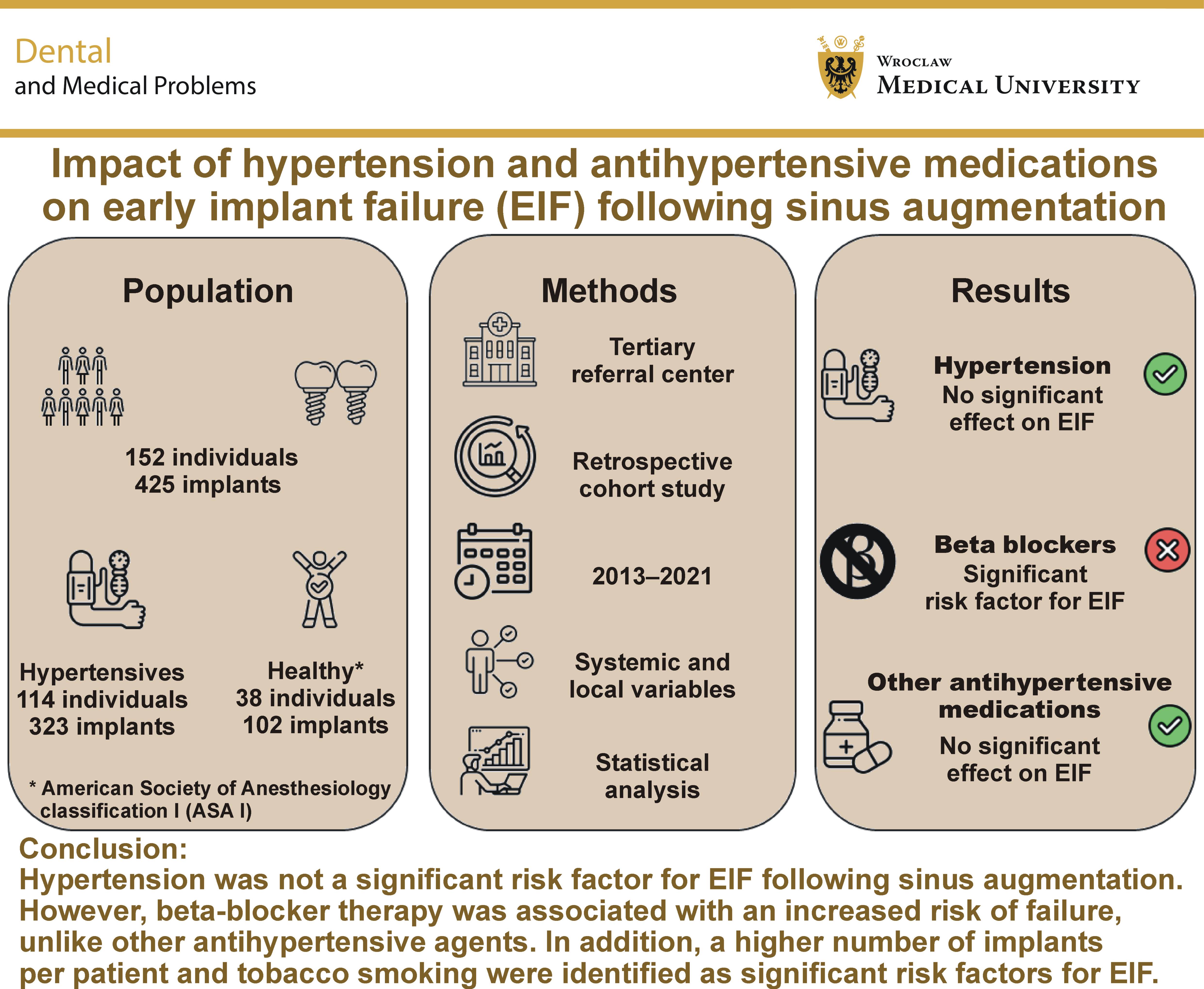
Material and methods. A retrospective cohort study was conducted at a tertiary referral center between 2013 and 2021. Data from 425 implants in 152 patients were analyzed. The primary outcome was EIF. Univariate and multivariable analyses were performed to identify potential risk factors. A p-value <0.05 was considered statistically significant.
Results. Hypertension did not significantly affect EIF. However, beta-blocker therapy was identified as an independent risk factor at both the patient and implant levels (OR (odds ratio) = 4.05; p = 0.018 and OR = 3.13; p = 0.045, respectively). A higher number of implants per patient and tobacco smoking were also associated with an increased risk of EIF (OR = 1.49; p = 0.039 and OR = 8.52; p < 0.001, respectively). Other antihypertensive medications were not significantly associated with EIF.
Conclusions. Hypertension was not a significant risk factor for EIF following sinus augmentation. However, beta-blocker therapy was associated with an increased risk of failure, whereas other antihypertensive agents, including diuretics, angiotensin-converting enzyme inhibitors (ACEIs), angiotensin II receptor blockers (ARBs), and calcium channel blockers (CCBs), were not significantly associated with EIF.
Keywords: risk factors, dental implants, medications, antihypertensive agents, maxillary sinus augmentation
Introduction
Sinus augmentation is a common procedure aimed at increasing bone volume in the posterior maxilla to facilitate dental implant placement. First introduced by Boyne and James in the 1970s, the technique has undergone significant advancement, becoming a predictable and widely used procedure.1 Although generally successful, implants placed following sinus augmentation may still fail, either at an early or late stage. Early implant failure (EIF) refers to implant failure occurring before osseointegration is achieved.2, 3, 4
Numerous risk factors for EIF have been identified and extensively studied. These factors can be categorized as local or systemic.5 Local risk factors include anatomical factors, such as residual bone height, the quality of the peri-implant microenvironment, including the quality of the keratinized gingiva, and the specific surgical technique used.4, 5, 6, 7, 8, 9, 10 Systemic risk factors include various health conditions, medications and patient habits, including tobacco smoking, diabetes mellitus, and the patient’s physical status as graded by the American Society of Anesthesiologists (ASA) classification.2, 3, 4, 5, 11, 12, 13
Hypertension (HTN) is a condition characterized by persistently elevated arterial blood pressure. According to the American Heart Association (AHA), approx. 50% of American adults have HTN.14 In 2019, Eurostat data indicated that 22% of the European Union (EU) population aged 15 years and older reported having HTN, with the highest prevalence in Croatia (37%) and the lowest in Ireland (12%).15 Normal blood pressure is defined as a systolic blood pressure of less than 120 mmHg and a diastolic blood pressure of less than 80 mmHg.14 The AHA defines HTN as a systolic blood pressure of ≥130 mmHg or a diastolic blood pressure of ≥80 mmHg.16 In contrast, the European Society of Hypertension (ESH) defines HTN as an office systolic blood pressure of ≥140 mmHg and/or a diastolic blood pressure of ≥90 mmHg.17
There are 2 main types of HTN – primary and secondary. Primary HTN, also known as essential or idiopathic HTN, is characterized by elevated blood pressure without an identifiable underlying cause. It is a chronic and typically irreversible condition that is more common in older individuals. Secondary HTN, in contrast, refers to elevated blood pressure caused by an underlying medical condition, such as obstructive sleep apnea (OSA) or kidney disease. Although potentially reversible when the underlying condition is addressed, secondary HTN can be more resistant to treatment and often affects younger individuals.18 Hypertension may lead to ischemic heart disease, heart failure, kidney disease, and sexual dysfunction.16
Treatment for HTN is initially based on lifestyle modifications, including weight loss, a diet low in saturated and total fat, low in sodium and high in potassium, regular aerobic exercise, and limiting or eliminating alcohol consumption. When these measures do not result in adequate blood pressure control, antihypertensive medication therapy is initiated.16 Antihypertensive medications comprise a diverse range of pharmacological agents, each targeting a distinct biological pathway to reduce blood pressure. Diuretics, such as thiazide and loop diuretics, promote the renal excretion of sodium and water, thereby reducing blood volume and cardiac output.19 Angiotensin-converting enzyme inhibitors (ACEIs), including lisinopril and enalapril, inhibit the conversion of angiotensin I to angiotensin II, thereby reducing peripheral vascular resistance.20 Angiotensin II receptor blockers (ARBs), such as losartan and valsartan, antagonize angiotensin II receptors, preventing vasoconstriction and aldosterone release.21 Calcium channel blockers (CCBs), such as amlodipine and nifedipine, inhibit calcium influx into arterial smooth muscle cells, promoting vasodilation and reducing cardiac contractility.22 Finally, beta blockers, including metoprolol and atenolol, antagonize beta-adrenergic receptors, thereby reducing cardiac output and renin release.16, 23
First-line pharmacological treatment typically includes ACEIs or ARBs, such as enalapril or candesartan, CCBs, such as amlodipine, and diuretics, such as hydrochlorothiazide. Unless patients have a history of ischemic heart disease or heart failure, beta blockers are generally not prescribed as first-line agents, as their benefit in stroke prevention is lower than that of the aforementioned first-line therapies.16, 24
While the systemic effects of HTN are well established, its impact on implant dentistry, particularly sinus augmentation, remains less well understood. Recent systematic reviews by Mishra et al.25 and Hamadé et al.26 examined the relationship between HTN and implant failure, and concluded that HTN itself did not significantly increase the failure rates, while patients receiving antihypertensive medications had comparable implant success rates to non-medicated patients. However, both reviews highlighted limitations in the existing literature, particularly the tendency to group different antihypertensive medications together, which limits a more nuanced understanding of their individual effects on implant outcomes.25, 26
To address this gap in knowledge, the present study aimed to investigate the influence of HTN, as well as specific medications used to manage the condition, on EIF following sinus augmentation. The null hypothesis was that neither HTN nor antihypertensive medications influence EIF following sinus floor elevation.
Material and methods
Following the Strengthening the Reporting of Observational Studies in Epidemiology (STROBE) guidelines,27 a retrospective cohort study was conducted at a tertiary referral center (Department of Oral and Maxillofacial Surgery, Rabin Medical Center, Petah Tiqwa, Israel) between January 2013 and December 2021. All study participants provided written informed consent prior to enrollment. The study adhered to the ethical standards outlined in the Declaration of Helsinki and was approved by the institutional review board at Rabin Medical Center (approval No. 0674-19).
The characteristics of this cohort reflect those of the medical center’s patient population, which is referred to this department for the management of complex systemic and local conditions.
Surgical protocol
Patients with less than 5 mm of residual bone height underwent sinus floor elevation using the lateral window approach described by Boyne and James (1980). Individuals with 5–8 mm of residual bone height underwent the Summers technique for transcrestal sinus floor elevation to facilitate dental implant placement.1, 28 Prior to the procedure, three-dimensional (3D) imaging, using either cone-beam computed tomography (CBCT) or multidetector computed tomography (MDCT), was performed to evaluate the bone structure.
The surgical procedure involved accessing the maxillary sinus through the creation of a surgical flap. Incisions were made along the midline of the alveolar crest and extended vertically, with additional incisions performed when necessary to facilitate adequate closure and ensure flap flexibility. A round diamond bur was used to create a window in the lateral sinus wall, through which the sinus membrane was carefully elevated. Any accidental perforations of the membrane were repaired using a collagen barrier (Ossix® Plus; Datum Dental, Lod, Israel). The resulting space was subsequently filled with a bovine-derived bone graft material (Bio-Oss®; Geistlich Pharma, Wolhusen, Switzerland).
Following augmentation, implants were placed according to the manufacturer’s instructions, using the dedicated bur set, ensuring adequate primary stability. The surgical site was then meticulously closed with sutures to promote blood clot formation and facilitate healing.
Implants were either placed simultaneously with the augmentation procedure or using a delayed approach, in which implant placement was performed 4 months after the initial surgery. In the latter cases, a second minor surgical procedure was performed 5 months later to uncover the implants. Final tooth restorations were placed 9 months after the initial intervention, allowing sufficient time for healing and osseointegration.
The patients were discharged with a 7-day regimen of amoxicillin–clavulanate (875 mg twice daily). Patients with a penicillin allergy received clindamycin (300 mg 3 times daily) for 7 days. All patients were also prescribed xylometazoline nasal spray twice daily for 3 days.
Eligibility criteria
Patients were eligible for inclusion if they were either healthy (ASA I–II)29 or had HTN, with the diagnosis of HTN based on the patients’ medical records (see “Data collection” below for further details), were aged >18 years, underwent sinus augmentation using either a lateral or transcrestal approach, had complete radiographic records, and had complete follow-up data from the time of sinus augmentation until abutment connection.
Patients were excluded if they had incomplete documentation, underwent implant placement in the posterior maxilla without prior sinus augmentation, or had systemic conditions other than HTN.
Data collection
To minimize human and measurement errors, data were collected 3 times by two independent collectors (E.J. and D.M.). In cases of discrepancies between the two collectors, consensus was reached through discussion. The medical center’s electronic medical record (EMR) systems provided access to data from other medical centers and community clinics, including prescribed and purchased medications, past and present diagnoses, imaging and pathology results, and complete blood count (CBC) data. The comprehensive nature of these medical records minimized the risk of non-disclosure bias, and enhanced the reliability and credibility of the database.
The data collected comprised:
– demographic data – age; gender;
– patient-level data – systemic conditions; medications (diuretics (furosemide, spironolactone, triamterene, hydrochlorothiazide, chlorthalidone), ACEIs (lisinopril, enalapril, ramipril, captopril), ARBs (losartan, valsartan, candesartan), CCBs (amlodipine, nifedipine, diltiazem, verapamil, felodipine), beta blockers (metoprolol, atenolol, propanolol)); tobacco smoking;
– surgical data – the sinus augmentation technique; residual alveolar ridge height; implant dimensions; and bone gain (calculated by subtracting residual alveolar ridge height from implant length).
Primary outcome variable
The primary outcome variable was EIF, defined as implant removal before temporary or permanent rehabilitation.
Statistical analysis
In this study, Python 3.12, Pandas 2.1.3 and Statsmodels 0.14.1 were used for comprehensive data analysis. Descriptive statistics were used to summarize the data, with continuous variables presented as means and standard deviations (M ±SD) and categorical variables as frequencies and percentages. The normality of variable distribution was assessed using the Kolmogorov–Smirnov test.
Patient-level associations were explored using the χ2 test for univariate analysis. Differences between independent groups were assessed using the Mann–Whitney U test for comparisons between two groups and the Kruskal–Wallis test for comparisons among more than two groups. To account for within-subject correlation at the implant level, generalized estimating equations (GEE) were employed. The GEE model accounted for subject-level clustering and was specified with a binomial distribution and an exchangeable correlation structure.
Multicollinearity was assessed using the variance inflation factor (VIF). Variables with a p-value <0.10 and no evidence of multicollinearity were included in the multivariable regression analysis. Generalized estimating equations were applied at the implant level, whereas generalized linear models (GLM) were used at the patient level.
All statistical analyses were performed using a significance level of p < 0.05.
Results
A total of 425 implants were placed in 152 individuals. The mean patient age was 61.72 ±14.27 years, and 101 patients (66.45%) were female. Nine patients were tobacco smokers, while 114 (75.00%) had HTN and the remainder were healthy (ASA I). Regarding antihypertensive medications, 25 patients (16.45%) were treated with diuretics, 46 (30.26%) with ACEIs, 31 (20.39%) with ARBs, 34 (22.37%) with CCBs, and 72 (47.37%) with beta blockers. On average, the patients took 1.37 ±1.05 antihypertensive medications. Regarding the surgical technique, 58 patients (38.16%) underwent simultaneous implant placement and sinus augmentation, 54 (35.53%) underwent delayed implant placement, and the remaining patients underwent transcrestal sinus augmentation. Eighteen patients (11.84%) experienced at least one EIF (Table 1).
At the implant level, 25 implants (5.88%) were placed in smokers and 323 (76.00%) in patients with HTN. Additionally, 14.35% of implants were placed in patients taking diuretics, 30.59% in patients taking ACEIs, 21.65% in patients taking ARBs, 25.41% in patients taking CCBs, and 47.29% in those taking beta-blockers. The mean implant length was 12.40 ±1.20 mm, the mean residual alveolar bone height was 4.87 ±1.88 mm, and the mean bone gain was 7.52 ±2.37 mm. Twenty-four implants (5.65%) were associated with at least one EIF (Table 2).
Univariate analysis at the patient level identified beta-blocker therapy (p = 0.040) and delayed implant placement (p = 0.010) as significant risk factors for EIF. In addition, the patients who experienced EIF received a significantly higher mean number of implants than those without EIF (3.78 ±1.76 vs. 2.67 ±1.30, respectively; p = 0.006) (Table 3).
At the implant level, univariate analysis showed that tobacco smoking significantly increased the odds of EIF by more than five-fold (OR (odds ratio) = 5.19; p = 0.009). Delayed sinus augmentation was also significantly associated with an increased risk of EIF (OR = 3.69; p = 0.030). Furthermore, each 1-millimeter increase in bone gain was associated with a 14% increase in the odds of EIF (OR = 1.14; p = 0.030). Beta-blocker use (OR = 2.02; p = 0.080), ARB use (OR = 0.54; p = 0.090) and residual alveolar bone height (OR = 0.85; p = 0.070) demonstrated borderline statistical significance (0.05 < p < 0.10) (Table 4).
Multivariable analysis at the patient level identified beta-blocker therapy (OR = 4.05; p = 0.018) and a higher number of implants (OR = 1.49 per additional implant; p = 0.039) as independent risk factors for EIF (Table 5). At the implant level, multivariable analysis using GEE demonstrated a 19.8% within-patient correlation among the implants placed in the same individual. Tobacco smoking (OR = 8.52; p < 0.001) and beta-blocker therapy (OR = 3.13; p = 0.045) were significant independent risk factors for EIF (Table 6).
Delayed sinus augmentation showed a consistent trend toward increased EIF in both multivariable models (OR = 3.20; p = 0.068 at the patient level; OR = 3.67; p = 0.058 at the implant level), but did not reach statistical significance.
Discussion
Hypertension is a common condition, affecting approx. 50% of adults, and is frequently encountered in daily clinical practice.14 As the population ages, implant placement in medically compromised patients is becoming increasingly common, necessitating a comprehensive understanding of the effects of systemic chronic comorbidities and the medications used to manage them.5
The results of the present study showed that the patients diagnosed with HTN did not have significantly higher odds of EIF compared with healthy individuals, consistent with previous studies evaluating implants placed in patients with HTN.8, 11, 25, 26, 30, 31, 32 Hypertension has been associated with increased bone loss and impaired new bone formation, potentially due to its association with impaired angiogenesis.32, 33 During HTN, endothelial function is compromised, resulting in the narrowing of the capillaries and reduced blood flow within the microvasculature, which may lead to vascular rarefaction, and potentially impair osteogenesis.34 However, these findings do not necessarily indicate that HTN has no effect on the occurrence of EIF following sinus floor elevation. All patients with HTN included in this study were receiving antihypertensive treatment, and were therefore likely to have relatively well-controlled disease, which limits the generalizability of these findings. Consequently, we cannot conclude that uncontrolled HTN would not influence the occurrence of EIF or the success of sinus floor elevation procedures.
Studies investigating the effects of antihypertensive medications on bone metabolism have suggested that several classes, including diuretics, ACEIs, ARBs, and beta blockers, may have beneficial effects on bone metabolism, fracture resistance and calcium homeostasis, potentially promoting osseointegration.30, 32, 34 The beneficial effects of ACEIs, ARBs and CCBs on the small-artery structure may further contribute to improved osseointegration and a reduced EIF risk. These medications may inhibit adverse vascular remodeling, exert antioxidant effects, reduce vascular stiffness, and normalize collagen-to-elastin ratios in small arteries, potentially benefiting bone health and implant success.32
Multivariable analyses at both the patient and implant levels revealed that the implants placed in the patients receiving beta-blocker therapy had significantly higher odds of failure (patient level: OR = 4.05; implant level: OR = 3.13). Beta blockers are commonly prescribed for persistent HTN or for patients with HTN and comorbid conditions, such as ischemic heart disease, cerebrovascular disease or heart failure.16 In the present study, however, these comorbidities were not significantly associated with EIF. Beta blockers have been reported to be less effective in promoting favorable vascular remodeling. Their lack of vasodilatory properties, together with their potential association with increased arterial stiffness, may impair microcirculation.34 These changes could potentially reduce blood flow to the implant site, thereby impairing osseointegration and increasing the risk of EIF.
It may therefore be hypothesized that the observed association between beta-blocker therapy and EIF reflects a more advanced stage of HTN among patients receiving these medications, which may adversely affect vascular remodeling and increase the risk of failure. The number of antihypertensive medications may serve as an indicator of disease severity.35 Based on this hypothesis, the odds of failure would be expected to increase with a greater number of antihypertensive medications. However, in the present study, the number of antihypertensive medications was not significantly associated with EIF.
The influence of tobacco smoking on EIF and HTN has been extensively discussed in the literature.36 Although cigarette smoking acutely increases blood pressure through the stimulation of the sympathetic nervous system, its long-term effects on blood pressure and the incidence of HTN remain equivocal.37 Observational studies have reported a modest positive association between smoking and the risk of HTN.38, 39 However, a definitive causal relationship between cigarette smoking and HTN has not been established, as smoking cessation does not consistently result in a reduction in blood pressure.36
In the present study, tobacco smoking was associated with an 8.52-fold increase in the odds of EIF at the implant level. This finding is consistent with previous studies reporting a higher risk of EIF among smokers.4, 5, 8, 9, 13, 40 Nicotine may adversely affect osseointegration and new bone formation by disrupting critical processes involved in microvascular function, angiogenesis and growth-factor migration. These effects may result from several interconnected mechanisms, including nicotine-induced vasoconstriction, increased catecholamine release and microvascular occlusion.40
The number of implants per patient was a significant risk factor for EIF, with each additional implant increasing the odds of failure by 49%. This finding is consistent with previous studies.5, 41 The increased risk may be attributed to the longer and more extensive surgical procedures associated with the placement of multiple implants, and larger augmentation procedures. These factors may prolong the healing period and compromise blood flow to the augmented sites, thereby increasing susceptibility to infection and impaired healing. Another potential explanation for the increased risk of failure is the association between residual alveolar bone height and the number of implants. In the present study, lower residual alveolar bone height was associated with a higher number of implants. Although the present analysis did not demonstrate a significant association between EIF and residual alveolar bone height, several studies have reported that reduced residual bone height is associated with lower success rates following sinus floor augmentation.5, 42, 43, 44 It may therefore be hypothesized that, in addition to the increased surgical complexity associated with multiple implants, reduced residual bone height may further compromise the biological processes involved in bone augmentation and osseointegration in these patients.
Limitations
The limitations of this study arise from its retrospective design, the involvement of multiple operators, and the characteristics of the medical center. The participation of multiple operators may have introduced variability in case selection, the surgical technique, and the management of intraoperative complications. In addition, the data were collected from a tertiary medical center that treats patients with complex systemic and local conditions, which may limit the external validity and generalizability of the study findings.
Conclusions
In conclusion, HTN was not significantly associated with EIF following sinus floor augmentation. However, beta-blocker therapy was identified as a significant risk factor, whereas other antihypertensive medications, including diuretics, ACEIs, ARBs, and CCBs, were not significantly associated with EIF. In addition, a higher number of implants per patient and tobacco smoking were identified as significant risk factors for EIF.
Ethics approval and consent to participate
All study participants provided written informed consent prior to enrollment. The study adhered to the ethical standards outlined in the Declaration of Helsinki and was approved by the institutional review board at Rabin Medical Center, Petah Tiqwa, Israel (approval No. 0674-19).
Data availability
The datasets supporting the findings of the current study are available from the corresponding author on reasonable request.
Consent for publication
Not applicable.
Use of AI and AI-assisted technologies
Not applicable.