Abstract
Insomnia symptoms reported in sleep bruxism may partly reflect circadian misalignment rather than insomnia disorder per se, highlighting the need to integrate chronobiological assessment into both bruxism research and clinical practice.
Keywords: insomnia, sleep bruxism, circadian misalignment
Introduction
There are moments in science when a familiar association, long accepted, repeatedly described, almost taken for granted, suddenly reveals an unexpected contour. It often happens quietly – not in the results section of a paper, but in the unease that arises while reading it, in the intuition that something important may be missing from the framework we habitually use. It was precisely this feeling that accompanied me as I examined a recent study exploring the relationship between insomnia symptoms and probable sleep bruxism.1 The findings were sound and clinically relevant, yet one question persisted, like a faint rhythmic pulse beneath the explicit conclusions: perhaps our interpretation is too firmly anchored in insomnia, while overlooking a more fundamental temporal dimension that shapes both sleep quality and nocturnal motor activity. From this unease emerged a single, deceptively simple possibility – one that may broaden the conventional interpretation of such findings. Could it be that what we call insomnia in this context is, at least in part, the consequence of living out of synchrony with our biological time?
Bruxism as a temporally structured phenomenon
Sleep bruxism is not temporally random. It is currently defined as a centrally mediated masticatory muscle activity during sleep, conceptualized as a behavior rather than a disease entity, and characterized by rhythmic or non-rhythmic activity, in accordance with the most recent international consensus on bruxism.2 Its distribution across the night follows recognizable patterns that mirror key features of sleep architecture and autonomic regulation. Bruxism episodes cluster preferentially in the first half of the sleep period, occur around sleep-stage transitions, and are preceded by characteristic fluctuations in cortical and autonomic activity.3 These observations are commonly interpreted within the frameworks centered on arousal mechanisms, emotional processing and sleep instability.2 Yet the consistency of these temporal peaks also points to broader rhythmicity, suggesting that bruxism is shaped not only by micro-arousal dynamics, but potentially also by circadian modulation. The circadian system regulates sympathetic tone, parasympathetic balance, motor readiness, and arousal thresholds. Together, these processes define periods of greater or lesser vulnerability to motor events during sleep. If bruxism were merely a peripheral or mechanical phenomenon, one would not expect its occurrence to conform so consistently to 24-hour rhythmic patterns. The fact that it does invites us to consider that sleep bruxism may emerge at the interface between sleep regulation and circadian timing.
Insomnia or misalignment? A conceptual shift
In the study under discussion, patients with probable sleep bruxism reported insomnia symptoms, a finding that the authors rightly interpret as reflecting psychological burden, sleep fragmentation, and possibly hyperarousal.1 However, insomnia symptoms – particularly difficulties initiating sleep, non-restorative sleep and daytime dysfunction – are phenomenologically nonspecific and frequently overlap with those observed in circadian rhythm sleep–wake disorders. Delayed sleep–wake phase disorder (DSWPD) is especially relevant in this context, as it often presents with a remarkably similar clinical picture while arising from a fundamentally different mechanism, i.e., the inability to fall asleep at a desired or socially imposed time due to a biologically delayed circadian phase.3 Individuals with DSWPD often report prolonged sleep latency on work or school nights, yet experience deep and restorative sleep when allowed to follow their natural schedule. The resulting fatigue and cognitive impairment reflect not intrinsic insomnia, but the consequences of chronically mistimed sleep. This pattern is particularly common among younger individuals,4 a population that is also overrepresented in studies on sleep bruxism. Consequently, the insomnia signal detected in the study may partly reflect circadian misalignment rather than insomnia disorder as defined by the International Classification of Sleep Disorders, Third Edition (ICSD-3). If so, sleep bruxism may be interacting with, rather than causing or resulting from, a misaligned biological clock, giving rise to a clinical presentation that resembles insomnia while emerging from a different upstream mechanism. Asking whether circadian misalignment is the true underlying driver fundamentally reframes the interpretation.
Arousal, autonomic activation, and the role of the clock
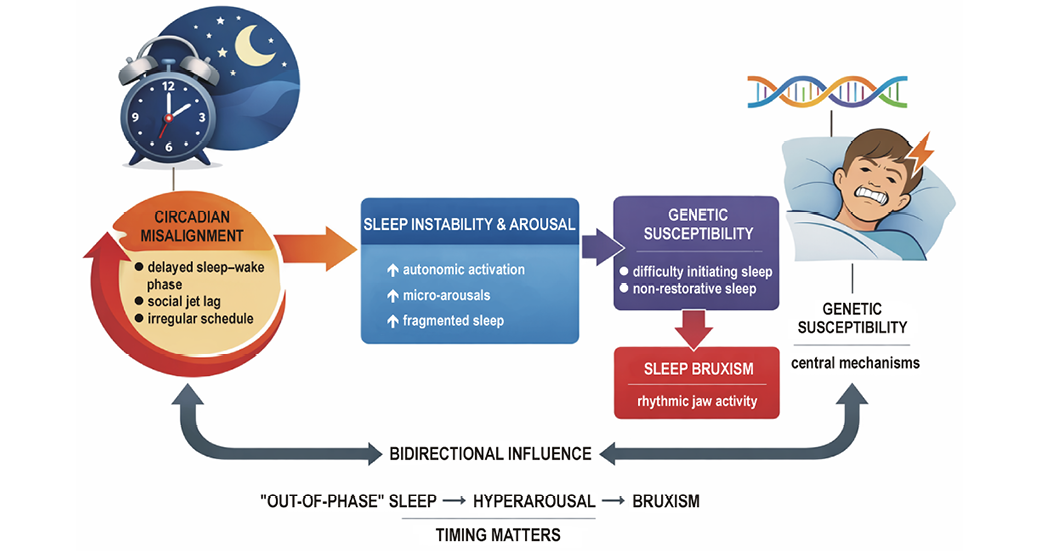
Bruxism is tightly linked to autonomic fluctuations. Micro-arousals, increases in the heart rate, sympathetic surges, changes in respiratory stability, and cortical micro-deactivations precede or accompany bruxism episodes. All of these physiological processes are themselves modulated by the circadian phase. The circadian system regulates arousal thresholds, cardiovascular variability, stress responsivity, and the propensity for sleep fragmentation. If the biological night is shifted later, the sleep obtained at an earlier, socially imposed time becomes more unstable, more fragile, and more susceptible to arousal. This instability increases the likelihood of motor events, particularly those emerging during transitional non-rapid eye movement (NREM) sleep, when arousability is highest. Within this framework, bruxism and insomnia-like complaints may both arise as downstream consequences of a single upstream disturbance, namely sleeping “out of phase”. Circadian misalignment may promote sleep instability, autonomic activation, and ultimately the expression of sleep bruxism. The proposed sequence can be summarized as follows: circadian misalignment → unstable sleep → increased arousals → increased bruxism → perceived poor sleep → self-reported “insomnia” (Figure 1). Although circadian variables were not assessed in the studies included in the systematic review, this model is compatible with the reported findings, and offers an integrated explanation for why bruxism and insomnia symptoms co-occur so consistently, at times beyond what psychological variables alone would predict.
Why the distinction matters clinically
Distinguishing insomnia from circadian misalignment is not merely a theoretical exercise. It has direct implications for treatment selection, prognosis, and patient education. Treating DSWPD with cognitive behavioral therapy for insomnia (CBT-I) may provide partial relief, but often fails to address the underlying mechanism and, in some cases, may inadvertently reinforce circadian misalignment. Conversely, interventions targeting the circadian phase, such as morning bright light exposure, evening light restriction, appropriately timed melatonin, consistent wake schedules, and better alignment of social obligations with biological time, can substantially improve sleep continuity, reduce perceived insomnia and stabilize autonomic function. Importantly, if sleep bruxism is amplified by unstable or mistimed sleep, circadian realignment may reduce its frequency or intensity, even when the intervention does not target bruxism directly.5 In this sense, sleep bruxism may represent a marker of circadian vulnerability or instability rather than a condition driven solely by stress, hyperarousal or mechanical factors. Interpreting insomnia symptoms without assessing circadian parameters therefore carries a risk of misclassifying patients and selecting suboptimal interventions. Recent clinical studies further support this perspective, demonstrating that the management of both insomnia and sleep bruxism benefits from precise phenotyping and individualized therapeutic approaches. Emerging evidence suggests that interventions integrating behavioral, sleep-focused and chronobiological components may be more effective than symptom-based treatment alone, particularly in patients exhibiting heightened arousal and increased motor activity during sleep.6, 7
The methodological gap: Missing circadian variables
The systematic review by Machado et al. provides valuable insights, but does not include measures of chronotype, sleep timing, social jet lag, actigraphy-derived sleep parameters, or biological circadian phase markers, such as dim-light melatonin onset (DLMO).1 Without these assessments, distinguishing true insomnia disorder from circadian misalignment remains difficult.5 Given the high prevalence of delayed sleep–wake phase tendencies in the age groups commonly represented in bruxism research, the absence of circadian assessments may lead to an overestimation of insomnia prevalence and an underrecognition of circadian contributors. Incorporating even simple chronobiological tools, such as the Morningness–Eveningness Questionnaire (MEQ) or the Munich Chronotype Questionnaire (MCTQ), would enable future studies to better distinguish circadian misalignment from hyperarousal. Actigraphy could further strengthen this approach by providing objective measures of sleep timing and regularity, and phase variability. Together, these assessments could determine whether the insomnia-like symptoms observed in bruxism cohorts primarily reflect circadian mistiming rather than intrinsic difficulties with sleep initiation or maintenance.8 Such a distinction would not only refine diagnostic interpretation, but also deepen our understanding of the mechanisms underlying sleep bruxism.
Bruxism as a marker of systemic desynchrony
If circadian misalignment contributes to hyperarousability, autonomic dysregulation and sleep fragmentation, then sleep bruxism might represent an early physiological marker of systemic desynchronization, with potentially important clinical implications.5 Many of the processes implicated in sleep bruxism, such as stress reactivity, emotional regulation, cardiovascular variability, and muscle tone dynamics, are strongly influenced by circadian timing. When the circadian system is out of synchrony with behavioral schedules, these physiological processes may interact in unpredictable or unstable ways, creating conditions that favor nocturnal motor events. Within this framework, sleep bruxism may be viewed not as an isolated disorder, but as a manifestation of broader physiological dysregulation. Such interpretation is consistent with recent reconceptualizations of sleep bruxism as a centrally mediated, multifactorial behavior rather than a strictly peripheral jaw-related condition. This perspective also opens new avenues for research by encouraging the study of sleep bruxism through a chronobiological lens, integrating sleep timing, the circadian phase, autonomic balance, and environmental zeitgebers. Importantly, sleep bruxism is increasingly recognized as a centrally regulated behavior with a significant genetic contribution. Neurophysiological and genetic studies suggest that individual susceptibility is partly determined by central arousal networks and heritable traits influencing autonomic responsiveness and sleep–wake regulation.9 This central and genetic framework provides a plausible biological substrate through which circadian misalignment may amplify the expression of sleep bruxism, rather than acting as an isolated peripheral trigger.10
Returning to the central question
Considering all these factors, it becomes increasingly plausible that the insomnia symptoms observed in the abovementioned study may reflect circadian misalignment in at least a subset of participants. If so, the associated findings on sleep bruxism acquire a different interpretation – one rooted less in insomnia per se than in the destabilizing effects of sleeping at a biologically inappropriate time. A similar conceptual challenge has emerged in obstructive sleep apnea (OSA) research, particularly in the context of comorbid insomnia and sleep apnea (COMISA), where circadian misalignment is increasingly recognized as a modifier of symptom expression, disease burden and treatment response. In these patients, insomnia complaints frequently coexist with delayed or irregular sleep timing, and growing evidence suggests that at least some reported “insomnia” may reflect circadian mistiming rather than primary insomnia disorder. This parallel reinforces the broader importance of circadian phenotyping across sleep-related conditions and supports the notion that biological timing may shape symptom expression beyond disorder-specific mechanisms.11, 12
The question that inspired this reflection therefore returns with greater force. Could the observed association be an artefact of timing rather than the expression of insomnia? Could aligning the circadian clock, rather than focusing exclusively on sleep, provide a more effective strategy for reducing both insomnia complaints and sleep bruxism severity? These questions lie beyond the scope of the original study, but they may help shape future research directions.
Conclusion
By integrating chronobiological assessment into future research, we may uncover mechanisms that remain invisible yet clinically decisive. Bruxism, insomnia complaints and sleep fragmentation may represent different manifestations of a deeper disturbance in biological timing. From this perspective, the interplay between bruxism and insomnia is not merely a coexistence of two diagnoses, but a potential consequence of a misaligned circadian system. Exploring this hypothesis may reveal novel therapeutic pathways and provide a more nuanced understanding of how nocturnal motor activity intersects with the fundamental temporal organization of human physiology.
Ethics approval and consent to participate
Not applicable.
Data availability
Not applicable.
Consent for publication
Not applicable.
Use of AI and AI-assisted technologies
Not applicable.