Abstract
Dental injuries frequently occur in children and adolescents. It is common for multiple types of injuries to affect the teeth and the surrounding tissues. Medical doctors often provide initial treatment; therefore, it is crucial for them to have the knowledge and skills necessary to provide first aid for traumatic dental injuries (TDIs).
The present study aimed to analyze, synthesize, and evaluate the quality of the existing research on medical students’ knowledge, skills and attitudes regarding the provision of first aid for dental injuries.
The electronic medical databases Web of Science, PubMed, Wiley Online Library, Dentistry & Oral Sciences Source, and Scopus were searched. To identify additional publications, the reference lists of relevant articles were manually reviewed. The analysis included publications in English and Polish, including original research studies, such as randomized trials, cohort studies and cross-sectional surveys, while excluding case reports, reviews, commentaries, letters, and conference abstracts. The credibility of the studies was assessed using the Cochrane Collaboration’s risk-of-bias tool. Due to substantial methodological and statistical heterogeneity, a meta-analysis was not possible; instead, a narrative synthesis was conducted to summarize the findings.
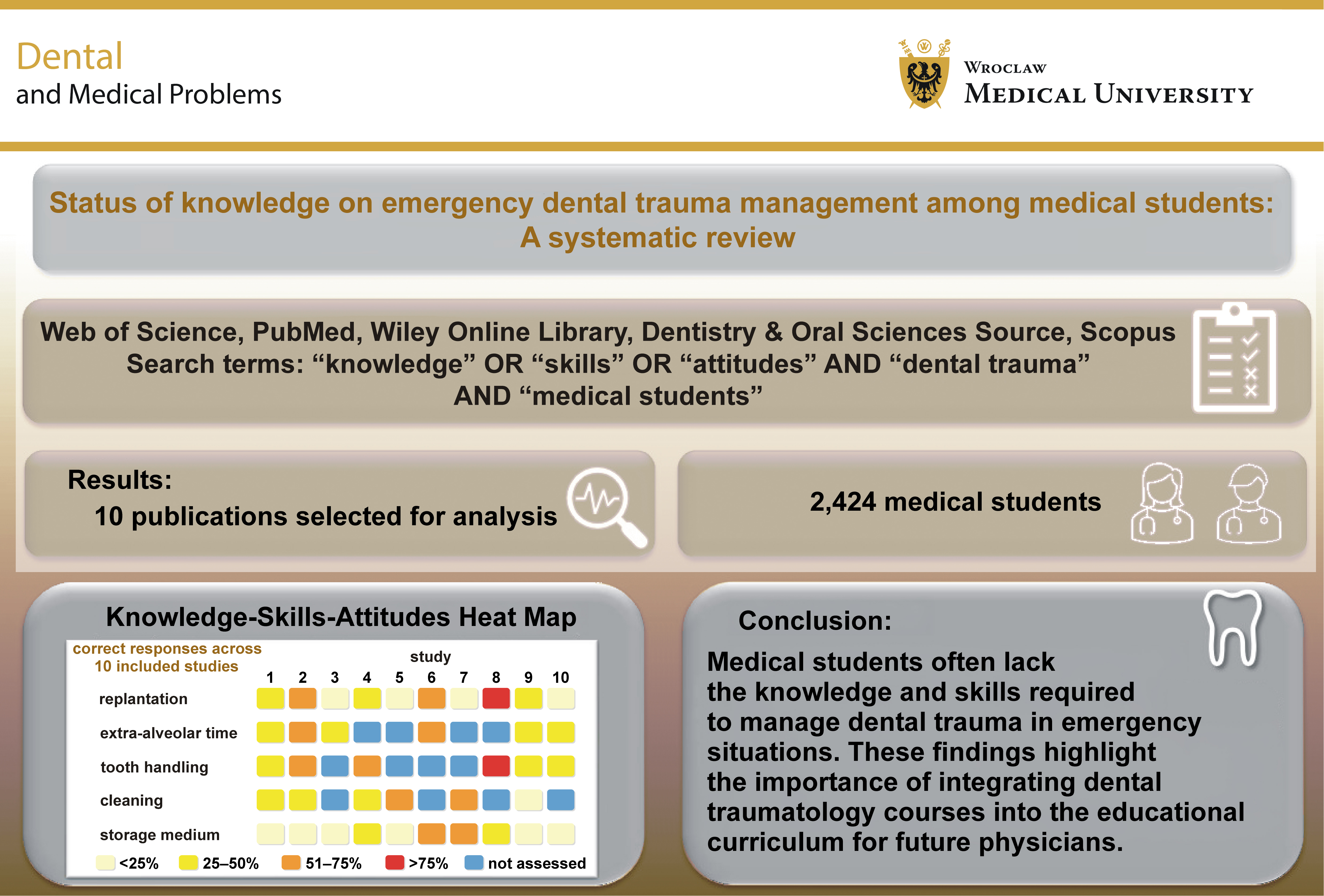
The search identified 55 studies, of which 10 were included in the systematic review, involving a total of 2,424 medical students. All studies focused on tooth avulsion; 3 also addressed tooth fractures, and 1 discussed tooth luxation.
The systematic review indicates that medical students often lack the knowledge and skills required to manage dental trauma in emergency situations, highlighting the need to include dental traumatology courses in medical education. Early training in the management of dental injuries should be implemented and integrated into first-aid training to improve preparedness for such situations.
Keywords: medical students, dental trauma, tooth fracture, tooth avulsion, emergency management
Introduction
Traumatic dental injuries (TDIs) involve damage to the teeth, periodontal tissues and the soft tissues of the oral cavity.1, 2 These injuries represent a significant global health concern and are often associated with sports activities, falls, impacts, or accidents. Children and adolescents are affected more frequently than adults.1, 2, 3 Data published by the International Association of Dental Traumatology (IADT) in 2020 indicate that dental injuries account for 5% of all injuries in children aged up to 6 years.1, 2 Additionally, 25% of school-aged children have experienced a dental injury, and 33% of adults have reported an injury to their permanent teeth, with the majority of these injuries occurring before the age of 19.1, 2
Dental trauma can occur as an isolated injury affecting only the teeth and the surrounding supporting tissues, or it can accompany other maxillofacial injuries, referred to as dentofacial injuries.3 As a result, patients with TDIs may initially seek care from emergency medical doctors.4, 5 The range of symptoms resulting from post-traumatic damage to dental tissues is diverse. These symptoms can vary from transient conditions requiring only periodic follow-up to complex complications that may ultimately lead to tooth loss. Addressing dental injuries presents significant challenges in both diagnosis and treatment. The prognosis largely depends on how quickly appropriate care is provided after the trauma and on the type of first aid administered.1, 3, 5 To improve the likelihood of a successful outcome and increase the potential for maintaining a healthy, complete dentition, it is essential for emergency department (ED) medical personnel to be familiar with the basic procedures for providing first aid in dental emergencies.
Emergency care plays a crucial role in determining the prognosis and the effectiveness of specific specialist treatment that may be required later. The time interval between an injury and the provision of appropriate care can significantly influence the risk of complications, such as pulp necrosis, root resorption, bone loss, ankylosis, or even tooth loss.2, 3 Furthermore, complications resulting from a lack of treatment or delayed intervention can interfere with the proper development of the stomatognathic system, negatively affecting the self-esteem, psychological well-being and the overall quality of life (QoL) of young patients. Understanding basic first-aid protocols for traumatic injuries to oral tissues – such as the immobilization of a luxated tooth, the replantation of an avulsed tooth, or the proper storage of fragments from a fractured tooth crown – can help prevent complications and spare patients from complex and costly dental procedures.1, 2 Therefore, it is essential for medical professionals to possess the knowledge and skills necessary to provide first aid in cases of TDIs.5, 6
Education on dental trauma is very important for medical students, as they will inevitably need to use this knowledge to provide emergency dental care for stabilizing acute TDIs before referring patients to a dentist for further treatment. Understanding how to assess and manage TDIs is crucial for medical professionals, as their actions significantly impact patient outcomes. This educational focus aims to prevent inadequate emergency treatment in these circumstances. However, studies indicate that in many countries, dental curriculum and training, including topics such as dental traumatology, are lacking in medical education programs.7, 8, 9 To address the gap in medical training, it is essential for medical students to receive additional education on dental trauma. This training will help them understand the importance of accurately assessing and managing TDIs, including the retention and replantation of damaged teeth.6, 7
Therefore, the objective of this systematic review was to selectively collect and evaluate the available scientific evidence on medical students’ knowledge, skills and attitudes regarding the provision of first aid for dental injuries.
Methods
Information sources and search strategy
The present systematic review of the available literature on medical students’ knowledge, skills and attitudes regarding TDIs was performed according to the Cochrane Collaboration guidelines.10 The literature search was conducted according to a previously prepared protocol that specified the eligibility criteria, the search strategy, the study selection method, and the planned methodology for data analysis and synthesis.10
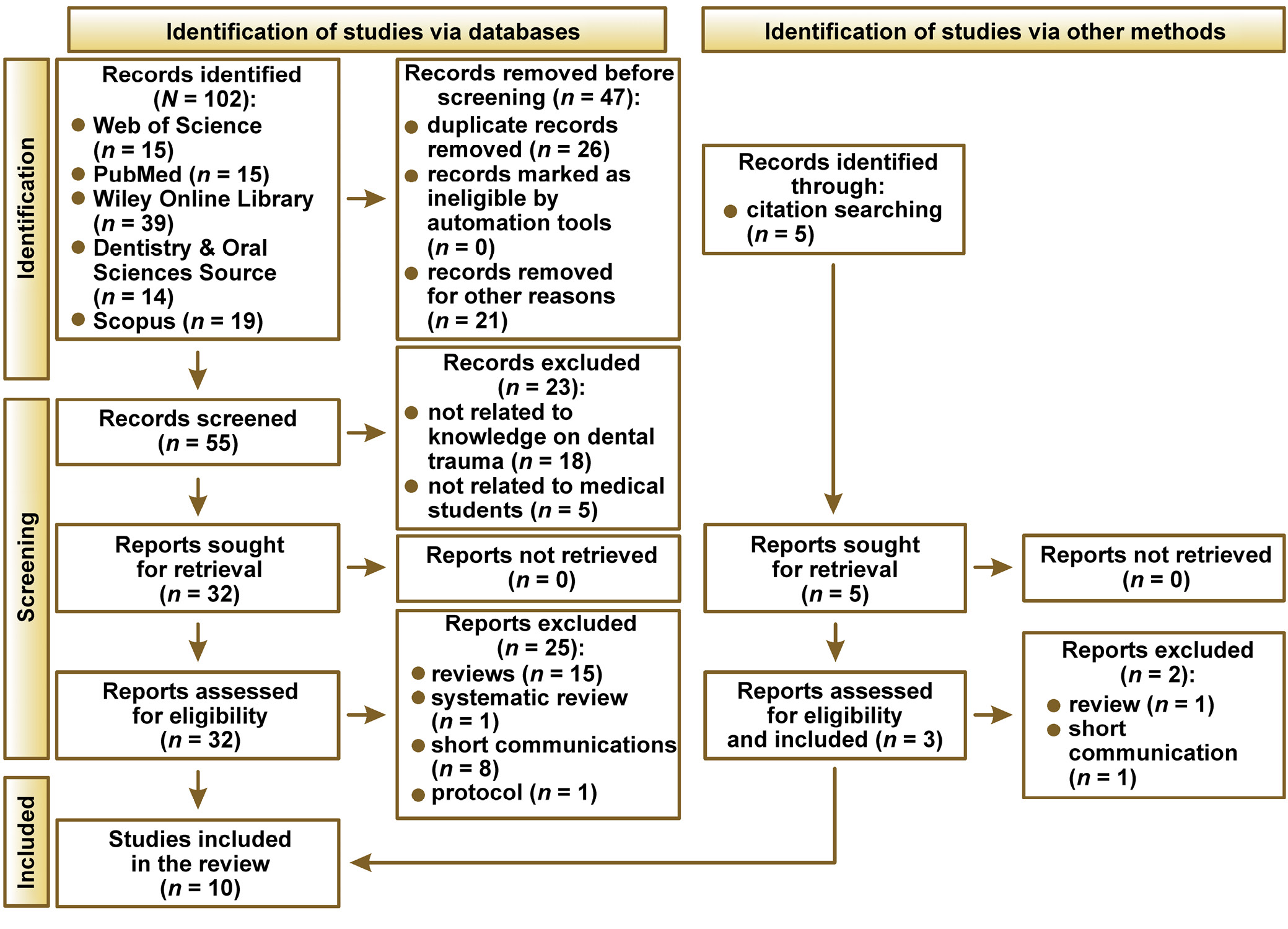
The search strategy adhered to the Preferred Reporting Items for Systematic Reviews and Meta-Analyses (PRISMA) 2020 statement (Figure 1).11 The electronic medical databases Web of Science, PubMed, Wiley Online Library, Dentistry & Oral Sciences Source, and Scopus were searched. Additionally, to identify publications not indexed in these databases, the electronic search was complemented by a manual search of the reference lists of all relevant articles. The analysis included publications in English and Polish. Original research studies, including randomized trials, cohort studies and cross-sectional surveys, were eligible for inclusion. Case reports, reviews, editors’ commentaries, letters to the editor, and conference abstracts were excluded. To optimize sensitivity and minimize potential bias, no date restrictions were applied to the inclusion of studies. Duplicate studies were identified and removed. The search strategy used Medical Subject Headings (MeSH) terms and Boolean operators. The specific search terms included “knowledge” OR “skills” OR “attitudes” AND “dental trauma” AND “medical students”. The final search was conducted on January 24, 2025.
Eligibility criteria
The initial selection of articles was conducted by analyzing the titles and abstracts identified through the database search, using the PICO framework (Population, Intervention, Comparison, and Outcome).11 The research question was specified as follows: Population (P): medical students; Intervention (I): questionnaires assessing the knowledge, skills and attitudes regarding TDIs; Comparison (C): not applicable; Outcome (O): knowledge results.
Study selection
The study selection process was carried out independently by 2 researchers (P.K. and B.J.), who had previously calibrated their approach based on 20% of the publications. The agreement between the reviewers was good, with a kappa value of 0.83. The 2 researchers initially screened the titles and abstracts to remove duplicates, and to assess articles for inclusion in the review according to the predefined screening criteria. The full texts of potentially eligible articles were then obtained and evaluated to determine their eligibility for inclusion in the final analysis. A third reviewer (T.P.-K.) resolved any disagreement between the 2 reviewers.
Data collection process
Data were extracted from the included studies, focusing on demographic information, the purpose of each study, the methods employed, the results, and the conclusions. Survey questions with similar structures and assessment criteria were grouped into what we referred to as question groups (QGs). These groups were then analyzed and visually represented as the Knowledge-Skills-Attitudes Heat Map (KSA Heat Map).12 Each color indicated the level of knowledge, skills or attitudes among the surveyed medical students, categorized as follows: <25%; 25–50%; 51–75%; and >75%. A heat map visually represents data using color coding to show varying values, making it easier to understand and analyze complex datasets. Two reviewers (P.K. and B.J.) independently extracted the data from the included studies, and subsequently checked and verified the extracted data. Any discrepancies between the 2 reviewers were resolved through discussion and consensus with a third reviewer (T.P.-K.).
Risk-of-bias assessment
The credibility of the studies was evaluated using the Cochrane Collaboration’s risk-of-bias 2 tool (RoB 2). Each positive response was assigned 1 point. The following criteria were established: ≥7 points indicated a low risk of bias (high study credibility); 4–6 points indicated a moderate risk of bias; and ≤3 points indicated a high risk of bias (low study credibility).10 The credibility of each publication was assessed independently by 2 researchers (P.K. and B.J.), with any discrepancies resolved by a third researcher (T.P.-K.).
Synthesis
Due to substantial methodological and statistical heterogeneity among the included studies, the available data did not allow for a meaningful meta-analysis to be conducted. Instead, an extensive narrative synthesis of the data was performed. The findings of all included studies are summarized and presented through textual descriptions and tables.
Results
Study selection
Through a systematic search of medical information databases, a total of 55 publications were identified. After removing duplicates and applying the established search criteria, the scientific reports were initially screened based on their titles and abstracts. A total of 32 publications were deemed suitable for further analysis based on their full texts. Finally, 10 publications were selected for inclusion in the analysis (Figure 1).
Study characteristics
The studies included in this review were conducted between 2015 and 2024 across various continents, including Asia,13, 14, 15, 16, 17 South America,18 Europe,19, 20, 21 and Africa.22 All studies were cross-sectional (Table 1 and Table 2).
In total, the publications surveyed 2,424 medical students, with the number of participants in individual studies ranging from 8417 to 761.16 The studies by Coşgun and Coşgun,17 Oleszkiewicz and Emerich19 and Enabulele and Omo22 focused exclusively on final-year students. In contrast, the other studies included participants from various years of study: some included third-year students only,14 while others involved students in the latter half of their studies (4th, 5th and 6th years),13, 16 third- to fifth-year students,20 or students from all years of study.15 Notably, 2 publications did not specify the year of study of the surveyed participants (Table 1).18, 21
The systematic review analyzed publications that assessed medical students’ knowledge, skills or attitudes related to TDIs. All of the studies focused on tooth avulsion. Additionally, 3 studies included questions about tooth fracture16, 17, 21 and 1 study also addressed tooth luxation (Table 2).21 The surveys used in these studies collected the sociodemographic data of the participants, and included questions regarding dental trauma training, previous experience, attitudes toward dental trauma, the self-assessed knowledge of dental trauma, and scenario-based questions on the emergency management of dental trauma.
Results of individual studies
The KSA Heat Maps reflecting the studies included in the systematic review are presented in Table 3 and Table 4. Eight studies examined whether participants had received information or training regarding TDIs.13, 14, 15, 17, 18, 20, 21, 22 Of these, 7 studies reported that less than 25% of respondents had received such information,13, 14, 15, 17, 18, 20, 22 while 1 study reported a proportion of 37.80%.21 The predominant sources of knowledge were the Internet, family, friends, dentists, and medical journals. Furthermore, less than 20% of respondents reported having attended a first-aid course related to the management of dental trauma during the study period.13, 15, 18, 20, 21, 22
Two publications evaluated medical students’ knowledge of dental trauma management,13, 21 while 7 studies assessed students’ self-perceived level of knowledge.14, 15, 16, 17, 18, 21, 22 In the study conducted by Varghese et al., 98.40% of students demonstrated a low level of knowledge (less than 60% correct answers), while the remaining students scored within the medium range (60–80%).13 Moreover, the authors found no statistically significant difference in the knowledge levels between fourth- and fifth-year students. The mean number of correct answers to the 10 questions was 3.4 (3.2 for fourth-year students and 3.5 for fifth-year students).13 In the study by Ivkošić et al., students answered an average of 4.32 ±1.67 questions correctly out of 10.21 Most respondents self-assessed their knowledge as limited or insufficient.14, 15, 16, 17, 18, 21, 22 A significant proportion of students considered dental education related to the management of dental trauma to be essential or very important.14, 16, 17, 20, 22
Questions regarding the appropriate procedures for managing tooth fracture were addressed in 3 publications.16, 17, 21 In the studies conducted by Coşgun and Coşgun17 and Ivkošić et al.,21 the proportion of students demonstrating the knowledge of the appropriate management of crown fractures was in the 25–50% range. In contrast, the study by Al-Haj et al. reported a higher proportion of participants with the knowledge of the appropriate management procedure, ranging from 50% to 75%.16 Additionally, 1 publication addressed the management of luxated teeth, revealing that only 2.20% of respondents were aware of the correct approach.21
The knowledge of the appropriate management of avulsed primary teeth was evaluated in 3 publications.13, 14, 21 The percentage of students who demonstrated the knowledge of the appropriate procedure varied considerably, ranging from 21%13 to 75%.21 Regarding the recognition of the importance of replanting an avulsed permanent tooth, the percentage of surveyed students ranged from 7.10% to 77.60%.13, 14, 15, 16, 17, 18, 19, 20, 21, 22 Despite this, fewer than 25% of respondents in 4 publications demonstrated the ability and competence to provide injured individuals, patients or caregivers with the accurate information regarding the appropriate procedure,13, 14, 16, 17 while 34.00% demonstrated this capability in 1 study.22 The proportion of students who knew how to manage the replantation of an avulsed tooth into its socket ranged from 2.95% to 34.00%.13, 17, 18, 22 Fewer than 52% of respondents were aware of the critical extra-alveolar time.13, 14, 15, 18, 21, 22 The percentage of respondents who knew how to properly handle a replanted tooth was below 50% in 3 publications,13, 21, 22 while 2 studies reported figures ranging from 50% to 75%,14, 16 and 1 study reported an awareness rate of 88.30%.20 The knowledge of the appropriate cleaning technique for an avulsed tooth prior to replantation, as well as the appropriate storage medium, was demonstrated by fewer than 75% of respondents across the publications.13, 14, 15, 16, 17, 18, 19, 20, 21, 22 In the study conducted by Varghese et al., when asked about the appropriate procedure in the absence of an avulsed tooth to prevent aspiration, 41.60% of medical students responded that a chest X-ray should be performed.13
Quality and risk-of bias assessment
Five publications demonstrated a low risk of bias, with scores ranging from 7 to 9 points, and were therefore considered highly credible.13, 14, 16, 17, 21 In contrast, 4 publications demonstrated a moderate level of credibility,15, 18, 19, 22 while 1 publication was classified as having low credibility, with a score of 3 points (Table 5).20
Discussion
Dental injuries are prevalent during the developmental years.1, 3 The most frequent causes are falls and sports-related injuries, with the upper incisors being the most commonly affected teeth. It is not uncommon for various types of injuries to occur simultaneously to the tooth and the surrounding tissues.1, 3, 23 Each post-traumatic dental injury necessitates prompt treatment.2, 3 The specific type of injury determines the appropriate dental specialist care required. The effectiveness of treatment is largely influenced by the time elapsed between the injury and the initiation of care, as well as by the adequacy of the treatment provided. Emergency interventions may include repositioning a displaced tooth, replanting an avulsed tooth, and stabilizing the tooth or its fragments. Although such injuries primarily affect children and adolescents, their esthetic and psychological effects may extend well into adulthood. The potential complications arising from these injuries include impaired root development, tooth resorption, pulp necrosis, crown discoloration, and, in severe cases, tooth loss.
Tooth avulsion, which occurs when a tooth is completely displaced from its socket, accounts for 0.5–3% of all dental injuries.24 The prognosis of this type of injury, which involves damage to the neurovascular bundle and the surrounding periodontal tissues, depends on the prompt administration of appropriate treatment. It should always be regarded as a dental emergency. According to the IADT guidelines, the preferred course of action is the immediate replantation of the tooth, ideally within 1 h, and preferably at the site of the accident.1, 2 At the site of the injury, after assessing the condition of the socket, the avulsed tooth should be carefully reinserted into the socket by holding it by the crown and aligning it with the position of the adjacent teeth.3 Following this initial intervention, the patient should be referred to a dentist for further treatment.
The success of tooth replantation largely depends on the length of time the tooth remains outside its socket. When a tooth is replanted more than 1 h after the injury, this is referred to as delayed replantation. The prognosis in such cases is less favorable due to an increased risk of complications, particularly the high likelihood of periodontal ligament necrosis.2 In cases of delayed replantation, the tooth should be stored and transported in an appropriate storage medium, such as Hanks’ balanced salt solution (HBSS), physiological saline, milk, or, when no other suitable medium is available, saliva.1 Although tooth avulsion carries a significant risk of complications, replantation should always be attempted. Unfortunately, delayed replantation often has a poor long-term prognosis, as the periodontal ligament (PDL) may no longer be viable, potentially resulting in bone resorption and the loss of the alveolar process.3 The primary aim of replantation is to preserve the tooth for esthetic, functional and psychological reasons, while also maintaining the integrity of the alveolar bone.
Delayed replantation can result in ankylosis, which is characterized by the fusion of the mineralized structures of the tooth root with the surrounding alveolar bone. This condition results in the obliteration of the periodontal crevice. Post-traumatic tooth ankylosis poses a considerable challenge, particularly in young patients. The development of the alveolar process is closely associated with tooth eruption, which facilitates the vertical growth of the alveolar bone. In cases of ankylosis, the affected tooth remains positioned below the level of the adjacent teeth, as it becomes progressively embedded in the bone while the neighboring teeth continue to erupt. This condition can impede the vertical development of the maxillary alveolar process, resulting in the ankylosed tooth being positioned below the normal occlusal level, the potential tipping of the adjacent teeth, midline deviation, and the supra-eruption of the opposing teeth. Consequently, an open bite may develop, significantly affecting both smile esthetics and the overall function.2, 3
Out of the 10 analyzed publications included in the review, 7 focused solely on students’ knowledge regarding tooth avulsion.13, 14, 15, 18, 19, 20, 22 Three publications also included questions concerning procedures for tooth fracture.16, 17, 21 Although future medical professionals may not be directly involved in the reattachment of tooth fragments, it is crucial for them to understand the potential value of these fragments for reconstructive purposes. The fragments should be preserved securely, and whenever possible, the young patient should be referred to a dentist at the earliest opportunity.
A medical graduate should attain specific learning outcomes throughout their studies, focusing on knowledge, skills and attitudes. Knowledge involves the acquisition of information through learning, enabling students to comprehend a variety of issues. Skills refer to the ability to apply this knowledge, encompassing the practical “know-how” necessary to perform tasks and solve problems. This ensures that students can effectively implement what they have learned. Attitudes involve the ability to integrate knowledge, skills, and personal and social competencies within the medical profession. This preparation equips students to interact appropriately with patients and their caregivers.25 These learning outcomes define what students should know, understand, and be able to accomplish upon completing their education. Beyond imparting theoretical knowledge, medical education aims to foster appropriate professional attitudes and develop students’ skills in diagnosis, treatment planning, and patient care.
The systematic review of the analyzed publications reveals that medical students demonstrate insufficient knowledge, skills and competencies regarding first-aid procedures for TDIs. While many students were aware that an avulsed permanent tooth can be replanted,13, 14, 16, 18, 20, 21 only a small proportion were able to perform this important procedure independently.13, 17, 18, 22 Additionally, few students were familiar with the appropriate methods for protecting and storing an avulsed tooth.13, 14, 15, 17, 21, 22 The findings indicate that, although students recognize their deficiencies in providing first aid for dental injuries,14, 15, 16, 17, 18, 21, 22 not all consider such education essential to their training as medical professionals.13, 14, 16, 20, 21, 22
Insufficient knowledge and skills in providing appropriate care for patients with dental injuries can be attributed to the lack of relevant courses in medical curricula.7, 8, 24, 26, 27, 28 It is crucial for aspiring medical doctors to be adequately prepared to implement effective pre-dental treatment strategies. The evident lack of awareness among physicians regarding dental injuries highlights the need to integrate dental traumatology into medical education.6, 29, 30 Such integration would help ensure a high standard of care for patients with dental injuries. Moreover, incorporating dentistry, particularly with an emphasis on dentofacial injuries, into medical curricula would facilitate the development of the essential knowledge, skills and attitudes required for the basic diagnosis and management of post-traumatic dental injuries.9, 29, 30, 31, 32, 33 Given the importance of achieving favorable treatment outcomes while minimizing complications, it is vital for future physicians to be well versed in this area.
While it may be unrealistic to expect doctors to be fully trained in all aspects of dental trauma care, they remain responsible for appropriately managing dental emergencies. Therefore, they should possess a fundamental understanding of how to manage dental trauma. The aim of teaching dental trauma to medical students is not to prepare them to perform these procedures routinely, but rather to equip them with the knowledge necessary to respond effectively to emergencies when they arise. Dental injuries often occur unexpectedly and at inconvenient times, meaning that patients frequently present to EDs as their first point of medical contact. Final-year medical students, in particular, may benefit more from education in dental trauma, as they have already established a solid foundation in pre-clinical and clinical medical sciences, unlike first-year students. E-learning modules could enable medical students to learn at their own pace without disrupting their regular academic schedules.6, 30
In a study by Yeng et al., medical students evaluated an online course focused on dental trauma.26 The findings indicated that the students considered the course understandable and beneficial to their future medical careers.26 However, there is a recognized need to organize practical courses to help students develop essential clinical skills, as an online format alone may not provide sufficient hands-on experience. The combination of theoretical knowledge regarding patient management and clinical training has demonstrated positive outcomes, highlighting the importance of problem-based education in preparing medical students to interact with patients and effectively manage dental trauma cases.34
Limitations and strengths
The data obtained from the reviewed studies present difficulties in terms of comparison, as the student cohorts in the individual studies were not homogeneous. Notably, 3 publications specifically focused on students who were approaching the completion of their academic programs, thereby involving individuals with the highest levels of knowledge and qualifications.17, 19, 22 In contrast, other studies included respondents from various academic years. Of particular note, the study conducted by Soğukpınar Önsüren and İpek included first- and second-year students as well.15
Another potential source of bias is the size of the study groups, which in survey research is influenced by the number of individuals in the target population. In 5 publications, the study group sizes were representative of the overall student population.13, 14, 16, 18, 19 However, in the remaining studies, the sample sizes were insufficient to accurately represent the target population.15, 17, 20, 21, 22
The objective of this study was to analyze, synthesize, and evaluate the findings of the published scientific research concerning the knowledge, skills and attitudes of medical students regarding the provision of initial first aid for post-traumatic dental injuries. To our knowledge, this is the first report to assess medical students’ knowledge of dental trauma. A study conducted by Tewari et al. investigated the global awareness of the prevention and emergency management of TDIs among non-dental healthcare professionals.35 The results indicated that the knowledge of the emergency management of these injuries was generally low or insufficient in many cases. Additionally, there was a significant lack of research evaluating the prevention of TDIs. The authors concluded that this gap in the knowledge and understanding of first-aid procedures may stem from inadequate training in dental trauma during educational programs,34 as well as the absence of effective continuing education courses designed to enhance professionals’ expertise and confidence.36
This systematic review has a limitation related to language bias, as it includes exclusively studies published in English or Polish. Consequently, the review may have overlooked relevant findings and insights from research published in other languages, which could have provided valuable data and further strengthened the overall analysis.
Conclusions
This systematic review of the literature indicates that medical students have limited knowledge, skills and inadequate attitudes regarding the management of dental trauma in emergency situations. These findings highlight the urgent need to incorporate dental traumatology into the educational curriculum for future physicians. It is crucial to begin educating medical students about dental injuries early in their training and to progressively expand their knowledge as they advance through their studies and professional careers. Furthermore, incorporating awareness of dental injuries into first-aid training courses could significantly improve individuals’ preparedness to respond effectively in such situations.
Ethics approval and consent to participate
Not applicable.
Data availability
The datasets supporting the findings of the current study are available from the corresponding author on reasonable request.
Consent for publication
Not applicable.
Use of AI and AI-assisted technologies
Not applicable.