Abstract
This systematic review evaluates the outcomes of different radiotherapeutic strategies in the management of head and neck cancers (HNCs), including curative-intent radiotherapy (RT), palliative stereotactic body radiotherapy (SBRT), multimodal approaches combining surgery and RT, and immunotherapy-based combinations.
A structured literature search was conducted using 4 electronic databases – PubMed, BioMed Central (BMC), Scopus, and Ovid – to identify studies relevant to RT for head and neck squamous cell carcinoma (HNSCC), with a focus on the Quad Shot regimen and other hypofractionated approaches. The search strategy included keywords such as “palliative radiotherapy”, “head and neck cancer”, “Quad Shot”, “hypofractionated RT”, and “recurrent HNSCC”, and was limited to studies published in English up to March 2025.
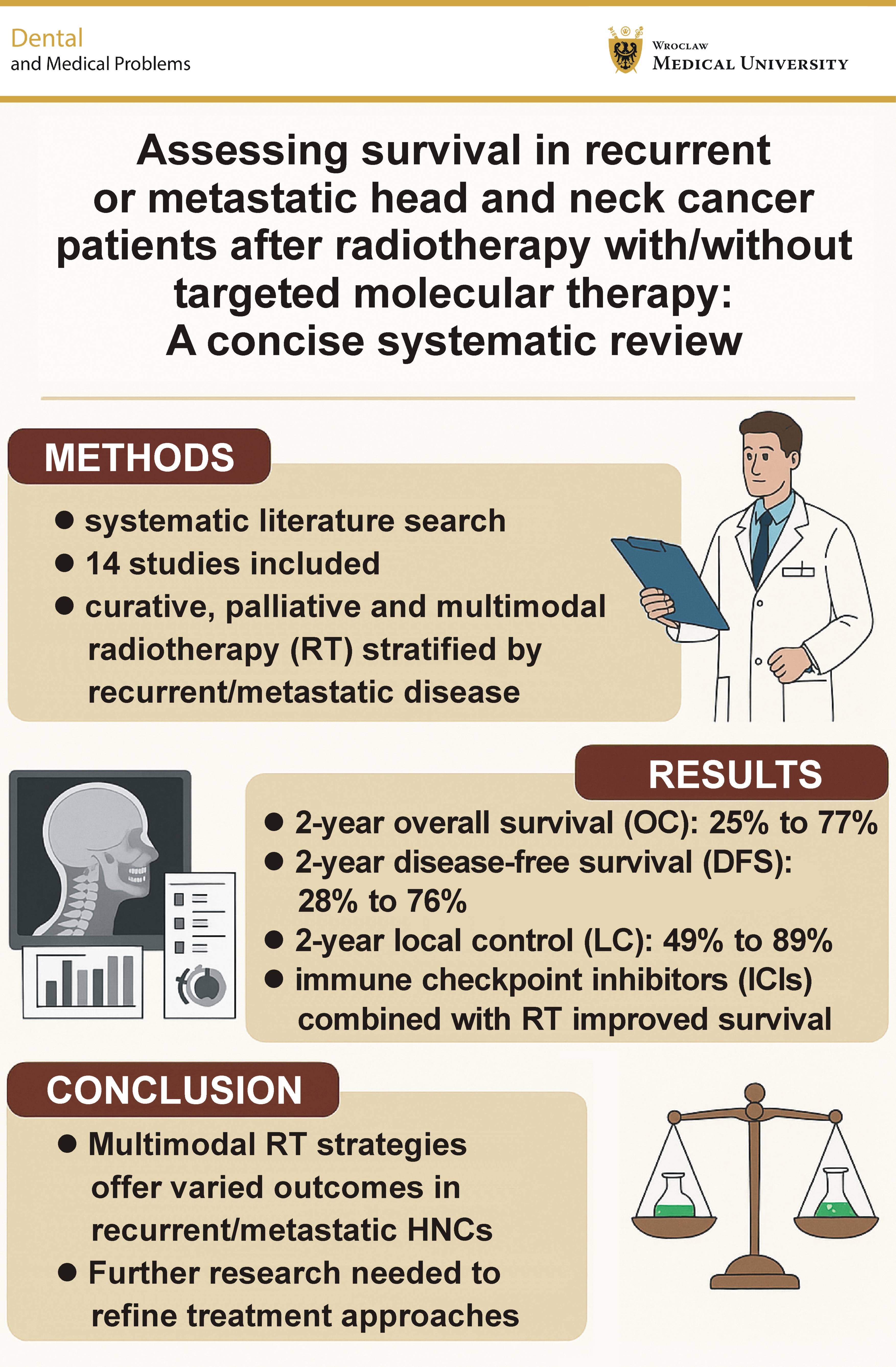
Fourteen studies were included in this systematic review, comprising a total of 26,734 patients. Curative RT demonstrated favorable outcomes in large cohorts, particularly in terms of overall survival (OS) and local control (LC). Palliative SBRT regimens provided substantial symptomatic relief and disease control with minimal toxicity among elderly and inoperable patients.
Multimodal treatment options yielded the most promising survival outcomes, particularly in patients with early-stage disease. Furthermore, the combination of immunotherapy and RT showed potential synergistic effects, improving both OS and progression-free survival (PFS).
Keywords: prognosis, survival, radiotherapy, HNC, Quad Shot
Introduction
Head and neck cancers (HNCs) represent a heterogeneous group of malignancies arising from the mucosal surfaces of the upper aerodigestive tract. Globally, they account for more than 650,000 new cases and 330,000 deaths annually, placing a substantial burden on healthcare systems and patients.1, 2 Risk factors include tobacco use, alcohol consumption and oncogenic viral infections, including human papillomavirus (HPV), Epstein–Barr virus (EBV) and cytomegalovirus (CMV), with prognosis heavily influenced by tumor site, stage, and patient comorbidities.1, 3, 4, 5
Researchers emphasize the synergistic role of the gut microbiota in modulating immune responses, potentially enhancing the effectiveness of immunotherapy in cancer management.6, 7
Systemic inflammation has also emerged as an important modifier of cancer risk and progression. Banthia et al. reported a significant association between periodontal disease and overall cancer risk, with odds ratios (ORs) of 3.986 and 4.286 for clinical attachment loss (CAL) and the periodontal disease index (PDI), respectively, among cancer patients as compared to controls.8 Chrysanthakopoulos investigated a possible correlation between the periodontal disease indices and lung cancer.9 These findings highlight the potential role of oral-systemic inflammatory markers as adjunctive prognostic tools in oncology.
Multiple therapeutic modalities are employed in the management of HNCs, including surgery, radiotherapy (RT), systemic therapies (chemotherapy and immunotherapy), and combinations thereof.1, 10, 11 Definitive RT is a cornerstone of organ preservation and is commonly used in both curative and palliative settings. Treatment outcomes vary by modality – curative-intent RT can achieve 2-year local control (LC) rates exceeding 85% in selected populations, while palliative approaches prioritize symptom relief and disease control with acceptable toxicity.1, 12
Some authors point to the potential value of integrating artificial intelligence (AI) tools into the early detection of oral cancer, which may ultimately improve treatment selection and RT planning, thereby contributing to better clinical outcomes.13, 14
Recent advances have highlighted the potential advantages of combining molecularly targeted therapies with conventional RT in the management of recurrent or metastatic HNCs. When used in combination with RT, agents such as cetuximab have demonstrated modest improvement in survival and LC, particularly in patients who are not suitable candidates for platinum-based chemotherapy.15 Furthermore, as the overexpression of epidermal growth factor receptor (EGFR) and other biomarkers may influence treatment response and prognosis, studies have emphasized the importance of tailoring therapy according to individual molecular profiles.16
Immunotherapy, particularly immune checkpoint inhibitors (ICIs), has emerged as a promising adjunct to RT, with combination approaches demonstrating enhanced tumor control and improved survival outcomes in recurrent or metastatic settings.17, 18, 19
However, treatment selection must balance efficacy and toxicity while taking into account patient-specific factors, such as age and performance status.
Given that no systematic assessment has been conducted to date, the current evidence remains fragmented, varies in methodology, and frequently lacks standardized outcome reporting, resulting in inconsistent and potentially suboptimal clinical decision-making. Consequently, a comprehensive synthesis of the existing evidence is urgently needed to inform optimal treatment strategies and improve survival outcomes in this high-risk population.
The primary objective of this study was to systematically evaluate the outcomes associated with curative, palliative and multimodal RT strategies, with particular emphasis on overall survival (OS), disease-free survival (DFS), LC, toxicity, the Karnofsky performance status (KPS), and the emerging role of immunotherapy-based regimens.
Methods
The study was registered on the International Prospective Register of Systematic Reviews (PROSPERO) platform (registration ID: CRD42024575386).
This systematic review was conducted and reported in accordance with the Preferred Reporting Items for Systematic Reviews and Meta-Analyses (PRISMA) 2020 guidelines.20
A focused review question was developed using the PICO framework:
– Population: Adult patients with HNC;
– Intervention: Radiotherapy, including curative, palliative and multimodal approaches;
– Comparison: Not applicable;
– Outcome: OS, DFS, LC, toxicity, KPS, and quality of life (QoL).
Using Boolean operators, a comprehensive literature search was conducted in the PubMed, BioMed Central (BMC), Ovid, and Scopus databases up to March 2025. The search strategy included combinations of terms such as: (“head and neck cancer” OR “HNSCC”) AND (“radiotherapy” OR “SBRT” OR “Quad Shot”) AND (“curative” OR “palliative” OR “multimodal” OR “surgery”) AND (“survival” OR “toxicity” OR “quality of life”). Initially, no restrictions were placed on language or publication date; however, only full-text publications in English were included in the final analysis. Before the screening process, duplicate records were removed.
Eligibility criteria
Inclusion criteria:
– studies reporting the clinical outcomes of RT in patients with histologically confirmed HNSCC;
– studies including ≥10 patients;
– the use of curative-intent RT, palliative stereotactic body radiation therapy (SBRT) or multimodal treatment (e.g., surgery and RT);
– outcomes including OS, DFS, LC, KPS, or toxicity.
Exclusion criteria:
– abstract-only studies or conference proceedings;
– non-English articles;
– animal or in vitro studies;
– studies focused exclusively on thyroid or salivary gland tumors;
– imaging-only endpoints without clinical outcome data.
Two independent reviewers screened the titles and abstracts, followed by the full-text assessment of potentially eligible studies. Disagreement was resolved by consensus. Data were extracted using a standardized table, including study design, country, sample size, patient characteristics, type and dose of RT, number of treatment cycles/fractions, reported outcomes, and study limitations.
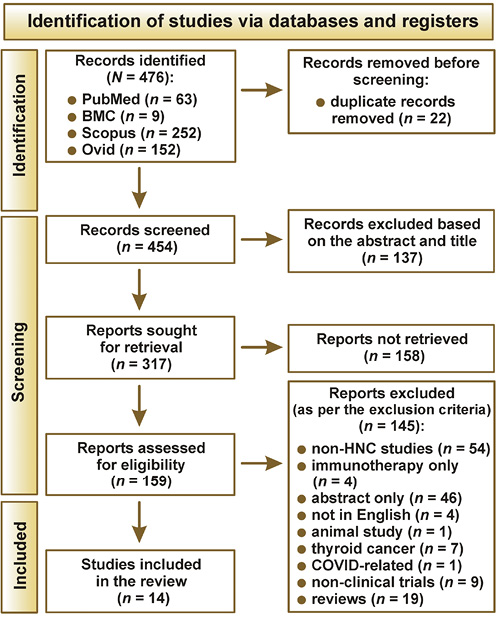
The study selection process is illustrated in the PRISMA flow diagram (Figure 1), based on the screening and selection data.20
The Newcastle–Ottawa Scale (NOS) was used to assess the risk of bias in the included observational studies. The scale evaluates 3 domains: the selection of study groups; the comparability of groups; and the ascertainment of outcomes in cohort studies or exposures in case–control studies. Two reviewers independently assessed each study, with discrepancies resolved through consultation or discussion with a third reviewer. Studies were classified as having a low, moderate or high risk of bias based on their total NOS score.21
A quantitative meta-analysis was not conducted because of substantial heterogeneity among the included studies in terms of study design, patient populations, RT regimens, treatment combinations, outcome measures, and follow-up periods. Statistical pooling of the data was not considered appropriate due to variations in radiation doses and fractionation schedules, the inconsistent reporting of outcomes such as OS, progression-free survival (PFS) and QoL, and the inclusion of both curative- and palliative-intent treatment. Therefore, a narrative synthesis was considered more appropriate for accurately presenting and interpreting the findings of this systematic review.
Results
The risk of bias was assessed across the 14 included studies,1, 3, 10, 12, 17, 18, 19, 22, 23, 24, 25, 26, 27, 28 with most demonstrating a low risk of bias in terms of selection, comparability and outcome assessment. Nine studies achieved a score of 8, indicating strong methodological quality. Four studies received a score of 6, while 1 study scored 7, suggesting a moderate risk of bias, primarily due to limited adjustment for confounders or smaller sample sizes. The robustness of the findings across most studies was largely attributed to their cohort designs, and the use of large databases or prospective follow-up (Table 1).
A total of 14 studies were included in this review, encompassing diverse geographic regions. The largest number of studies originated from North America, with 6 studies from the USA and 1 from Canada, demonstrating a notable concentration of research in this region. Additionally, 3 studies were conducted in Asia (2 from China and 1 from Taiwan), while 3 studies were conducted in Europe (one each from Finland, the UK and Germany). One study was conducted in Australia (Table 2). This geographic distribution highlights broad international interest in the research area while also reflecting regional differences in study design, patient populations and clinical practices. Such diversity may strengthen the generalizability of the findings, but also underscores the importance of considering contextual factors when interpreting the results.
Curative-intent radiotherapy studies
Studies evaluating curative-intent RT collectively included 12,483 patients from countries including Finland,17 the UK22 and Taiwan.23 Radiotherapy doses ranged from 60 to 72 Gy, with fractionation typically consisting of 30–36 fractions. Rudoltz et al.1 and Vargo et al.24 reported 6-month to 1-year OS rates exceeding 75%, with high LC rates (>85%) and preserved KPS. Disease-free survival was consistently above 60% in these studies. The multimodal integration of RT with surgery or concurrent chemotherapy further improved outcomes, particularly in early-stage disease. Toxicity was generally acceptable, with rates of grade ≥3 toxicity below 25%.
Palliative stereotactic body radiotherapy (Quad Shot)
Quad Shot regimens were investigated in patients with recurrent or metastatic HNC across several countries, including China,12 Germany19 and the USA.25, 26 Typical regimens delivered 14–14.8 Gy in 4 fractions, repeated over 3–4 cycles. Collectively, these studies included more than 800 patients, and demonstrated improvement in symptom relief and short-term LC. Overall survival ranged from 6 to 13 months, with generally favorable tolerability. Fan et al. reported improved QoL and reduced symptom burden with minimal grade ≥3 toxicity.26 Gogineni et al. reported improved OS when Quad Shot RT was combined with immunotherapy, particularly anti-programmed death-1 (PD-1) agents, suggesting a potential synergistic benefit.25
Multimodal strategies including immunotherapy
Combination therapies, particularly those incorporating surgery, RT and systemic agents, such as targeted therapies or ICIs, demonstrated the most favorable survival outcomes. Nguyen et al.3 and Crawford et al.18 reported 2-year OS rates exceeding 80% with combination regimens. Schubert et al.27 and Roden et al.28 reported improved DFS rates of up to 70% and durable LC. Importantly, immune-based approaches, as reported by Gogineni et al.25 and Fan et al.,26 demonstrated potential benefits in selected patients, including improved OS, reduced recurrence and acceptable toxicity. These approaches may be particularly valuable for patients with HNC who are medically unfit for surgery or have previously untreated disease, offering meaningful disease control and potential survival extension.
Discussion
Researchers have evaluated the efficacy of hypofractionated RT regimens, such as Quad Shot and SBRT, as palliative treatment for head and neck tumors.29, 30 The Quad Shot regimen, which consists of short courses of low-dose radiation delivered twice daily over 2 days, is generally preferred for frail patients because of its tolerability, convenience, and potential for repeat administration. In contrast, SBRT delivers higher radiation doses in fewer fractions with precise targeting and may provide superior LC in selected patients with limited disease burden and a good functional status. Several studies included in this review suggest that SBRT may offer improved tumor control and more durable disease control in appropriately selected patients. However, the Quad Shot regimen remains a valuable option, particularly for older patients, those with significant comorbidities, or those with a poor performance status. The choice between these regimens should be individualized based on patient characteristics, treatment goals, expected outcomes, and treatment burden.31
The Quad Shot regimen comprises a total dose of 44.4 Gy, delivered in 3.7-Gy fractions twice daily over 2 consecutive days per cycle, with a recovery interval of 2–4 weeks between the 3 prescribed cycles. Although this regimen is generally well tolerated, with grade ≥3 toxicity rates of approx. 5%, it has demonstrated a median latency to progression of 3–5 months, indicating limited durability of LC.26
The oropharynx emerged as the predominant tumor site investigated using the Quad Shot technique among the included studies.
Although the Quad Shot regimen has demonstrated promising palliative outcomes, the supporting evidence is primarily derived from small, single-institution studies with limited sample sizes and heterogeneous patient populations. Most studies lacked control groups, making direct comparisons with alternative palliative approaches difficult. Additionally, the subjective nature of symptom relief and QoL assessments, often based on non-standardized or retrospective reporting, may introduce measurement bias. Variations in RT delivery, including the number of cycles and dose per fraction, as well as differences in concurrent therapies, further complicate the interpretation of the findings.
Stereotactic body radiotherapy, on the other hand, is a highly precise form of RT that delivers a high dose of radiation to the tumor in a limited number of treatment sessions, typically 1–5 fractions.32 It uses advanced imaging and motion-management techniques to localize the tumor with submillimeter precision, thereby minimizing radiation exposure to the surrounding healthy tissues. It has become an established treatment modality for tiny, well-defined tumors in the lung, liver and spine, and is increasingly being used for recurrent or unresectable head and neck malignancies.
In the palliative setting, SBRT offers the potential advantages of rapid symptom relief, improved LC and a shorter overall treatment duration. These benefits may be particularly relevant for patients with limited life expectancy or a poor performance status. Studies have indicated that SBRT can achieve durable tumor responses while preserving QoL; however, it may also carry a higher risk of acute toxicity in anatomically complex head and neck regions. Careful patient selection and multidisciplinary treatment planning are therefore essential to maximize therapeutic benefits while minimizing toxicity.33
Quality-of-life assessment
The included studies highlight symptom relief as a key outcome, which inherently relies on subjective reporting. Although some studies reported improvement in KPS, detailed and standardized QoL assessments were not consistently reported across all studies. This inconsistency makes it challenging to compare the true impact of different RT regimens on patients’ overall well-being.
Radiotherapy delivery variability
There was substantial variation in RT delivery across the included studies. Some studies used hypofractionated RT with specific dose and fractionation schemes (e.g., 14.8 Gy/4 fractions, 14 Gy/4 fractions, or the Quad Shot regimen), whereas others employed SBRT with different fractionation schedules (e.g., 20–40 Gy in 5 fractions) or preoperative RT. The number of treatment cycles also varied, with some studies using a single cycle or a limited number of cycles and others employing multiple cycles. This variability makes it difficult to isolate the effects of specific RT approaches on clinical outcomes.
Concurrent therapies
Several studies incorporated multimodal treatment strategies, combining RT with surgery, chemotherapy or immunotherapy. The influence of these concurrent therapies on OS and other clinical outcomes can be difficult to disentangle from the effect of RT itself. For instance, Nguyen et al.,3 Chen et al.23 and Roden et al.28 evaluated multimodal treatment approaches. Studies investigating the combination of ICHs with RT showed promising results; however, the individual contribution of each treatment modality requires further investigation.27
In summary, variability in QoL measures, RT administration and concurrent treatment modalities complicates the interpretation of the available evidence and limits the ability to draw definitive conclusions regarding the optimal RT strategies for HNC.
Regarding follow-up duration, several studies included in this review had limitations that may have hindered a comprehensive assessment of long-term treatment outcomes. Studies such as Rudoltz et al.,1 Glatzel et al.10 and Bostel et al.,19 focusing on treatment feasibility, specific treatment outcomes or palliative measures, had varying and, in some cases, relatively short follow-up periods that did not capture the full spectrum of late toxicity that can develop months or years after treatment. Although early treatment-related toxicity was generally well documented, late complications, such as fibrosis, xerostomia and osteoradionecrosis, may have been underreported in studies with limited follow-up.1, 19
Furthermore, in the context of HNC, long-term disease progression, including local recurrence and distant metastasis, is a critical consideration. Studies with shorter follow-up periods may provide an overly optimistic assessment of disease control and potentially underestimate the recurrence rates over time. This is particularly relevant for studies evaluating novel approaches, such as immunotherapy combined with RT, in which the durability of treatment response and long-term survival benefits require extended observation. For example, Nguyen et al.3 and Schubert et al.27 highlight the importance of long-term follow-up when assessing the efficacy of novel therapeutic approaches. Studies with longer follow-up periods further demonstrate the importance of evaluating long-term outcomes. For example, Luukkaa et al.17 and Hall et al.22 provide insights into survival outcomes over extended periods, highlighting the potential for late events to influence overall treatment success.
In conclusion, the variability in follow-up duration across the included studies underscores the need for caution when interpreting the long-term effectiveness and safety of HNC treatment. Longer follow-up is essential to fully characterize late toxicity and the true extent of long-term disease control.
Moreover, biomarker data, such as PD-L1 expression and tumor mutational burden, were inconsistently reported, limiting subgroup analyses and the potential for personalized treatment. This is particularly relevant to studies evaluating immunotherapy-based combinations, such as Schubert et al.,27 in which biomarker data are important for understanding treatment response.3 Limited follow-up periods may also fail to capture delayed immune-related toxicity or long-term survival benefits, which are essential for fully evaluating the efficacy and safety of these treatment regimens.
The growing evidence supporting the combination of RT and immunotherapy represents a significant shift in the management of HNSCC. This shift is supported by studies demonstrating that immune-based approaches, particularly those combining ICIs with RT, may improve OS and reduce recurrence, particularly in tumors with favorable immune responsiveness. For example, Schubert et al. reported promising results with the combination of PD-1/programmed death ligand-1 (PD-L1) inhibitors and RT.27
While surgery and chemoradiotherapy remain important treatment modalities, particularly in localized and locally advanced disease, emerging strategies incorporating ICIs offer new opportunities for durable disease control in advanced settings.
Surgery plays a crucial role in achieving LC in early-stage HNSCC. Roden et al. evaluated the role of surgery in the management of early-stage tonsil cancer, highlighting its importance in achieving favorable local disease control.28 Chemoradiotherapy remains a standard treatment approach for locally advanced HNSCC, with the aim of improving locoregional control and OS. Chen et al. evaluated treatment outcomes in elderly patients with locally advanced HNSCC, including those treated with chemoradiotherapy.23
However, in advanced or recurrent/metastatic HNSCC, where traditional treatment options have limitations, the combination of immunotherapy and RT offers the potential for improved outcomes. Studies reported promising results in terms of OS, DFS and LC with these combination approaches. Schubert et al. demonstrated improved DFS and durable LC with immune-based approaches.27 Gogineni et al.25 and Fan et al.26 also reported promising outcomes with SBRT and the Quad Shot regimen, including improved OS and reduced recurrence.
These findings suggest that, while surgery and chemoradiotherapy remain essential treatment modalities, the integration of immunotherapy, particularly in combination with RT, is reshaping the therapeutic landscape of HNSCC. This approach may offer improved outcomes, particularly for patients with advanced or recurrent/metastatic disease.
The heterogeneity of radiation regimens used across the included studies represents a major limitation of this review. The dose, fractionation, and number of treatment cycles varied considerably among the RT protocols. For example, curative-intent RT protocols delivered doses of up to 72 Gy in 30–36 fractions, SBRT regimens ranged from 20–40 Gy in 5 fractions, and palliative approaches such as the Quad Shot regimen delivered 14–14.8 Gy in 4 fractions per cycle, often repeated for 3–4 cycles. This variability makes direct comparisons of treatment efficacy and toxicity difficult.
Additionally, follow-up durations varied substantially across studies. Some reports focused primarily on short-term symptom relief or early survival outcomes, such as 6-month OS, whereas others followed patients for several years. These differences limit the ability to comprehensively assess long-term outcomes, including late toxicity, disease recurrence and sustained LC. Rudoltz et al.1 and Bostel et al.,19 for example, provided valuable information regarding short-term palliation; however, their relatively short follow-up periods may have resulted in the underreporting of late complications or recurrence events. In contrast, studies such as Luukkaa et al.17 and Hall et al.22 included longer follow-up periods, emphasizing the importance of prolonged observation when assessing treatment durability.
The standardization of RT protocols and more consistent follow-up durations in future studies would improve the comparability and clinical applicability of findings in this complex patient population.
Limitations
This review has several additional limitations. First, substantial heterogeneity in study designs, treatment regimens and outcome reporting limited the ability to perform a quantitative meta-analysis. Second, most of the included studies were retrospective, increasing the risk of selection bias. Third, the relatively small sample sizes of studies evaluating immunotherapy-based approaches warrant caution when generalizing their findings. Additionally, the performance status, comorbidities and molecular biomarkers, such as PD-L1 expression, were inconsistently reported across studies, further limiting the ability to perform meaningful subgroup analyses and draw definitive conclusions.
Conclusions
Quad Shot RT remains a safe and effective palliative strategy for symptom relief in patients with advanced HNSCC. However, the integration of ICIs with RT, particularly in combination with the Quad Shot regimen, has demonstrated promising outcomes in terms of OS and PFS, with acceptable toxicity. Multimodal strategies combining surgery, RT and immunotherapy currently represent a promising approach to maximizing survival and disease control. Future prospective studies are needed to confirm these findings and optimize patient selection for individualized treatment approaches.
Ethics approval and consent to participate
Not applicable.
Data availability
The datasets supporting the findings of the current study are available from the corresponding author on reasonable request.
Consent for publication
Not applicable.
Use of AI and AI-assisted technologies
Not applicable.