



Abstract
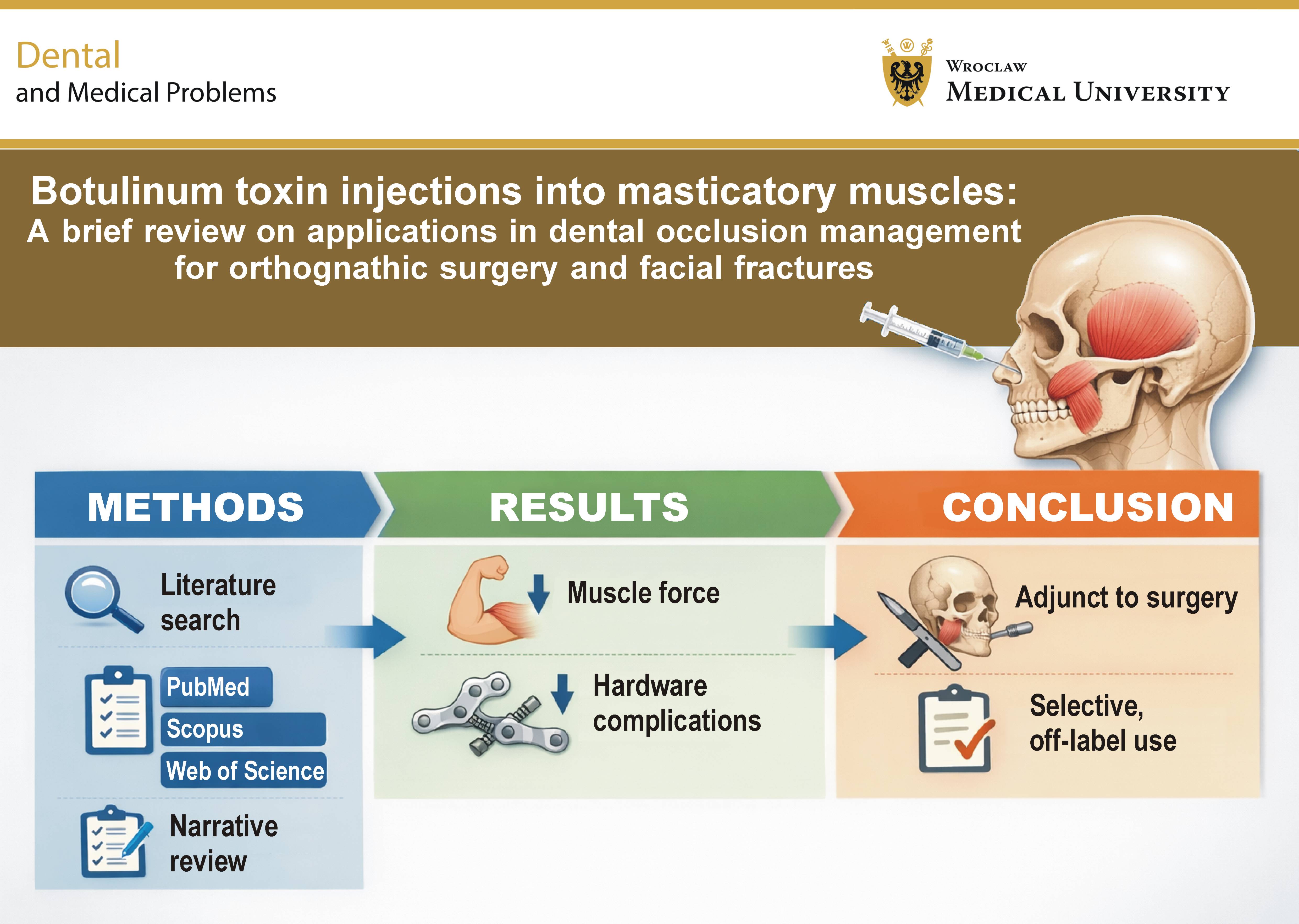
Background. Orthognathic and maxillofacial trauma surgeries are often challenged by postoperative instability resulting from persistent masticatory muscle forces acting on the repositioned bone segments. Botulinum toxin type A (BTX-A) has been proposed as an adjunctive intervention to transiently reduce these forces and enhance surgical stability.
Objectives. The aim of this narrative review was to evaluate the adjunctive role of BTX-A in orthognathic and maxillofacial trauma surgery, with particular emphasis on its potential to reduce postoperative masticatory muscle forces, thereby enhancing skeletal stability and optimizing healing. The review summarizes the current evidence regarding target muscles, dosing strategies, timing of administration, effects on skeletal and occlusal outcomes, and potential impact on bone regeneration. In addition, it identifies limitations in the existing clinical protocols and highlights areas requiring further standardized, high-quality research.
Material and methods. A narrative review was conducted using the PubMed, Scopus, and Web of Science databases to identify experimental, clinical and case-based studies investigating the use of BTX-A in orthognathic surgery and maxillofacial trauma management. The reference lists of relevant articles were also manually screened to identify additional key mechanistic and translational evidence.
Results. Botulinum toxin type A injections into the masseter, temporalis and digastric muscles may reduce postoperative muscle tension, protect fixation hardware, and improve skeletal and occlusal stability. The available studies suggest a transient 20–40% reduction in bite force lasting approx. 3–4 months, corresponding to the critical period of bone healing. Experimental models also indicate a potential beneficial effect on bone regeneration.
Conclusions. Botulinum toxin type A represents a minimally invasive and biologically plausible adjunct for enhancing outcomes in orthognathic and maxillofacial trauma surgery. However, standardized protocols regarding dosing, timing of administration, and safety have yet to be established. Well-designed controlled clinical trials are needed to define its optimal use, alongside ethical guidance addressing its off-label application and use in pediatric patients.
Keywords: facial trauma, orthognathic surgery, masticatory muscles, botulinum toxin type A, occlusal stability
Introduction
Orthognathic surgery and maxillofacial trauma management frequently involve the repositioning of the facial skeleton to correct occlusal or esthetic discrepancies. Despite advances in rigid internal fixation and three-dimensional (3D) surgical planning, postoperative complications such as skeletal relapse, malocclusion and hardware failure remain significant challenges, particularly due to variability in planning accuracy and postoperative biomechanical adaptation.1, 2 These complications are often attributable to the persistent forces exerted by the masticatory and suprahyoid musculature during the healing period.3
Botulinum toxin type A (BTX-A), a neurotoxin derived from Clostridium botulinum, has emerged as a potential adjunctive therapy in maxillofacial surgery due to its ability to induce temporary muscle paralysis.4 The injection of BTX-A into the masticatory muscles is well established in the management of temporomandibular disorders (TMD)5, 6, 7, 8 with a predominantly myogenous component9, 10 and in the treatment of bruxism-related symptoms.11, 12 By transiently weakening hyperactive or mechanically disadvantageous muscles during the critical postoperative healing phase, BTX-A may reduce the undesired movement of osseous segments, minimize complications, and promote more predictable occlusal and skeletal outcomes.13, 14, 15, 16
Although BTX-A has been extensively investigated for orofacial pain,4, 17 TMD9, 18 and cosmetic indications,19 its adjunctive application in orthognathic and maxillofacial trauma surgery remains relatively underexplored, with the available evidence dispersed across case reports, experimental studies and small clinical series. Furthermore, the literature lacks a comprehensive synthesis focused on its potential role in biomechanical stabilization, postoperative occlusal control and the protection of fixation constructs. This narrative review addresses this gap by critically summarizing the available experimental and clinical evidence regarding BTX-A injections into the masticatory and suprahyoid muscles as a surgical adjunct, with particular emphasis on the mechanisms of action, clinical indications, dosing variability, ethical considerations, and current limitations.
To our knowledge, this is the first narrative review specifically dedicated to the use of BTX-A as a biomechanical adjunct for enhancing occlusal stability and protecting fixation constructs in orthognathic surgery and maxillofacial trauma management, integrating mechanistic, clinical and ethical perspectives.
Methods
Study design
This narrative review evaluates the clinical and experimental evidence regarding the use of BTX-A injections into the masticatory and suprahyoid muscles to enhance occlusal stability and bone healing following orthognathic surgery and maxillofacial trauma. The review synthesizes current mechanistic insights, clinical outcomes, and the emerging considerations related to dosing, safety and accessibility.
Search strategy, data extraction and synthesis
A comprehensive electronic search was conducted in the PubMed/MEDLINE, Scopus, and Web of Science databases for studies published up to September 2025, without language restrictions. The search strategy combined the following keywords and Medical Subject Headings (MeSH) terms: “botulinum toxin” OR “BTX-A” AND (“orthognathic surgery” OR “jaw surgery” OR “maxillofacial fracture” OR “facial trauma” OR “masticatory muscle” OR “occlusal stability”). The reference lists of all included articles and relevant review papers were also manually screened to identify additional eligible studies.
Data extraction was performed independently by two reviewers (MV and MG) using a predefined, standardized data extraction form. For each included study, the following variables were systematically collected: first author and year of publication; study design; clinical indication and patient characteristics; sample size; type of botulinum toxin administered; dosage and dilution protocol; anatomical injection sites; timing of injection in relation to surgery or trauma; presence and type of a comparator group; duration of follow-up; primary clinical and radiographic outcomes; findings related to relapse or postoperative stability; and reported adverse events.
Particular attention was paid to variables directly related to occlusal stability and biomechanical unloading, including the targeted muscles (e.g., masseter, temporalis, digastric, and pterygoid muscles), timing of injection (preoperative, intraoperative or postoperative) and outcome measures used to assess relapse (e.g., changes in overbite, cephalometric parameters, and hardware failure). When quantitative data were incomplete or reported heterogeneously, findings were synthesized narratively to preserve their clinical relevance. Outcome heterogeneity was further influenced by differences in the assessment methods, including conventional cephalometry, cone-beam computed tomography (CBCT)-based analysis and digital model evaluation, which have been shown to produce non-equivalent results across studies.20
Disagreement at any stage of study screening or data extraction was resolved through discussion, with consensus reached in all cases without the need for third-party arbitration. Although this study was designed as a narrative review, a structured screening process informed by the Preferred Reporting Items for Systematic Reviews and Meta-Analyses (PRISMA) principles was adopted to enhance transparency and reproducibility. Studies were excluded following full-text review if they lacked relevance to surgical applications, focused exclusively on cosmetic indications, or did not report outcomes related to occlusal or skeletal stability.
Inclusion and exclusion criteria
Eligible studies included: (1) experimental or clinical investigations evaluating the use of BTX-A in orthognathic surgery or maxillofacial trauma contexts; (2) studies reporting injection sites, dosage, or outcomes related to occlusal or skeletal stability; and (3) animal studies providing mechanistic or histological evidence with potential translational relevance.
The exclusion criteria comprised: (1) studies focusing exclusively on esthetic or cosmetic indications; (2) investigations of orofacial pain, bruxism or TMD without a surgical context; and (3) reviews, editorials or opinion articles lacking original data.
Risk of bias assessment
Given the predominance of non-randomized studies and case-based reports in the included literature, the risk of bias was assessed using a qualitative approach adapted to the design of each study.
For non-randomized comparative studies, the risk of bias was evaluated according to the principles of the Risk of Bias in Non-randomized Studies-of Environmental Exposure (ROBINS-E) tool,21 with particular consideration given to bias arising from confounding, participant selection, deviations from the intended interventions, and outcome measurement. For uncontrolled case series and case reports, methodological quality was assessed based on the completeness of clinical descriptions, the clarity of intervention protocols, the adequacy of follow-up, and the transparency of outcome reporting.
Studies were categorized as presenting moderate, moderate-to-high, or high risk of bias, without the application of numerical scoring systems, given the heterogeneity of study designs and outcome measures. This qualitative classification was considered more appropriate for reflecting the exploratory and hypothesis-generating nature of the available evidence.
Results and discussion
The electronic search was completed on September 30, 2025. The database search identified 86 records from PubMed/MEDLINE, 414 from Scopus, and 203 from the Web of Science. Following duplicate removal, 54 records were screened based on title and abstract evaluation. Twenty-three full-text articles were assessed for eligibility, and 9 studies3, 13, 14, 15, 22, 23, 24, 25, 26 were included in the qualitative synthesis. Table 1 summarizes the included studies and their main characteristics.
Unless otherwise specified, claims derived from single case reports are presented descriptively and should not be interpreted as the evidence of efficacy comparable to controlled clinical studies.
Quality of evidence and the strength of clinical claims
The overall quality of evidence supporting the adjunctive use of BTX-A in orthognathic and maxillofacial trauma surgery remains low to moderate.13, 22, 23 The strongest clinical signals are derived from non-randomized comparative studies,3, 14, 15, 24, 25, 26 particularly with regard to reduced fixation hardware failure rates and improved postoperative skeletal stability.
The evidence supporting the prevention of cephalometric relapse and the maintenance of occlusal stability is primarily derived from small prospective cohorts and case series.15, 24, 25, 26 Mechanistic support is provided by animal studies3 and imaging-based investigations.24, 26 Although biologically plausible, single case reports13, 22, 23 should be interpreted as hypothesis-generating rather than confirmatory evidence.
Accordingly, the clinical recommendations derived from this review should be considered adjunctive and selective rather than universally applicable.
Mechanism of action and rationale
Botulinum toxin type A exerts its effects by cleaving SNAP-25, a component of the SNARE complex that is essential for acetylcholine release at the neuromuscular junction.4 This inhibition results in temporary flaccid paralysis of the targeted muscles, typically lasting approx. 3–6 months. Muscle weakening begins within 2–5 days after injection, reaches its peak effect at approx. 2 weeks, and gradually resolves as axonal sprouting and neuromuscular reinnervation occur.17
The rationale for BTX-A use in orthognathic and trauma-related surgery lies in its ability to temporarily reduce the contractile forces exerted by muscles that may otherwise compromise the stability of the recently repositioned bones or fractured segments. This effect is particularly relevant for muscles such as the masseter, temporalis, medial pterygoid, and digastric, whose activity influences mandibular stability and position.13, 14, 15, 24, 26 By attenuating these biomechanical forces, BTX-A may facilitate bony healing, reduce skeletal relapse, and optimize occlusal relationships during the early postoperative recovery phase.3
Applications in orthognathic surgery
Masseter muscle injections
In mandibular setback procedures, such as bilateral sagittal split ramus osteotomy (BSSRO), the masseter and medial pterygoid muscles generate posterior and superior forces that may compromise fixation stability and contribute to plate fracture or skeletal relapse. Shin et al. reported a reduction in titanium miniplate fractures following the bilateral postoperative administration of BTX-A into the masseter muscles.25 The study demonstrated a significant difference in plate failure rates (12.5% vs. 50%), favoring the BTX-A group, suggesting that the temporary attenuation of masticatory forces may provide protection for fixation constructs during osseous consolidation.25
Although the BTX-A group did not demonstrate statistically significant differences in the cephalometric markers of skeletal relapse, including the measures of mandibular position relative to the cranial base (e.g., the Sella–Nasion–B-point (SNB) angle), the mandibular plane angle and the gonial angle, the reduced incidence of mechanical failure highlights the potential utility of muscle inactivation in enhancing fixation integrity.25 These findings suggest that BTX-A may be particularly beneficial in patients with high bite forces, severe deformities requiring substantial segmental movements, or compromised fixation stability.
Digastric muscle injections
The anterior belly of the digastric muscle plays a critical role in mandibular depression. In patients undergoing counterclockwise mandibular rotation for Class II hyperdivergent malocclusion with anterior open bite, excessive or unbalanced digastric activity may generate downward forces that counteract surgical movements and predispose to relapse. Traditionally, suprahyoid myotomy has been employed to reduce these forces; however, this approach is associated with potential complications, including hemorrhage, dysphagia and prolonged recovery.
Coclici et al. used ultrasound imaging to evaluate dimensional changes in the digastric muscle following BTX-A injection, and reported statistically significant increases in muscle length, together with reductions in width and cross-sectional area, indicating the elongation and thinning of the muscle.15 These morphological changes were consistent with reduced muscle tone, supporting the potential role of BTX-A in mitigating downward mandibular relapse.15
In a five-patient case series, Ban et al. demonstrated the long-term stability of cephalometric measurements and occlusion following BTX-A injection into the anterior belly of the digastric muscle at the time of bimaxillary surgery.26 No significant differences in SNB or ANB angles were observed between early and late postoperative assessments, suggesting that a single intraoperative injection may provide sufficient functional attenuation during the critical period of skeletal relapse risk.26
Prevention of deep bite relapse
In Class II division 2 malocclusion with deep bite, relapse following mandibular advancement may be influenced by increased vertical forces generated by the masticatory muscles, particularly the masseter and temporalis. Mücke et al. conducted a prospective study comparing 24 control patients with 8 patients who received preoperative BTX-A injections into the masticatory muscles before mandibular advancement.24 After 1 year of follow-up, cephalometric analysis demonstrated significantly improved postoperative stability in the BTX-A group, particularly regarding vertical overbite and mandibular plane angle measurements.24 These findings highlight the potential contribution of muscle tone to skeletal relapse and suggest that BTX-A may represent a minimally invasive alternative to myotomy or rigid overcorrection.
Applications in facial trauma and fractures
Conservative treatment of condylar fractures
Condylar and subcondylar fractures present unique management challenges due to their proximity to the temporomandibular joint (TMJ) and associated musculature. Traditional closed reduction approaches often depend on patient compliance and physical therapy. In both pediatric and adult patients with displaced but reducible fractures, BTX-A has been used as an adjunct to reduce muscular forces and facilitate passive remodeling.
Canter et al. administered BTX-A injections into the masseter and temporalis muscles in adults with unilateral condylar fractures managed conservatively.14 The authors reported favorable anatomical reduction and functional recovery without the need for fixation hardware.14 Similarly, Akbay et al. described the use of BTX-A in the masseter, temporalis and medial pterygoid muscles in a pediatric patient, resulting in complete radiographic healing and restoration of occlusion.13 These reports illustrate the potential of BTX-A to facilitate fracture healing by reducing displacing muscular forces, particularly in selected patients where compliance, age or anatomical considerations may limit conventional management approaches.
Enhancement of fracture healing
Beyond its role in mechanical stabilization, BTX-A may also influence bone metabolism. In an experimental rabbit model, Tukel et al. demonstrated that BTX-A injection into the masseter muscle enhanced bone healing following surgically created mandibular fractures.3 Radiodensitometric, histomorphometric and biomechanical analyses showed significantly greater bone mineral density, trabecular volume and failure load in BTX-A-treated animals as compared to controls.3 These findings suggest that BTX-A may not only reduce mechanical stress, but also favorably modulate the biological environment involved in fracture repair.
Effects on occlusion and masticatory forces
The occlusal forces generated by the masticatory muscles are a crucial factor in postoperative dynamics.27, 28, 29, 30, 31 The administration of BTX-A into the masseter muscle has been shown to produce a quantifiable reduction in bite force, typically in the range of 20–40%, with effects lasting approx. 3–4 months.4 This temporary attenuation of masticatory forces may facilitate osseous consolidation by reducing excessive mechanical loading during the early healing phase, thereby promoting occlusal settling and protecting fixation constructs.
Cephalometric and ultrasonographic studies further support these functional changes. Coclici et al. observed increased length and reduced width of the digastric muscle following BTX-A injection, consistent with decreased muscle tone.15 These morphological changes were accompanied by improved stability of occlusal parameters, including overbite and incisal display.15 The modulation of muscle force vectors may therefore be particularly beneficial for optimizing occlusal outcomes, reducing relapse in high-risk skeletal configurations, and minimizing parafunctional loading during the early postoperative healing phase.32
Dosing and injection protocol variability
Considerable heterogeneity was observed across the included studies with respect to botulinum toxin formulation, dosage, dilution protocol, and timing of administration. Most clinical studies used onabotulinumtoxinA (e.g., Botox®, Meditoxin®),3, 13, 14, 22, 23, 24, 25, 26 whereas only one study employed abobotulinumtoxinA (Dysport®).15
For onabotulinumtoxinA, the most commonly reported doses ranged from 25–40 units per masseter muscle,13, 14, 25 15–30 units per temporalis muscle,13, 14 10–20 units per medial pterygoid muscle,13, 14 and 5–10 units per anterior belly of the digastric muscle,15, 22, 23, 26 with injections typically distributed across multiple sites within each muscle. When reported, dilution concentrations were approx. 20 IU/mL; however, the injected volume per site was inconsistently described across studies (Table 1).
AbobotulinumtoxinA was used in a limited number of studies at a total dose of 20 units for bilateral injections into the anterior bellies of the digastric muscles; however, detailed information regarding dilution protocols and injection volumes was frequently omitted. Since botulinum toxin units are formulation-specific and not biologically interchangeable, no dose conversion between onabotulinumtoxinA and abobotulinumtoxinA was applied. Consequently, comparisons between formulations were qualitative and based on the reported clinical outcomes rather than the assumed numerical equivalence.
This variability highlights the lack of standardized dosing protocols and limits direct comparisons across studies.
Contraindications and ethical considerations
The use of BTX-A as an adjunct for surgical stabilization is currently considered off-label, as regulatory approvals are limited to cosmetic19 and selected neuromuscular indications.33 Its application in orthognathic and maxillofacial trauma surgery therefore requires thorough informed consent, with the explicit discussion of its investigational nature in this clinical context.
Absolute contraindications include known hypersensitivity to BTX-A or human albumin, active infection at the intended injection site, neuromuscular junction disorders (e.g., myasthenia gravis), and pregnancy or lactation. Caution is also warranted in patients with coagulopathies or those receiving anticoagulant therapy.
Pediatric use remains particularly controversial. Although BTX-A has been used in children for conditions such as cerebral palsy34 and dystonia, its application in craniofacial fractures or orthognathic surgery lacks robust evidence regarding safety and long-term outcomes. Growth-related skeletal changes may influence treatment effects,32, 35, 36 rendering pediatric applications ethically sensitive. Accordingly, the use of BTX-A for orthognathic or trauma-related indications in pediatric patients cannot currently be recommended outside ethically approved research protocols.31, 37, 38 In such settings, the informed consent process should explicitly address the off-label nature of the intervention, the absence of long-term data on craniofacial growth, and the availability of the established alternative treatment options.
Repeated administration of BTX-A carries a potential risk of neutralizing antibody formation,39 which may reduce treatment efficacy over time. Consequently, its use should be reserved for carefully selected patients at high risk of relapse or fixation-related complications until robust long-term evidence becomes available.
Economic and accessibility implications
The integration of BTX-A into surgical workflows introduces additional cost and logistical considerations:
– cost-effectiveness: A vial of onabotulinumtoxinA (100 U) typically costs €150–€300, with per-procedure requirements ranging from 50 to 100 U for bilateral injections. In comparison with the costs associated with hardware replacement, the correction of skeletal relapse, or revision surgery, this expense may be justified in selected high-risk cases40;
– accessibility: the administration of BTX-A requires detailed anatomical knowledge and, in some settings, ultrasound guidance, potentially limiting its implementation to experienced surgeons or multidisciplinary centers with appropriate expertise;
– insurance and regulatory considerations: Reimbursement is uncommon for off-label surgical applications, potentially contributing to disparities in access across healthcare systems. The development of clinical guidelines and further cost–benefit analyses may support broader evaluation and adoption;
– workflow integration: BTX-A injection can be incorporated into the perioperative workflow without substantial additional operative time (<10 min) and with minimal patient discomfort, suggesting potential feasibility within standard surgical protocols as supporting evidence continues to evolve.
Limitations and considerations
Despite the growing body of supportive evidence, several limitations must be acknowledged. Most available studies are characterized by small sample sizes, case reports or experimental animal models, limiting the generalizability of current findings. The standardization of dosing protocols, injection techniques, and timing of administration remains a major area of clinical variability. Furthermore, repeated BTX-A administration may be associated with immunogenicity and the potential development of neutralizing antibodies, which could reduce therapeutic efficacy over time.
The principal limitation of the available literature is the predominance of low-level evidence, including case reports, small case series and experimental animal studies. Only a limited number of non-randomized comparative investigations have been published, and no randomized controlled trials (RCTs) have specifically evaluated BTX-A as an adjunctive intervention in orthognathic surgery or maxillofacial trauma.
Heterogeneity in dosing protocols, targeted muscles, outcome definitions, and follow-up duration further limits direct comparison between studies. Consequently, current evidence should be interpreted as supportive but not definitive.
The interpretation of outcomes is potentially confounded by variability in fixation systems, the magnitude of skeletal movements, postoperative rehabilitation protocols, and patient-specific factors, including baseline bite force and parafunctional activity. These variables were inconsistently reported across studies and may independently influence the risk of skeletal relapse or hardware failure, irrespective of BTX-A administration.
Based on current evidence, BTX-A may be considered in selected high-risk clinical scenarios, including patients with elevated masticatory forces, substantial mandibular movements, hyperdivergent Class II patterns, or compromised fixation stability. Beyond skeletal and occlusal outcomes, patient-reported outcomes and postoperative satisfaction represent important endpoints in orthognathic surgery and should be considered alongside objective functional measures when evaluating adjunctive interventions such as BTX-A.41 At present, the routine use of BTX-A in standard-risk cases is not supported by sufficient evidence.
The adverse effects associated with BTX-A administration are generally uncommon, but may include transient dysphagia, unintended muscle weakness, asymmetry, or hematoma formation. Appropriate anatomical localization and ultrasound guidance may help reduce these risks. However, the potential benefits of any adjunctive intervention must be considered within the broader risk profile of orthognathic procedures, which includes established complications, such as nerve injury, infection and functional impairment, as extensively discussed in recent risk assessment analyses.42
Additionally, the ethical considerations surrounding BTX-A use in pediatric populations and its potential role as an alternative or adjunct to conventional fixation strategies require further investigation.
Large-scale RCTs with long-term follow-up are necessary to define the precise role of BTX-A in orthognathic and maxillofacial trauma surgery. The development of consensus-based protocols will be essential to support evidence-based adoption and ensure consistency in patient selection, treatment application and clinical outcomes.
Conclusions
The injections of BTX-A into the masticatory and suprahyoid muscles represent a biologically plausible and minimally invasive adjunctive strategy for enhancing skeletal and occlusal stability following orthognathic surgery and facial fractures. Current evidence suggests potential benefits in reducing hardware failure rates, skeletal relapse and muscle-related complications.
Nevertheless, substantial heterogeneity in treatment protocols, the absence of regulatory approval for these specific indications, and limited long-term evidence currently constrain routine clinical adoption. Ethical implementation requires transparent communication regarding the off-label and investigational nature of BTX-A use, particularly in pediatric and other vulnerable populations.
As the understanding of musculoskeletal neuromodulation continues to advance, BTX-A may evolve from an ancillary therapy into an integrated component of personalized maxillofacial surgery, offering the potential to balance biomechanical modulation, biological healing processes and economic considerations to optimize patient outcomes.
Ethics approval and consent to participate
Not applicable.
Data availability
The datasets supporting the findings of the current study are available from the corresponding author on reasonable request.
Consent for publication
Not applicable.
Use of AI and AI-assisted technologies
Not applicable.