



Abstract
Quorum sensing (QS) is a communication mechanism enabling bacteria to inhabit countless habitats. Its role is mainly associated with the economization of gene expression, but also with gene transfers and biofilm development. There are 3 main QS patterns found in bacteria. This study examines intra-bacterial communication mechanisms and interactions between 3 key oral bacteria: Streptococcus mutans; Staphylococcus aureus; and Porphyromonas gingivalis. Streptococcus mutans, a Gram-positive bacterium, contributes to dental caries by forming robust biofilms via extracellular polysaccharides and QS. Contrastingly, P. gingivalis, a Gram-negative bacterium, is implicated in chronic periodontitis through its virulence factors like gingipains, and its role in dysbiotic biofilms. Both species adapt to oral cavity conditions and influence the host’s immune response. Understanding QS in S. aureus is crucial due to its high prevalence among the general population and healthcare professionals, along with the commonness of antibiotic-resistant strains. The cited research on its accessory gene regulator (agr) system demonstartes its role in the high tolerance of S. aureus to environmental stress. Recognizing these mechanisms is crucial for developing strategies to manage oral health and tackle periodontal diseases. This research highlights the importance of bacterial biofilm, intra- and inter-species communication, and the adaptive strategies of these pathogens.
Keywords: quorum sensing, AHL, agr, autoinducer
Introduction
Bacterial pursuit toward dominating various environments requires a wide range of mechanisms, the most prominent being quorum sensing (QS), which draws resemblance to intracellular interactions in multicellular organisms.1 Quorum sensing is at its core bacteria teaming up to achieve what is unachievable for a single cell. Essentially, the expression of each gene is modified according to the fluctuations of the population’s strength and density. It could be argued QS is bacteria’s way of optimizing the expenses in order to adjust to the ever-changing settings they find themselves in.
The present review highlights the intricate systems of intra-bacterial communication, which entail serious clinical implications. Realizing the scale and the commonness of QS may define the reasons why certain diseases, e.g. periodontitis, are so troublesome to combat, and with that in mind, new treatment possibilities arise, as QS transmitters may become targets for new chemotherapeutics.
Quorum sensing is mediated through a group of chemical molecules, which are produced by microorganisms and secreted to the surrounding environment. Historically, 3 types of QS molecules have been named: (1) oligopeptide autoinducers in Gram-positive bacteria; (2) acyl-homoserine lactones (AHLs), mostly found in Gram-negative bacteria; and (3) autoinducer-2 (AI-2) in both Gram-positive and Gram-negative species. These molecules mediate different types of QS, respectively (1) oligopeptide two-component type, (2) LuxI/LuxR-type, and (3) LuxS type.2 Aside from that, other QS modules have been described, e.g. extracellular death factor (EDF) responsible for stimulating mazEF-regulated cell death in Escherichia coli.3
Intracellular coordination through QS makes it possible for microorganisms to regulate virulence factor production, biofilm formation, genetic information transfers, metabolic pathways in a cell, and more. To illustrate these processes, it is worth highlighting the following: biofilm development in E. coli, which can be modulated by AHLs in the SdiA-CsrB pathway4; surfactin (a QS molecule) deficiency in Bacillus amyloliquefaciens, which leads to a decrease in glycolysis and tricarboxylic acid cycle efficiency, and ultimately cell death5; an increase in the expression of motility-related genes (namely, rhlA, rhlB, rhlC) involved in the synthesis of rhamnolipids in Pseudomonas aeruginosa and conversion into the swarming phenotype in response to phosphate starvation6; or short-range QS that may be used to determine whether a horizontal gene transfer is necessary or possible, in other words, whether there is a suitable recipient cell within a sufficient distance from the donor.7
Quorum sensing is a supposedly perfect communication system – efficient, wide-spread among microorganisms and enabling collective behaviors. Despite the enormous amount of studies conducted on its role in prokaryota, it is by no means limited to that kingdom; eukaryota benefit from QS as much. Candida albicans, for example, produces farnesol involved in hyphal growth inhibition and promoting hypha-to-yeast switch.8 What is more, bacterial QS molecules may interfere with C. albicans hyphal or biofilm formation. Certain diketopiperazines, 3-benzyl-6-isobutylidene-2,5-piperazinedione (QSSM 1157) and cyclo (L-Pro-L-Leu) (QSSM 1112), have been proven to successfully inhibit C. albicans dimorphism, thereby becoming a potent virulence inhibitor against the fungus.9 On the other hand, symbiosis may occur between bacteria and fungi. The mortality associated with Staphylococcus aureus infection escalates from 80% to a dire 100% when C. albicans is present, as the latter boosts staphylococcal virulence factors (primarily alpha and delta-toxins) through its influence on the accessory gene regulator (agr) system.10 It is worth mentioning that farnesol displays anti-cancer activity through the mechanism of increasing the apoptosis and decreasing the proliferation of cancerous cells, e.g. HCT-116 (human colorectal cancer), Saos-2 (human osteosarcoma) and human oral squamous cell carcinoma cells.11, 12
Since QS has been shown to occur between different kingdoms, it should be obvious it is not merely an intra-species relationship; inter-species communication appears as well and as strongly. Much research has been conducted on the mechanisms in which other bacteria inhibit various aspects of P. aeruginosa virulence by hampering its QS systems, e.g. Vibrio alginolyticus secreting tyramine and N-acetyltyramine, which weaken pioverdine production,13 or the Delftia tsuruhatensis extract hindering P. aeruginosa virulence on diverse levels, from biofilm formation, through motility, to virulence genes expression.14
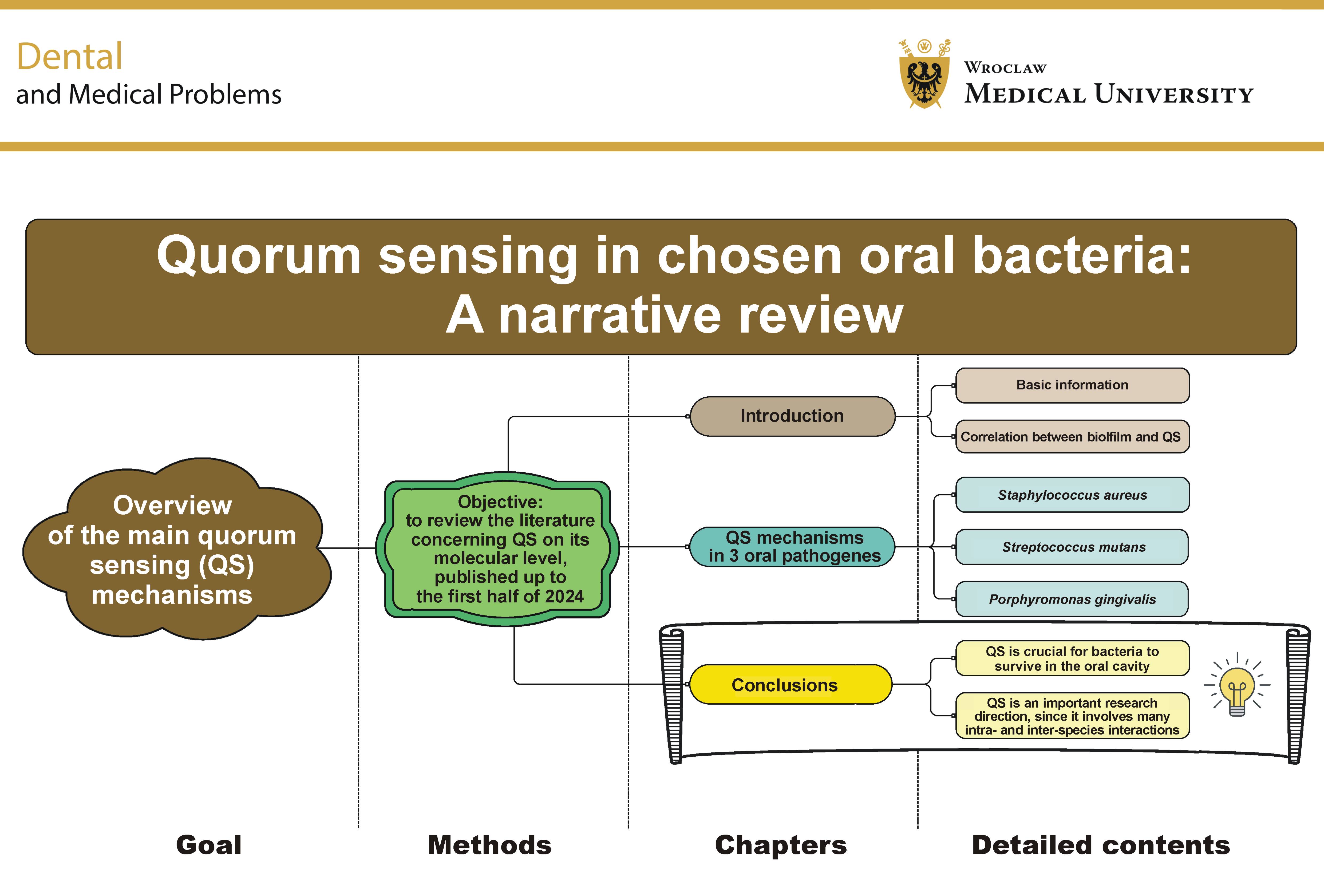
The aim of this review was to exhibit 3 different QS mechanisms displayed by 3 of the bacteria species present in oral microbiota: S aureus; Streptococcus mutans; and Porphyromonas gingivalis. The research mainly focused on the molecular aspects of QS communication, aiming to identify common patterns across QS mechanisms and to highlight the clinical implications of QS in each bacterium.
A short word on biofilm
There is no biofilm without QS and there is little QS without biofilm. Repeated physical disturbances of biofilm may impede QS-regulated processes in pathogenic bacteria.15 Biofilm formation model presented in 2002 by Sauer et al. is widely accepted, and provides a solid ground for further understanding of the problem.16 At the 1st stage, singular cells attach to a glass surface, using specific structures (the study was conducted on P. aeruginosa, in which case the structure was the flagellum). The number of the attached cells grows and the development reaches its 2nd stage – the attachment becomes irreversible. That first layer, a foundation, is then covered with the cells clustering and building subsequent layers, reaching certain thickness milestones (described as maturation-1 and maturation-2), which mark stages 3 and 4. At the 4th stage, the bacterial cluster achieves its maximal dimensions. The final stage of biofilm development is dispersion, during which bacteria from the interior, central regions of the biofilm revert to the planktonic, motile state and leave the original cluster. While this pattern has been generalized to apply to many bacteria, including S. aureus (with slight nomenclature modifications introducing the stages of exodus and expansion between the previously described attachment and maturation stages),17 it has been argued that this model does not fully capture the complexity of microbial communities. Similar to QS, polymicrobial biofilm-forming interactions have been described, for example, between Vibrio cholerae and E. coli.18 Furthermore, biofilms are not always attached to solid surfaces. As demonstrated by Knott et al., free-floating aggregates of methicillin-sensitive S. aureus (MSSA) were isolated from the prosthetic joint infection fluid, highlighting the existence of unattached biofilms.19 What is striking, the formations were more abundant and sophisticated than those formed by the same bacterium on a smooth, titanium surface.19
To fully fathom not only the process of biofilm formation, but also its overall advantages for the microorganism, insight into biofilm structure is crucial. It generally could be simplified as bacteria submerged in a gel-like fluid called extracellular matrix (ECM). The whole arrangement may be viewed as a “city of microbes”20 representing the entirety of the biofilm with the microbes located in the “house of the biofilm cells”, an accurate depiction of the matrix.21 It is built of extracellular polymeric substance which contains polysaccharides, glycolipids, glycoproteins, certain amounts of extracellular DNA, and more. Establishing a comprehensive biochemical profile of ECM across the vast majority of biofilms remains unattainable. Nevertheless, several of its components have been characterized and shown to play essential roles in microbial biology. One such example is the proteinaceous component curli in E. coli, which contributes to biofilm structural integrity. This was demonstrated in a 3D-printed biofilm durability study that investigated the impact of curli presence or absence on biofilm resistance to chemical agents.22 The authors showed that curli-positive biofilms remained intact following citrate treatment, and exhibited limited molecular oxygen penetration as compared to curli-negative biofilms printed under the same conditions.22
Biofilms might be formed by more than one microbial species. However, in such cases, QS occurs similarly to that observed in single-species aggregates. Such multispecies interactions may be more complex, and either competitive or cooperative in nature. A study by Armes at al. focused on 5 Roseobacteraceae strains exhibiting varied levels of QS component expression, ranging from paired LuxR/I QS systems in Sagittula stellata E-37, Citreicella sp. SE45 and Rhodobacterales strain Y4I to orphan LuxI and LuxR homologs in Sulfitobacter sp. EE-36 and Roseovarius nubinhibens ISM.23 The study demonstrated that the Y4I strain possesses the ability to inhibit the growth of two of the 4 other strains, which directly corresponds with the indigoidine production observed in this strain. Indigoidine release is induced by the presence of metabolites produced by other community members within ECM, demonstrating its connection to a QS system in phaR and phaI mutants.23 Another study investigating an in vitro model of a mixed-species biofilm formed by P. aeruginosa PAO1, Pseudomonas protegens Pf-5 and Klebsiella pneumoniae KP1 demonstrated that the biomass volume percentage of K. pneumoniae and P. protegens within the aggregate was dependent on the AHL-based QS system of P. aeruginosa.24 The community containing QS-deficient P. aeruginosa exhibited a lower concentration of K. pneumoniae and a higher concentration of P. protegens, in contrast to the community containing wild-type P. aeruginosa with functional QS activity, which displayed a higher biomass volume of K. pneumoniae and a lower biomass volume of P. protegens.24 These in vitro findings showcase the multispecies relations that might occur in every biofilm-rich environment, including human oral cavity, which confirms the intricacies of microbial interactions should be further researched.
The well-studied species revisited through the lens of their QS mechanisms are notorious biofilm producers with substantial clinical implications. The connection between P. gingivalis and periodontitis has long been recognized, with specific strains frequently identified among patients; for example, the W83_W50 strain was detected in the subgingival plaque samples obtained from 13% of participants in a recent study.25 Furthermore, Porphyromonas spp. detected in the saliva samples of patients suffering from sialolithiasis have shown a positive correlation with Porphyromonas spp. present in their salivary stones.26 Such a correlation was not observed for Pseudomonas spp.; however, another case report described the simultaneous recovery of P. aeruginosa and P. gingivalis strains from the bronchial sputum of a periodontal disease patient with a pulmonary abscess.27 The authors suggested that this infection may have resulted from the aspiration of these bacteria originating from the oral cavity.27 These examples demonstrate that these bacteria remain sufficiently unpredictable to warrant further investigation, including a deeper understanding of their QS mechanisms.
Quorum sensing in Staphylococcus aureus
Staphylococcus aureus is a Gram-positive, facultative anaerobic, spheroidal bacterium usually occurring in clusters. Years of multidimensional research on this species provided a foundation for the current bacteriology knowledge. The significance of S. aureus is linked to its prevalence, among the general human population and notably healthcare professionals. A StaphDent study showed that 23.5% of the dentists tested carried MSSA,28 while another study investigating methicillin-resistant S. aureus (MRSA) reported a 2.9% prevalence of these strains among dental personnel, with identification based on the presence of the mecA gene.29
The fact that S. aureus was present both in the outer and inner layers of the masks collected from dentists, dental assistants and nursing assistants, and made respectively 9.3% and 10.5% of the bacteria obtained from the samples prove the relevance of S. aureus in the context of this research.30
In line with other Gram-positive cocci, S. aureus possesses the two-component agr QS system. At the molecular level, it incorporates the RNAII and RNAIII transcripts, which are regulated by the P2 and P3 promoters, respectively.31 RNAII is an operon consisting of 4 genes, agrB, agrD, agrC, and agrA, whereas RNAIII serves as the primary effector molecule of this regulatory system.32 AgrC is a dimeric histidine protein kinase that undergoes autophosphorylation in response to the connection of the autoinducing peptide (AIP) to its receptor site.33 The signal is subsequently transmitted to AgrA through phosphate group transfer.31 The phosphorylated AgrA then binds to the aforementioned promoters and regulates the expression of RNAII and RNAIII, completing the QS regulatory loop.34 Interactions between the cytosolic domain of AgrC and the response domain of AgrA are highly specific, as several conserved hydrophobic polypeptide sequences are present among agr types I–IV, with distinct differences as compared to other response regulators.35 This relationship is highly significant, as mutant variants of the agrB transcript have demonstrated impairment in both protein stability and proteolytic activity – the former resulting in undetectable AgrD levels, while the latter leading to reduced AIP production in certain cases.36 Regarding AIP itself, each molecule can be assigned to one of 4 different classes (I–IV) based on the sequence and length of the peptide chain, which ranges from 7 to 9 amino acids. Studies have shown that blocking AIP signaling through the removal of the peptides from the environment results in the inactivation of the agr QS system, leading to the inhibition of agr-dependent hemolysin expression.37
The mechanism has been tested thoroughly and each element of the agr system encodes various protective mechanisms, for example it protects S. aureus cells from lethal doses of H2O2, as mutants with deleted agr show lower rates of survival when exposed to reactive oxygen species (ROS).38 Aside from that, cell death in a more propitious setting without any stressors is dependent on the agr system as well, since agr-absent cells show higher fractions of non-viable cells. However, deaths that may be related to agr occur in the agr-positive strains, in which case they facilitate the expansion of remaining, viable cells.39 Regarding the regulation of the QS system, it is dependent not only on the expression products of the agr regulon, but also on other staphylococcal excretory factors. The P2 and P3 promoters rely heavily on AgrA for the activation of RNAII and RNAIII expression through a classical positive feedback mechanism; however, additional regulatory factors are also involved, including SarA and SarR, DNA-binding proteins belonging to the SarA family. The former stimulates P2 promoter activity, whereas the latter represses this process.40 Another interesting aspect of agr regulation is the recent finding that androgens present in human skin, specifically testosterone and dihydrotestosterone, exert a measurable effect on the S. aureus agr transcriptome by activating the P3 promoter in a manner similar to AIP-I.41
Quorum sensing in Streptococcus mutans
This section on S. mutans is worth beginning by noting that this bacterium is relatively easy to culture under laboratory conditions, which has resulted in a considerable number of studies investigating its biology.42
S. mutans is a Gram-positive streptococcus characterized by high genotypic heterogeneity. A study by Cornejo et al. demonstrated that this bacterium possesses more than 3,000 genes, approx. half of which are conserved across all currently identified strains.43 This genetic diversity plays an important role in competition among different S. mutans isolates. The considerable phenotypic variability of this species has also been highlighted.44 Streptococcus mutans is classified as a lactic acid bacterium, meaning that it ferments carbohydrates and produces lactic acid. Furthermore, due to its high cariogenic potential, this bacterium can convert sucrose into extracellular polymers. Through the activity of glucosyltransferases and glycosyltransferases, among other enzymes, it produces water-insoluble glucans, which serve as a structural foundation for dental biofilm formation.45
It is worth noting that the etiology of dentin and root caries differs significantly, with S. mutans being primarily associated with the carious lesions affecting the tooth root. Research indicates that the prevalence of this condition is substantial, with approx. 41% of individuals affected. This highlights the importance of further investigation into the communication mechanisms of this bacterium and its interactions with other members of the oral biofilm.46
In addition, S. mutans produces adhesins that interact with specific receptors, such as those present on the surface of the salivary pellicle. These adhesins also play an important role in the interactions of bacteria with each other within the biofilm. Among the most significant adhesins is antigen I/II. Studies have demonstrated that bacterial strains deficient in this component exhibit reduced ability to interact effectively with other cells, and consequently display lower cariogenic potential.47, 48, 49, 50, 51
Streptococcus mutans can efficiently adapt to the changing conditions of the oral cavity. It is capable of surviving under low pH conditions through a mechanism known as the acid tolerance response (ATR). This mechanism protects the bacterium from acid-induced damage52, 53, 54; as a result, the intracellular pH remains higher than that of the surrounding oral environment.55
However, the most relevant aspect of this article is the QS mechanism. The aforementioned mechanism is actively utilized by S. mutans, a member of the oral microbiota. A already note, S. mutans is also an important etiological agent of dental caries,56 with its presence being associated with acidic saliva conditions.57 Understanding how this bacterium employs QS may open new possibilities for developing methods to prevent dental caries.58
This type of inter-bacterial communication involves specific signaling molecules (pheromones) that can be detected by other bacteria. The vast majority of signals utilized in the QS mechanism are small-sized organic molecules. In some cases, bacteria also employ short-chain peptides consisting of up to 20 amino acids for this purpose.59
The description of the QS mechanism is worth beginning with its intra-species variant. Quorum sensing in S. mutans involves gene transcription processes that result in the production of compounds increasing the virulence of these bacteria. Furthermore, maintaining a self-perpetuating system, namely positive feedback, is essential; the factors responsible for this process are also generated during QS activation.58 This system includes the AIP precursor, the transporter responsible for AIP export to the extracellular environment, and a histidine kinase, which initiates the transcriptional response.58
An inter-species model of QS signaling in S. mutans involves the use of AI-2, a class II signaling molecule that binds fish-like structures.60, 61, 62, 63 This signaling molecule is utilized by both Gram-positive and Gram-negative bacteria.64 Its synthesis depends on the enzyme LuxS, which is essential, among other things, in the protein methylation pathway.65 Once AI-2 is released into the extracellular environment, it is recognized by a specific receptor, initiating signal transduction, gene transcription and the production of virulence factors.58
Quorum sensing is important to mention in the context of the caries-forming potential of S. mutans, as this bacterium takes control of biofilm formation in the oral cavity. In addition, it also regulates the production of mutacins,66, 67 which adversely affect other bacteria in the surrounding environment.56 Due to its genetic competence, S. mutans has the ability to acquire genetic material from other organisms present in the substrate and incorporate it into its genome. This allows it to acquire new traits or repair damaged DNA.59 The greater the similarity between the DNA of the recipient cell and the DNA to be incorporated, the higher the probability of acquiring a new trait.59 Streptococcus mutans uses type IV surface proteins for the aforementioned transformation mechanism.68 The development of these competencies is most pronounced in only a few strains of S. mutans; however, compared with other streptococci, it remains relatively limited.69 Increasingly, the literature suggests that competence is associated with the general bacterial response to stressors, as its activation is induced, among other factors, by mutagens and significant environmental fluctuations.70
Two major pathways are used for communication between S. mutans cells. They are presented below.
1. CSP–ComABCDE: a 5-gene system responsible for peptide export, enabling the stimulation of genetic competence in S. mutans.71
The precursor peptide of CSP, a 21-amino acid competence-stimulating peptide, is ComC.72 At an early stage, ComC is truncated by ComAB, resulting in the formation of the active CSP.73 Accordingly, ComA can be considered to participate in CSP maturation.74 The remaining genes, comD and comE, encode a histidine kinase and a response regulator protein, respectively.75 Furthermore, the addition of CSP to non-competent cells has been shown to increase the frequency of genetic transformation.76 This pathway is also crucial for the initiation of biofilm formation in the oral cavity,77 as the ComDE system regulates, among other processes, the production of specific bacteriocins (mutacins) in S. mutans.78
2. XIP–ComRS.56, 58, 79, 80
Both cell-signaling pathways are interconnected. For the inducer peptide XIP, the precursor is ComS.81 The ComR–XIP complex acts as a transcriptional activator of the comR, comS and comX genes. The activation of comX transcription ultimately leads to the development of genetic competence in S. mutans.82
Quorum sensing in Porphyromonas gingivalis
Porphyromonas gingivalis is a Gram-negative anaerobic bacterium that plays an important role in the development of chronic periodontitis, as it has the ability to induce the transition of the oral biofilm from a eubiotic to a dysbiotic state.83 Various virulence factors contribute to the pathogenicity of P. gingivalis, including the secreted lysine- and arginine-specific gingipains. These proteases are primarily associated with tissue destruction, but also contribute to the dysregulation of the host immune response.84, 85 Fimbriae are involved in adhesion to other bacteria and play an important role in biofilm formation.86 Porphyromonas gingivalis has also been shown to possess extensive invasive potential, as it not only colonizes the oral cavity, but has also been detected in the aortic endothelium, where it is thought to gain access through the damaged epithelium.87, 88
Numerous studies have been conducted to demonstrate the association between P. gingivalis and the occurrence of various diseases in the human body. Among other findings, they have linked the presence of this bacterium in periodontal disease with an increased risk of conditions such as myiasis, hypertension, gastrointestinal cancer, squamous cell carcinoma, Alzheimer’s disease, and the development of diabetes-related complications.89, 90, 91, 92, 93, 94, 95 These findings highlight the broad impact of P. gingivalis on human health. However, to fully understand its pathogenicity, it is worth beginning with the initial stage of this process, namely biofilm formation and, more specifically, the interactions among the bacteria that constitute the biofilm.
Three bacteria – P. gingivalis, Tannerella forsythia and Treponema denticola – constitute the so-called red complex. They can be detected in periodontal pockets, where they participate in the initiation and maintenance of the inflammatory process within the periodontium. These bacteria are considered the primary periodontal pathogens responsible for extensive destructive changes in periodontal tissues.96 However, it is worth noting that the presence of a dental biofilm is a prerequisite for the P. gingivalis colonization of the gingiva.97
As previously mentioned, P. gingivalis is a Gram-negative anaerobic bacterium. It is highly capable of adapting to the conditions of the oral cavity, owing, among other factors, to its ability to adhere to the surfaces of the oral mucosa, cheeks and gingiva. This enables the bacterium to effectively resist the host’s defense mechanisms.98 Porphyromonas gingivalis exhibits extensive and highly diverse gene expression that supports its growth, maturation, survival, and communication with other bacteria within the dental biofilm.98 The survival and function of P. gingivalis under these conditions are further facilitated by the presence of fimbriae and surface polysaccharides. These structures are key features promoting biofilm formation, as they enable the bacterium to adhere to the colonized surfaces and establish a highly specialized bacterial community.99
As mentioned earlier, QS is a fundamental mechanism of bacterial communication. Gram-negative bacteria produce specific QS signaling molecules – AHLs. It was initially believed that P. gingivalis did not produce these molecules; however, this assumption was later shown to be incorrect.100 It is worth mentioning that AHL production has not been reported in other oral pathogens.100, 101, 102 In a study by Muras et al., the authors indicated a probable association between the presence of AHLs in saliva samples and the formation of bacterial communities dominated by P. gingivalis, which was identified as the producer of these signaling molecules.100 Interestingly, P. gingivalis possesses a homolog of the AHL synthase HdtS, and both AHLs and their homologous compounds have been shown to reduce the growth potential of this bacterium.103 Furthermore, AHLs have the ability to alter protein expression in P. gingivalis.100 The same study also reported that C8-HSL (N-octanoyl-L-homoserine lactone) was detected in saliva samples. The researchers observed that this compound was produced by P. gingivalis, a key periodontal pathogen. Notably, all individuals in whom C8-HSL was detected were diagnosed with periodontal disease.100 In addition, P. gingivalis has been shown to produce AI-2, a furanosyl borate diester involved in the QS mechanism that enables communication with other bacterial species.104
In vivo findings on the reviewed bacterial species
It is worth noting that the aforementioned QS mechanisms are considerably more difficult to study in vivo because of the numerous interactions occurring within the microbial community, which may obscure the primary subject of investigation. Nevertheless, in vivo studies of QS remain a valuable source of knowledge about the overall phenomenon, and therefore should not be omitted from this review.
As the agr QS system should certainly be considered an important and relatively universal virulence factor of S. aureus, it may represent a potential target for antibacterial therapy. A compound that has shown promising results in in vivo studies is pyocyanin (PCN). The use of PCN against the 10 most virulent strains among 160 MRSA isolates, derived from the blood, wounds, sputum, and abscesses of patients admitted to an Egyptian hospital in a 2023 study by Abo Kamer et al., demonstrated a significant decrease in agrA gene expression in each tested strain.105
Streptococcus mutans QS is dependent on Aggregatibacter actinomycetemcomitans and the broader composition of the periodontal microbiota. The in vitro part of a 2017 study by Szafrański et al. demonstrated that the alternative sigma factor X (SigX) regulon, a central regulon of QS in S. mutans, is activated as a result of an inter-species QS-based interaction between these bacteria within a dual-species biofilm, as such activation does not occur in a single-species biofilm.106 The in vivo part of the same study focused on this interaction, using samples derived from the periodontal pockets of 3 healthy patients and 1 patient suffering from chronic periodontitis. The results showed that SigX expression levels in the S. mutans strains isolated from periodontal pockets were similar to, and in some cases higher than, those observed in in vitro dual-species biofilms.106 Therefore, it could be argued that the presence of S. mutans within the multispecies environment of a periodontal pocket enables the expression of its virulence potential.
Porphyromonas gingivalis is a prominent target for anti-QS therapy; therefore, a number of studies investigating the suppressive effects of different compounds on its physiology have been conducted. For example, an experimental mouse model demonstrated that treatment with QS inhibitors (furan compounds and D-ribose) resulted in a decrease in bone destruction, measured as the distance between the cementoenamel junction (CEJ) and the alveolar bone crest (ABC), as well as a 68.36% reduction in P. gingivalis DNA levels as compared to the untreated, bacteria-infected group.107 These findings further support QS inhibitors as a noteworthy research prospect in the context of periodontitis treatment.
Is there any correlation between the reviewed bacterial species?
A bacterial biofilm can exist primarily due to the cooperation and communication between microorganisms. Within this structure, the mutual aggregation of bacteria plays a decisive role. However, bacteria do not aggregate randomly; instead, there are specific patterns governing how this aggregation process occurs.108 A good example is the aggregation of S. mutans with Fusobacterium nucleatum and the lack of interaction with P. gingivalis, as described earlier.108 It is worth mentioning that the main mechanism underlying this process is the ability of bacteria to recognize polysaccharides located on their surfaces, which forms the basis of microbial communication. In addition, competition with other microorganisms for nutrient availability and favorable living conditions is also an important factor.108
An important element in the bacterial interaction chain is represented by proteins called bacteriocins. They are produced by numerous Gram-positive and Gram-negative bacteria; however, in the oral cavity, streptococci are the predominant producers of these compounds.109 Streptococcus mutans produces 2 types of bacteriocins known as mutacins. They benefit this bacterium by effectively influencing its function and competitiveness within the biofilm.110
As previously mentioned, S. mutans does not exhibit aggregation with P. gingivalis, despite the presence of both microbial species being characteristic of patients with carious disease.108 However, in the case of S. mutans, a correlation has been observed with another bacterium not described in the aforementioned article, but worth mentioning, namely Streptococcus sanguinis. Which bacterium dominates within a given environment depends on the order in which that environment is colonized.108
Furthermore, it was discovered that the CSP molecules involved in the communication pathway of S. mutans can be recognized by type 2 taste receptors (T2R). These receptors are proteins located on the membrane of host cells and can be found in the oral cavity, among other sites. Medapati et al. emphasized that S. mutans secretes QS molecules, namely the aforementioned CSPs, which are detected by these receptors.111, 112 Additionally, it has been demonstrated that CSP-1 is the most potent inducer of the QS molecule–receptor pathway in gingival epithelial cells.113
The research demonstrated the relationship that may exist between the aforementioned S. mutans, S. aureus and the described T2R receptor.112 It showed that when the receptor was blocked, oral cavity cells exhibited greater difficulty in absorbing S. aureus, whereas the uptake of S. mutans remained unchanged. Additionally, when oral cavity cells were blocked with CSP-1, a similar effect was observed.112
Methods
A literature search was conducted using the PubMed and ScienceDirect databases, focusing on articles published up to the first half of 2024. The searched terms included keywords such as “quorum sensing mechanisms”, “biofilm”, species names of the described bacteria, and other related terms, often used in various combinations. The inclusion criteria required studies to be written in English, published in international peer-reviewed journals, and describing specific aspects of QS mechanisms among the investigated bacteria. To ensure the quality of the selected articles, the authors prioritized original research articles, with preference given to (1) pilot studies and (2) the most recent reports. Additionally, several case studies were referenced.
The final assessment of the presented review was conducted with the help of the Scale for the Quality Assessment of Narrative Review Articles (SANRA).114 The authors evaluated the work according to 6 aspects: justification of the importance of the article (item 1); clear formulation of the aim (item 2); description of the methodology (item 3); referencing (item 4); scientific reasoning (item 5); and presentation of data (item 6). Each item was rated as 0 (low standard), 1, or 2 (high standard), with a maximum possible score of 12. Efforts were made to improve each element during the revision process in order to maintain the highest quality of reporting.
The key literature findings are presented in Table 1.
Limitations
Three bacterial species were selected, which represents a limitation, given the number of microorganisms present in the oral cavity. The complexity of the interactions occurring between these species is also a limitation, as it introduces a potential risk of errors in the interpretation of QS mechanisms. Due to the complexity and broad scope of the topic, only selected mechanisms and molecules involved in QS were described.
Conclusions
The above examples cited in this article demonstrate how diverse, unique and complex the bacterial community inhabiting the human oral cavity is. It is not limited to simple communication, but represents a sophisticated system of information exchange that enables bacteria to cooperate and effectively inhabit all available niches. The examples presented illustrate the numerous directions, pathways and signals involved in QS mechanisms. The mechanisms of only 3 bacterial species have been described, while the oral cavity contains more than 700 bacterial species. Without cooperation, their survival would not be possible. Many of the pathways through which QS occurs have not yet been fully elucidated or thoroughly studied, leaving much more to be explored. Bacteria are highly capable of adapting to the prevailing conditions within the oral cavity.
Ethics approval and consent to participate
Not applicable.
Data availability
Not applicable.
Consent for publication
Not applicable.
Use of AI and AI-assisted technologies
Not applicable.