Abstract
Over the past 2 decades, a wide range of post-and-core materials has been developed to restore endodontically treated teeth (ETT) with extensive loss of coronal tooth structure. Although the prognosis and long-term success of ETT are influenced by multiple factors, most research has focused on post-and-core materials, the ferrule effect and luting agents. However, a classification of failures associated with post-and-core assemblies is currently lacking. This study aimed to identify and classify post-and-core assembly failures.
A literature search was conducted using the terms “post and core” and “dental post and core” in the title and abstract. Articles published in English between 1991 and 2024 were retrieved from the PubMed®, Scopus and Cochrane Library databases. Of the 491 articles identified, 23 met the inclusion criteria and were used to develop the proposed classification.
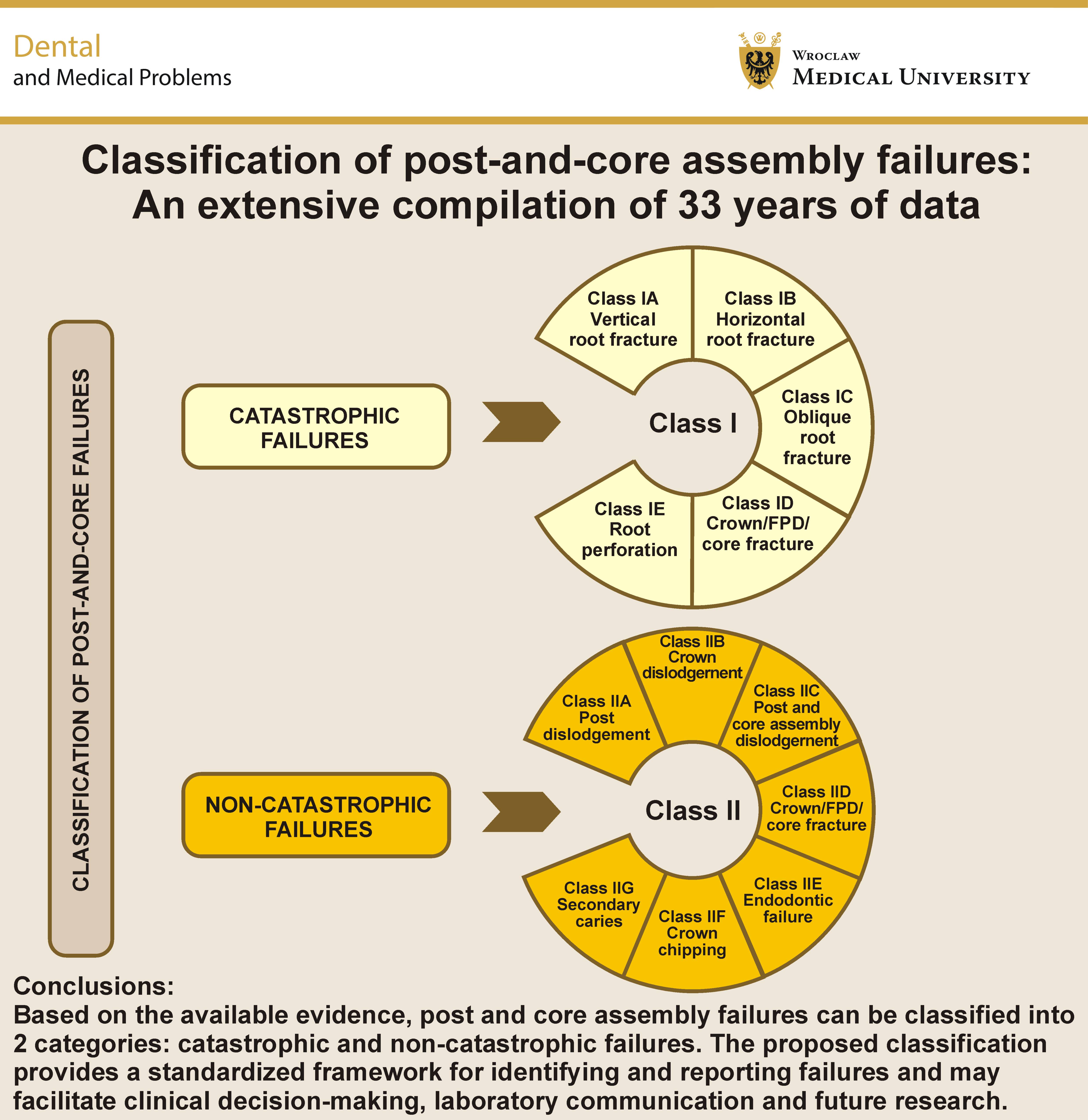
Based on the available evidence, post-and-core assembly failures can be classified into 2 categories: catastrophic and non-catastrophic failures. To the authors’ knowledge, this is the first comprehensive classification of post-and-core assembly failures derived from evidence spanning 33 years of published literature. The proposed classification provides a standardized framework for identifying and reporting failures and may facilitate clinical decision-making, laboratory communication and future research.
Keywords: luting agents, ferrule, endodontically treated teeth, post-and-core failures, dental posts
Introduction
The restorative success of endodontically treated teeth (ETT) has been a subject of considerable debate over the past 2 decades. Because non-vital teeth are generally more susceptible to fracture than vital teeth,1 a multifactorial approach is essential to ensure long-term survival of ETT. The prognosis of ETT depends on several factors,2 and careful evaluation of each of these factors enables the clinician to assess the prognosis, determine the complexity of treatment3 and develop an appropriate treatment plan.
Traditionally, it has been assumed that an endodontically treated tooth with extensive loss of coronal tooth structure requires the use of an anchorage from the root canal to improve strength and function of the restoration. However, Trope et al. demonstrated that preparation of the root canal for post placement weakens the tooth and reduces its resistance to functional forces.4 It is also commonly believed that pulpless teeth become brittle and more prone to fractures due to reduced moisture content. However, only minor differences were noticed in the hardness and microhardness of dentin between vital and non-vital teeth.5 Assif and Gorfil stated that the loss of dentin during access cavity preparation and post space preparation is the primary factor compromising the survival of ETT.6 Hence, performing restorative procedures that preserve the remaining dentin thickness is more crucial than strengthening the tooth. 6
The wide variety of available post materials and restorative techniques has resulted in conflicting recommendations regarding the optimal restorative approach. A systematic review evaluating the biomechanical considerations for restoring ETT concluded that interfacial defects and severe tooth breakdown associated with post failure occurred more frequently with rigid metal and ceramic posts.5 However, fiber posts combined with composite resin demonstrated favorable clinical performance because their mechanical properties are more similar to those of dentin. It was also established, based on fatigue studies, that post placement is unnecessary when an adequate ferrule and sufficient coronal tooth structure are present. Nevertheless, when a post is required to improve the stability of the tooth, a resin post must be used along with an adhesive luting agent.5
Another systematic review evaluating the clinical performance and failure modes of pulpless teeth restored with posts found no significant differences in the survival rates of metal and fiber posts.7 The authors concluded that both post systems demonstrate comparable clinical performance during short- to medium-term follow-up.7
Although several studies have supported the use of posts,8, 9, 10, 11, 12 whereas others have questioned their placement,13, 14, 15, 16, 17 there is currently no standardized classification of post-and-core failures. Such a classification would facilitate communication among clinicians and provide a standardized framework for research. A simple and reproducible classification describing both the type and severity of post-and-core failures could be useful for surveys, clinical trials, treatment planning, and outcome assessment.
Following a review of the published literature on post-and-core failures and after evaluation of the available evidence, the authors propose a new classification system for post-and-core failures together with recommendations for their management. To the best of our knowledge, no standardized classification of post-and-core failures has been described in the literature. The proposed classification categorizes failures into 2 broad groups, catastrophic and non-catastrophic, based primarily on whether the affected tooth can be salvaged. This classification is intended to assist clinicians in determining whether the tooth requires further treatment or needs to be extracted. Catastrophic failures comprise those resulting in irreparable damage to the tooth, whereas non-catastrophic failures include conditions in which the tooth can be salvaged even after the failure.
Material and methods
Search methodology
A literature search was conducted using the following search terms: (“post and core”(Title/Abstract)) OR (“dental post and core”(Title/Abstract)). Articles published in English between 1991 and 2024 were retrieved from the PubMed®, Scopus and Cochrane Library databases. The identified studies were screened according to the predefined inclusion and exclusion criteria.
Inclusion and exclusion criteria
The inclusion criteria encompassed randomized controlled trials (RCTs), quasi-RCTs, in vivo or in vitro studies, retrospective or prospective studies, cohort studies, case–control studies, systematic reviews, or meta-analyses that evaluated and described the types of post-and-core failures and their management. Literature reviews, scoping reviews, narrative reviews, case reports, and case series were excluded.
Data collection
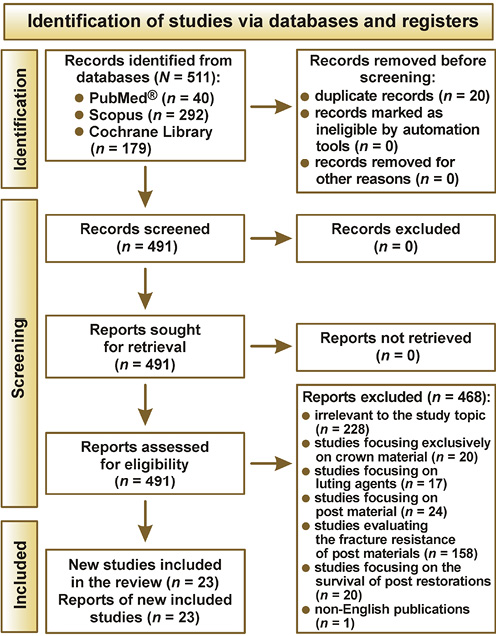
A total of 511 records were identified across all databases on April 10, 2024. After removal of duplicate records, 491 articles remained for title and abstract screening. Following screening and application of the inclusion and exclusion criteria, 23 studies were included in the final analysis (Figure 1). These 23 articles were used to formulate the proposed classification system (Table 1).11, 12, 18, 19, 20, 21, 22, 23, 24, 25, 26, 27, 28, 29, 30, 31, 32, 33, 34, 35, 36, 37, 38
Results
Classification of post-and-core failures
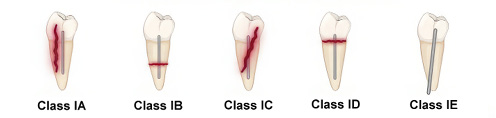
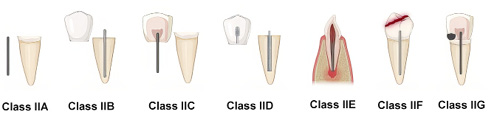
Post-and-core failures can be broadly classified into 2 major categories: catastrophic and non-catastrophic failures (Figure 2,Figure 3). Each category is further subdivided according to the type and extent of failure. The proposed classification was developed from evidence reported in 23 studies conducted in both clinical and laboratory settings. Hence, it encompasses the various types of failure that may occur under laboratory conditions, in clinical setting, or both. A comprehensive classification of post-and-core failures has the potential to standardize the reporting of outcomes in future RCTs, in vitro studies, cohort and case–control studies, systematic reviews, and meta-analyses. In addition, in may facilitate scientific communication among clinicians, researchers and dental technicians (Table 2,Table 3).
Discussion
The proposed classification identifies the spectrum of failures that may occur in ETT restored with a post-and-core system. It may serve as a practical framework for evaluating outomes in a laboratory setting, predicting prognosis, establishing a diagnosis, formulating treatment plans, and facilitating communication among clinicians. The classification was developed following a critical appraisal of evidence from prospective and retrospective studies, RCTs, in vitro investigations, systematic reviews, and meta-analyses.
There remains no clear consensus regarding the role of post-and-core restorations in improving the clinical outcomes of ETT. Numerous studies have focused on identifying the post-and-core material that provides the greatest fracture resistance and lowest failure rate. However, the prognosis of ETT is influenced by several additional factors, including the periapical status, tooth position, occlusal contacts, collagen degradation, and intermolecular cross-linking of the tooth root dentin.39
The primary purpose of a post is to retain the core in teeth with extensive loss of coronal tooth structure rather than to reinforce the remaining tooth structure.6 Post placement has been shown to reduce the incidence of catastrophic failures in selected ETT. However, when 3 or 4 coronal walls remain intact, neither post placement nor the type of post-and-core material appears to significantly influence the clinical outcome.39
A nationwide survey conducted among German dentists in 2006 reported that 52% of respondents routinely placed a post in every second endodontically treated tooth, while almost 54% believed that posts reinforce ETTs.2 Current evidence, however, indicates that unnecessary post placement increases the risk of root perforation and may predispose the tooth to root fracture.1, 40, 41, 42
Although in vitro studies provide valuable information regarding the prognosis and prediction of clinical outcomes of ETT, RCTs produce the highest level of clinical evidence. A 17-year follow-up of a RCT by Fokkinga et al. on ETT with and without prefabricated metal posts concluded that placement of a post did not significantly influence tooth survival.43 Similar findings were reported by Mannocci et al.44 However, a RCT by Zicari et al. noted a 3-year survival probability of 97.2% and a success rate of 91.7% for restorations supported by glass fiber and gold alloy-based posts, respectively.15 Similar results were reported in another clinical trial,45 in which post-endodontic restorations exhibited a failure rate of only 6.42% after 3 years.
Bitter et al. in their in vitro study reported that self-adhesive resin cements produced only a modest increase in the retentive strength of the dowel.17 Conversely, Mazzoni et al. demonstrated significantly reduced retention and increased interfacial nanoleakage with 2 self-adhesive resin cement.46 Balkenhol et al. investigated the influence of luting agents under cyclic loading conditions and concluded that the choice of luting agent had a minor influence on the survival of post-and-core restorations.31
As far as luting agents are concerned, the survival of the post-and-core assembly depends largely on the accuracy of each clinical step and the operator’s handling of the procedure. In addition to technical challenges involved, the limited access within the root canal space further complicates the bonding procedure. To better understand the effect of luting agents on the survival of the post-and-core assembly, long-term clinical investigations in the form of RCTs are required; however, such evidence is currently lacking.
Although several RCTs have investigated the performance of post-and-core restorations, definite conclusions regarding the optimal restorative strategy remain elusive. The success or failure of these restorations depends on numerous factors. Therefore, additional well-designed, comprehensive RCTs that account for these variables are required to reach a consensus. At present, the available literature remains heterogeneous, contributing to continued uncertainty regarding the indications for post placement, the selection of rigid versus flexible posts, the importance of the ferrule effect, and the optimal luting agent.
Conclusions
Until comprehensive RCTs evaluating all relevant factors affecting the success and failure of post-and-core restorations become available, consensus regarding the indications for post placement is unlikely to be achieved. Future in vitro studies and well-designed clinical trials are needed to validate the proposed classification and assess its reliability and clinical applicability. Based on the currently available evidence, the authors propose a novel classification of post-and-core failures that may provide a standardized approach for classifying the type of post-and-core failures, predicting prognosis, and guiding treatment planning.
Ethics approval and consent to participate
Not applicable.
Data availability
Not applicable.
Consent for publication
Not applicable.
Use of AI and AI-assisted technologies
The AI tool (BioRender; Science Suite Inc., Toronto, Canada) was used to generate the images and graphical abstract.