Abstract
Background. The acquisition of dental skills during the final year of the Dentistry degree is primarily based on clinical training, which was severely disrupted during the coronavirus disease 2019 (COVID-19) pandemic.
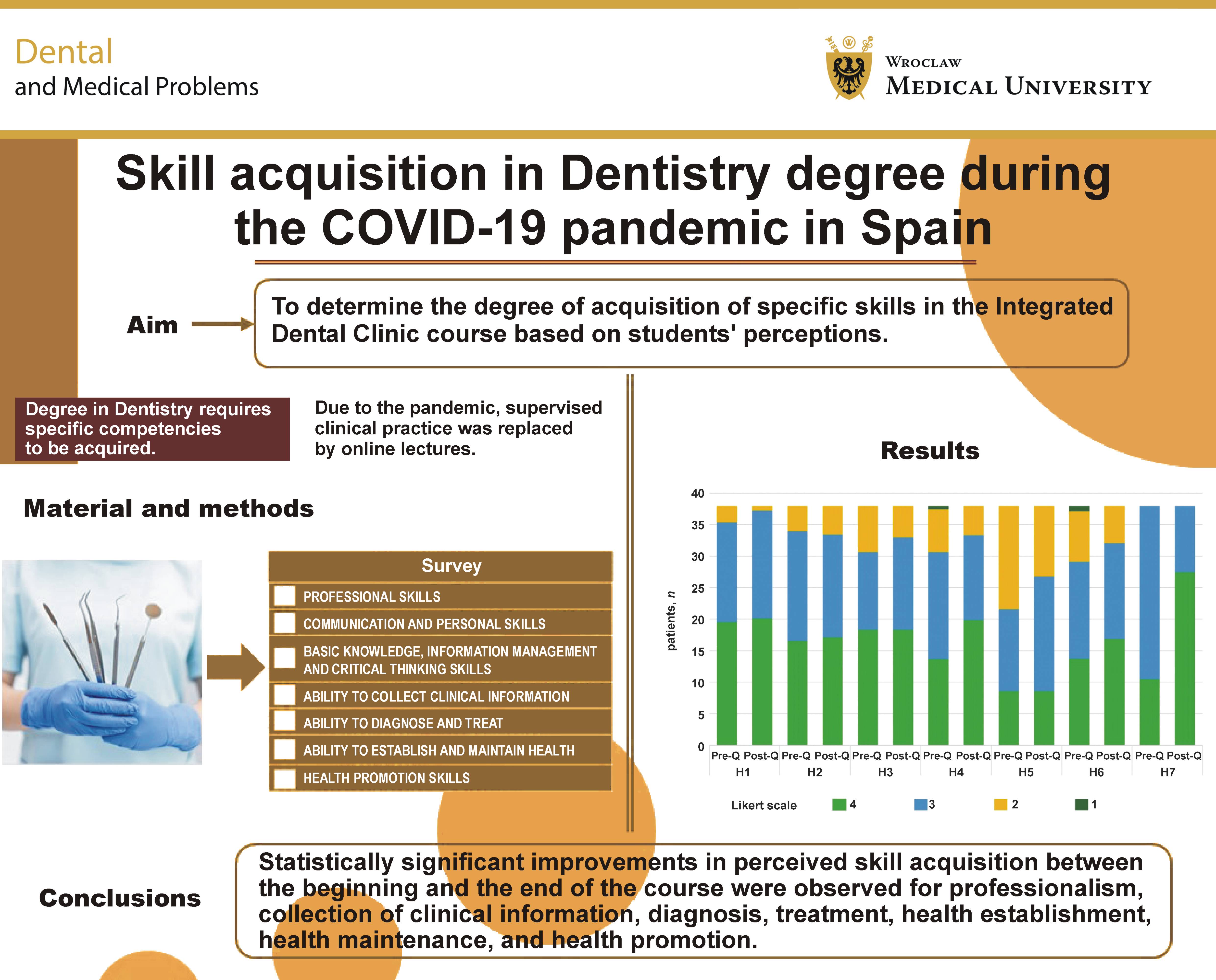
Objectives. The aim of the study was to determine the degree of acquisition of specific skills in the Integrated Dental Clinic course based on students’ perceptions.
Material and methods. A total of 84 dental students were included in the study. Online forms were administered to evaluate students’ perception of competency acquisition in professionalism, communication, basic knowledge, information management, critical thinking, collection of clinical information, diagnosis, treatment, health establishment, health maintenance, and health promotion. The questionnaires were sent before and after the declaration of the COVID-19 state of alarm in Spain. Statistical analysis was performed using R statistical software, v. 4.1.1.
Results. The highest percentage of students reporting high levels of perceived competency acquisition corresponded to health promotion (72.37%), professionalism (52.86%) and ability to collect clinical information (52.34%). Statistically significant improvements in perceived skill acquisition between the beginning and the end of the course were observed for professionalism, collection of clinical information, diagnosis, treatment, health establishment, health maintenance, and health promotion.
Conclusions. Despite the disruptions caused by the pandemic, fifth-year dental students perceived that they had successfully acquired specific skills by the end of the academic course, particularly professional skills, ability to collect clinical information, ability to diagnose and treat, ability to establish and maintain health, as well as health promotion skills.
Keywords: COVID-19, resources, competencies, skills in dentistry, dental education
Introduction
Contemporary models of university education propose the implementation of curricula focused on competency-based education.1, 2 The coronavirus disease 2019 (COVID-19) pandemic has prompted an unexpected methodological shift toward online teaching and learning. Within a short period, educators adapted their teaching practices by incorporating digital technologies, regardless of their professional background. This situation has been described as emergency distance education (EDE), characterized by the intentional adoption of educational technologies.3 Consequently, experience with information and communication technologies (ICT) and the potential for innovation became relevant, broadening the scope of the teaching role.4 This transition required educators to adapt creatively to technology-enhanced learning.5, 6 Teachers’ expertise in instructional design and course organization is necessary for educational objectives to be fulfilled, supported by feedback, instruction and evaluation.6
This transition is limited by the heterogeneous backgrounds of higher-level education professors, whose experience with distance education varies and who often require personalized technological, institutional and pedagogical support.4 Consequently, the evaluation of competencies has also undergone changes.7, 8 Successful implementation of these changes depended heavily on institutional support.9 However, some authors have argued that insufficient institutional commitment limits the design, implementation and maintenance of online teaching.10 Additional challenges included the rapid development of online learning materials and the provision of adequate technical infrastructure and pedagogical support during the emergency transition.11 The use of digital technologies in these extreme situations can play a catalytic role in the development of educational innovations.
In Spain, the final year of the Dentistry degree is centered on clinical training, which serves as the prelude to the student’s incursion into professional life. The curriculum includes an annual course worth 24 European Credit Transfer System and Accumulation System (ECTS) credits, and it is taught together with the courses of Maxillofacial Surgery (6 ECTS), Preventive and Community Dentistry (6 ECTS), 2 elective subjects (12 ECTS), Legal and Forensic Dentistry (6 ECTS), and a Final Degree Project (6 ECTS). The practicum provides supervised training in a real clinical environment, enabling students to acquire professional competencies through experiential learning. Assessment is based on the acquisition of competencies that encompass professional values, communication skills, individualized clinical reasoning and judgment skills, as well as clinical management skills. These supervised activities allow the acquisition of a competent professional profile with appropriate knowledge and skills expected of a competent dentist.12 Technology-based learning has become an increasingly accepted component of dental education, and its integration into the dental curriculum is considered essential for improving teaching quality.13 Nevertheless, translating face-to-face clinical dental training into an online learning environment remains a major challenge for educators and has required the rapid development of innovative teaching strategies. Competency-based clinical education in this context represents a substantial challenge for clinical professors.14 Competencies extend beyond the acquisition of theoretical knowledge, encompassing the skills, attitudes and psychological resources required to address complex healthcare and social needs.15 The success and high professional standards of dental graduates depend largely on the acquisition of these competencies, which are established as learning objectives by the community directives governing dental education.
Taking this scenario into account, the COVID-19 pandemic raised important concerns regarding dental education. The interruption of clinical patient care and the suspension of many research activities generated uncertainty about the professional preparation of dental students, as the inability to participate in face-to-face clinical training could adversely affect the acquisition of specific skills. Accordingly, the objectives of the present study were to assess students’ perceptions of their acquisition of specific skills in the Integrated Dental Clinic course during the pandemic and to determine their satisfaction with the education provided. These findings may inform future improvements in teaching methodologies and support the development of educational strategies that enhance the acquisition of competencies.
Material and methods
The present study was reviewed and approved by the Ethics Committee of the Quality Office of the Complutense University of Madrid, Spain (code No. 375-2019). The study was conducted in accordance with the principles of the Declaration of Helsinki, the recommendations of the World Association of Medical Editors (WAME), the International Committee of Medical Journal Editors (ICMJE) guidelines for the reporting and elaboration of research, and the Spanish Organic Law 3/2018 of December 5 on the Protection of Personal Data and Guarantee of Digital Rights (LOPD).
The study population consisted of 84 fifth-year dental students enrolled in the Dentistry degree program. The required sample size was calculated using the formula for estimating a proportion in a finite population. Assuming a 95% confidence level, an alpha error of 0.05, a beta error of 0.2, and a bilateral hypothesis, the minimum required sample size was 39 students. All eligible students were invited to participate regardless of sex, ethnicity or type of university access. Students who declined to participate were excluded. This cross-sectional study was conducted in 3 phases:
• Phase 1. Research team coordination. Coordination meetings were held to define and distribute responsibilities among the investigators, and develop data collection instruments;
• Phase 2. Questionnaire development and administration. The target population included all students enrolled in the fifth-year Integrated Dental Clinic course. This annual subject comprises 24 ECTS credits, of which 21 are face-to-face supervised training, while the remaining 3 are dedicated to online learning activities, including clinical case preparation and the final degree project. The course is taught in Spanish and is primarily delivered at the university clinic under the supervision of 53 professors and 1 coordinator. Clinical training focuses on the development of discipline and specific skills through the treatment of patients aged 6 years and older. At this stage of the study, the academic guide for the subject was reviewed to collect all possible information about skills that the students were expected to acquire.12 These competencies were based on the White Book of the National Agency for Quality Assessment and Accreditation (ANECA). Data was collected using an online questionnaire created with Google Forms (Google LLC, Mountain View, USA). The questionnaire included sociodemographic variables (sex, age, university admission pathway, and occupation at the time of the survey), as well as 71 questions related to students’ perceptions of competency acquisition across 7 sections: Professional Skills; Communication and Personal Skills; Basic Knowledge, Information Management and Critical Thinking Skills; Ability to Collect Clinical Information; Ability to Diagnose and Treat; Ability to Establish and Maintain Health; and Health Promotion Skills (Table 1). Responses were recorded using a 4-point Likert scale, where 1 indicated little or no acquisition of skills and 4 indicated the highest level of skill acquisition. Completion of all questionnaire items was mandatory. To preserve participant anonymity, the questionnaires were distributed by the Dean’s Office of the School of Dentistry through e-mails. Anonymous identification codes were assigned to each participant throughout the study. The students received information regarding the study objectives, procedures and planned use of the collected data. Respondents were allowed unlimited time to complete the questionnaire. The initial questionnaire was administered at the beginning of the 2019–2020 academic year, before the declaration of the COVID-19 state of alarm or lockdown in Spain (pre-Q). The follow-up questionnaire was distributed to the students by the Dean’s Office in May 2020, at the end of the academic year (post-Q), after the lockdown had been implemented by the government and all teaching activities had transitioned to an online format, with the suspension of face-to-face clinical training. Online teaching was carried out from January 2020 until the end of the second semester in May 2020, coinciding with the government lockdown;
• Phase 3. Data analysis. Statistical analyses were performed using R statistical software, v. 4.1.1. Descriptive analyses were conducted by summarizing students’ responses before and after the intervention for each competency domain. Median scores for each item were also taken into consideration and used for the inferential analyses. Differences between the pre-Q and post-Q responses were assessed using the Wilcoxon non-parametric test for paired samples. The results were considered significant for p-values <0.05.
Results
Of the 84 students enrolled, 38 completed both questionnaires (pre-Q and post-Q). The majority of respondents were female (84.4%), and the mean age of the participants was 23.0 years. Most of the students (90.6%) had been admitted to the university through the admission examination, and 28.1% of the participants were employed while studying.
Competency domain analysis
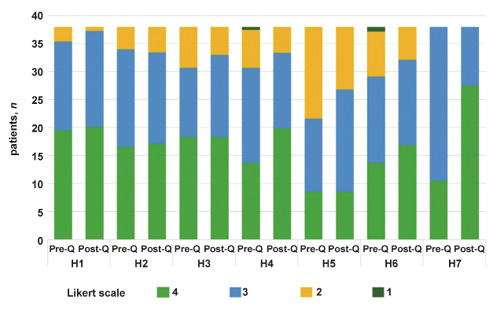
Table 2 presents the distribution of responses for each skill. Significant differences between the beginning and the end of the course were observed for the competency domains of Professional Skills (H1), Ability to Collect Clinical Information (H4), Ability to Diagnose and Treat (H5), Ability to Establish and Maintain Health (H6), and Health Promotion Skills (H7). Figure 1 illustrates the comparison of students’ perceived competency acquisition before (pre-Q) and after (post-Q) the COVID-19 lockdown. In most items, students’ satisfaction levels increased after lockdown.
Item-level analysis within each competency domain
Professional Skills
Table 3 shows the p-values obtained from the χ2 test for each questionnaire item within this competency domain. The global assessments obtained before and after the lockdown for questions 3 and 8 are identical. Significant changes were detected in the distribution of opinions for questions 1, 2, 4, 5, 6, and 7. Question 5 showed the greatest change, with 21 students assigning the highest score (4) in the pre-Q compared with only 6 students in the post-Q. The mean competency score was 3.44 ±0.62 in the initial questionnaire and 3.51 ±0.54 in the final questionnaire (p = 0.341).
Communication and Personal Skills
Statistically significant differences were observed for questions 10, 13 and 14. For questions 10 and 15, six and five students, respectively, reported lower scores in the post-Q than in the pre-Q. Thirty-three students assigned a score of 3 to question 12 at the end of the course (Table 3). The mean competency score remained unchanged, at 3.33 ±0.65 in the initial questionnaire and 3.33 ±0.68 in the final questionnaire.
Basic Knowledge, Information Management and Critical Thinking Skills
Statistically significant differences were observed for question 18 (Table 3). At the end of the course, 5 students assigned a score of 2 to question 16, whereas more than half of the students assigned the highest score (4) to question 18. The mean competency score increased slightly from 3.30 ±0.77 to 3.35 ±0.70, although this difference was not statistically significant (p = 0.696).
Ability to Collect Clinical Information
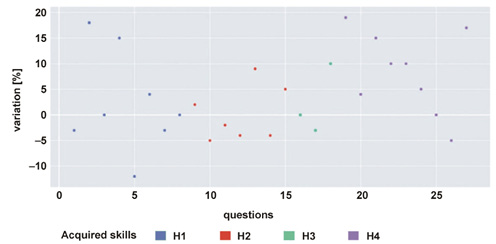
With the exception of question 25, significant differences between the pre-Q and post-Q were observed for all questions (Table 3). Question 25 showed an identical distribution of responses at both assessment time points. Question 19 received predominantly the highest rating (4) at the end of the course. In contrast, students’ ratings for question 26 declined compared with the baseline assessments. For item 27, although 5 students assigned the lowest possible score in the pre-Q, no student selected this rating in the post-Q. The changes in the perceived competency acquisition across competency domains H1–H4 before and after the lockdown are displayed in Figure 2. The mean competency score increased from 3.15 ±0.75 to 3.40 ±0.69, representing a statistically significant improvement (p = 0.008).
Ability to Diagnose and Treat
No statistically significant differences were detected for 2 questionnaire items (Table 4). For question 28, the students reported greater confidence at the end of the course. For question 29, the majority of the students assigned a score of 3 in the post-Q, whereas a score of 2 predominated in the pre-Q. The obtained responses improved significantly between the 2 time points. The mean scores for this ability increased from 2.78 ±0.78 to 2.93 ±0.72, reaching statistical significance (p = 0.048).
Ability to Establish and Maintain Health
Statistically significant differences were detected for most questionnaire items (Table 4). For skills with a p-value of 1.000, the distribution of responses was identical at both time points. However, the evaluations were more positive at the end of the course as a rule. The mean competency score increased from 3.10 ±0.81 to 3.29 ±0.72 (p < 0.05).
Health Promotion Skills
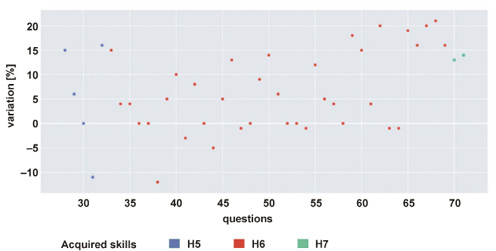
Significant differences were observed for both questionnaire items, with considerable improvement in students’ perceived competency acquisition between the pre-Q and post-Q. Figure 3 illustrates the changes in perceived competency acquisition for sections H5–H7 before and after the lockdown. The mean score increased from 3.28 ±0.45 to 3.72 ±0.40 (p < 0.05).
To illustrate in a didactic way the changes in students’ perceived competency acquisition before and after the COVID-19 lockdown, the percentage of students reporting changes in their perception was calculated. Figure 2 and Figure 3 present these changes for sections H1–H4 and H5–H7, respectively. Positive percentages indicate an improvement in the acquisition of skills whereas negative percentages indicate a decline in the perceived competency acquisition relative to students’ expectations. Each point in Figure 2 and Figure 3 represents the variation in perception for an individual questionnaire item and is color-coded accordingly.
Discussion
After analyzing the results, it was concluded that the education received by the students for the proposed competencies was acceptable but insufficient for the development of their future professional career. It is important to bear in mind the period during which the questionnaires were administered, from December 2019 to March 2020. During this time, the students had completed the first academic semester and had started the second semester. The skills in which a greater number of students showed deficiencies and, therefore, required more reinforcement were the Ability to Collect Clinical Information and the Ability to Establish and Maintain Health. When the students assessed their professionalism, it was observed that they felt quite capable in 4 out of the 8 competencies evaluated, with the highest confidence reported for respecting patients and colleagues regardless of gender, origin, socioeconomic status, language, or culture. However, they reported limited confidence in recognizing inappropriate conduct, taking appropriate action and support patients, when necessary. When assessing Communication and Personal Skills, their preparation was acceptable in 3 of the 7 competencies evaluated. They felt highly capable of establishing an adequate dentist–patient relationship required for effective dental care. Their preparation for working with other members of the professional team was also considered good. However, they reported little ability to share verbal or written information with patients and other professionals, including discussion skills, as well as to give and receive constructive criticism. When assessing their Basic Knowledge, Information Management and Critical Thinking Skills, the deficiencies were mainly related to the ability to evaluate scientific research and clinical studies and integrate this information to improve patient’s oral health. Regarding the Ability to Collect Clinical Information, the students felt capable only of identifying the patient’s chief complaint. However, their preparation for performing diagnostic procedures in oral pathology was, in some cases, perceived as inadequate. None of the students felt sufficiently prepared to diagnose and plan treatments, especially for patients with special needs. The highest-rated competency was the preparation of the clinical history.
Based on our results, it is evident that the collection of clinical information through an interview could be implemented online, but the information obtained through palpation of extraoral structures requires in-person contact, as do the different radiographic techniques required to establish an adequate diagnosis. There is no doubt that the interpretation of radiographic tests does not necessarily require the presence of the patient, and therefore all these activities could be implemented without the presence of the patient in the dental clinic. The students considered that they were quite capable of informing patients about relevant aspects of the pathologies they presented. The largest number of skills that can be acquired in the practicum is based on the establishment and maintenance of health. Of the 37 competencies that must be acquired, the students perceived that they had been adequately trained in 14 of them. These included preventive, cariogenic and periodontal aspects. Their main deficiencies were associated with pharmacological, surgical, prosthetic, orthodontic, and orthopedic therapies. The poor ability to diagnose temporomandibular disorders was noteworthy. The fact that none of the students felt sufficiently prepared to perform extractions of erupted teeth was surprising. Regarding the competencies based on health promotion, the future dentists considered themselves quite or adequately prepared (>90%). Individualized health education and counseling to improve and maintain patients’ oral health can be provided through the implemented technologies. In all cases where significant differences were detected, the improvement in the students’ assessments was positive, with no significant changes noted for communication and knowledge skills.
In Spain, Congosto et al.16 conducted a similar study to the present one. However, these authors evaluated the acquisition of student competencies in a non-pandemic setting, where clinical activities were not affected. They determined the students’ perception regarding the acquisition of skills at the end of their dental studies, classifying them into 5 groups: professional values; ethical attitudes and behaviors; scientific foundations; acquisition and critical assessment of information; clinical skills such as diagnosis, prognosis, treatment planning and dental therapy; and public health and healthcare systems. In this study, the students felt very competent in identifying patient concerns and expectations, and in communicating effectively and clearly, both verbally and in writing, with patients, relatives and other healthcare professionals. In our research, 45.11% of the students reported being highly trained in communication skills at the end of the academic year, which was similar to the percentage of students who felt qualified in this skill at the beginning of the study. In addition, according to these authors, the students felt very capable of sharing information with other professionals and working as a team. They obtained favorable scores for recognizing ergonomics principles, maintaining workplace safety, and planning and applying appropriate treatments according to the patient’s dental condition. In our case, a high percentage of the students felt that these skills had been acquired at an acceptable level. Congosto et al. detected competency deficits regarding knowledge of the scientific method and critical thinking16; however, most of our students reported an acceptable level of these skills.
The pandemic prevented students from attending the university clinic from the beginning of March, practically halving the face-to-face clinical training period. Hence, the professors focused on promoting, through online activities, skills that were not directly related to the development of specific manual abilities of the profession. Since it was impossible to simulate a clinical environment at the students’ homes or to perform activities requiring manual skills, professors had to adapt their teaching methods.
The complex organization of the course divided the students into groups of 20–25, facilitating virtual activities and personalized attention.
Different learning methodologies were applied to compensate for the lack of direct patient care, including classroom debates and online clinical situations. Reflection is a key component of professional skills, yet aspects of the healthcare professionals’ emotional sphere are left aside.15
In the Communication and Personal Skills domain, the students felt able to identify psychological and social components, share information with patients and other professionals, apply stress management principles with patients, and work as a team. It should be noted that these skills are developed throughout the 5-year degree program, so students may feel more confident in the competencies developed before the final year of the program. To acquire these skills, clinical cases were designed to allow students to develop an appropriate treatment plan and subsequently present it during virtual discussions. This activity was complemented with problem-based learning in larger groups, allowing students to discuss therapeutic options within a theoretical framework. As a future option, simulated interviews were proposed so that the student could assume the patient’s role to enrich the dentist–patient relationship and identify the patient’s needs and objectives. This tool would favor the integration of theoretical knowledge with clinical practice.17
Regarding Basic Knowledge, Information Management and Critical Thinking Skills, most students felt acceptably competent in assessing the validity of statements related to the advantages attributed to different instruments, products and techniques, as well as in evaluating scientific studies. A total of 12.5% felt insufficiently prepared to use current electronic communication and information technologies, a problem that, in a situation such as the COVID-19 pandemic, limits the possibilities for planning certain activities. It is essential to know how to use online resources and understand how to evaluate clinical studies and research related to health sciences, since professionals need to remain constantly updated. Even though this competency is developed transversally throughout the degree, it was one of the most complex for students to achieve. Small groups of students were assigned to perform bibliographic searches in scientific journals with a high impact factor and then to synthesize and discuss the collected information virtually.
The competency related to collecting clinical information has an important practical component, being essential for identifying the patient’s chief complaint, obtaining the history of the present illness, writing reports and referrals, making additional records, and informing the patient. Almost half of the students considered themselves unable to diagnose oral pathology, including performing biopsy. These deficiencies could not be corrected since the practical aspects of this competency were not addressed; therefore, they should be included in future training. Problem-based learning could be an effective methodology for facilitating the development of these skills in dentistry.18 The objective structured clinical examination (OSCE) as an educational tool could also help overcome these skill deficiencies thanks to the active involvement of the student in virtual environments.19
Regarding the Ability to Diagnose and Treat, at the beginning of the pandemic the students had insufficient and/or acceptable knowledge. Diagnosing and planning treatment priorities for patients with special needs was a particular concern. To address this aspect, the educational system focused on the resolution of virtual clinical cases proposed by the professor and student working groups. Through the virtual campus, the seminars planned at the beginning of the academic year were maintained. To improve this competency, the implementation of clinical simulations involving different common scenarios in dentistry was assessed, as this has been reported to be a very favorable and effective educational tool according to some authors.16 Infographics and applications such as Kahoot!, Edpuzzle and Socrative were also implemented as highly engaging educational resources. The integration of mobile technology into the virtual classroom is an innovative teaching resource that could also enhance student communication and participation by generating scenarios that support the learning process.20 A reflective diary could contribute to the acquisition of diagnostic and treatment skills.21
Furthermore, within the Ability to Establish and Maintain Health domain, many deficiencies were identified, including the diagnosis of temporomandibular disorders, treatment planning, the design and application of adhesive restorations, crowns, bridges, and removable prostheses, as well as the design, placement and adjustment of space maintainers and active appliances for less complex treatments. In addition, the students reported a lack of confidence in managing orthodontic emergencies, performing simple surgical extractions of unerupted teeth and fractured or retained roots, or referring the patient when necessary. To address this problem, the initial plan was to develop videos with patients or phantoms, but this approach was replaced by practical online seminars, videoconferences and clinical case discussions through the educational platform. Methods based on solving problems associated with clinical images, such as the WebCT virtual platform,22 could have contributed to the acquisition of these skills. As a long-term strategy, the implementation of virtual reality could be considered, as it is an appropriate tool for acquiring clinical treatment skills while reducing risks and providing a safe environment for future professionals.23
The students did not feel highly competent in developing and implementing health programs and coordinating interinstitutional and interprofessional collaborations. This deficiency was addressed through collaborative work focused on developing individualized protocols based on scientific evidence for different population groups, such as adolescents, adults, older adults, or patients with special needs.
Due to the COVID-19 pandemic, it was necessary to modify the teaching and learning methodology used in clinical practice. Despite students’ positive assessment of online resources, partly because of the flexibility they offer and the accessibility of information from anywhere,24 the acquisition of some competencies proved complex. Information and communication technologies helped students acquire theoretical knowledge, but they contributed only marginally to the acquisition of practical skills. Therefore, new tools should be devised, such as the use of simulators to improve manual skills in exceptional situations such as the COVID-19 pandemic.25
However, one of the greatest technological limitations has been the information and communication skills of the faculty staff, which interfered with the achievement of some planned activities. Ethical and technical aspects related to the use of these tools continue to be challenging for professors and students.26 This experience should be used to provide more evidence regarding positive and unfavorable aspects that technology offers in education and to study the safety of the technological environment in universities. In a systematic review carried out by Naciri et al., the authors observed a lack of consensus among students regarding their perception, motivation and commitment to this type of education.27
Another important obstacle was the loss of direct contact with the students, who reported a great overload of work and information received by e-mail. The literature includes studies that analyze the impact of the COVID-19 pandemic on health, both orofacial28 and psychological.29, 30, 31 This loss of contact, possibly exacerbated by a lack of motivation and acceptance, could be responsible for the loss of students who were willing to participate in the second questionnaire, thus affecting the total sample size of the study. This inconvenience is consistent with the results reported by other authors, such as Kivlehan et al.32 and Singhi et al.33 who, despite initially recruiting larger samples, reported final sample sizes of only 30 subjects due to participant loss during data collection.
One aspect that was not taken into account, but which some authors have highlighted, was the influence of professors’ beliefs and knowledge on teaching strategies.34
This exceptional situation has led us to rethink our methodology for future situations in which face-to-face teaching or clinical practice with patients cannot be provided.
Mentoring could have been an additional strategy to improve the acquisition of skills and attitudes by giving students greater self-confidence, self-knowledge and the ability to establish priorities.35
One of the most important limitations of the present study is the small sample size. Considering that completion of the questionnaires was voluntary and that participation did not entail any economic or academic reward, the lack of participation of all enrolled students is understandable. To ensure the transparency of the reported results, a post hoc analysis for paired samples, taking into account the statistical test used, was carried out using the G*power software. The result indicated a small effect size (0.24) and statistical power of 30%. This has motivated the researchers to start new projects with larger sample sizes and methodologies designed to encourage student participation.
This research is pioneering in its field because the pandemic provided a unique opportunity to evaluate the students’ perception of their ability to acquire competencies necessary for future professional practice without traditional face-to-face clinical practice or advanced face-to-face simulation activities. We believe that the excellent results obtained under these circumstances could be due to the fact that these same students had previously completed fourth-year courses involving clinical practice with patients.
Based on the present research, it can be affirmed that patient management cannot be replaced entirely by online teaching, but online teaching can complement traditional teaching. Medical educators and students have also stated that they are in favor of the face-to-face modality and perceive online learning as appropriate for theoretical teaching and some clinically oriented activities, especially as a vehicle for the discussion of clinical cases.36 However, according to research in the field of health professions education, there is still no consensus, and researchers agree on the need for further research to overcome the current lack of studies that comprehensively address these issues during pandemic.26
It must be emphasized that the last phase of this study was not planned at the beginning of the investigation and was initiated in response to the pandemic.
Conclusions
Based on the perception of fifth-year students enrolled in the Dentistry degree, despite the challenges posed by the pandemic, they consider that by the end of the academic year they had acquired specific competencies related to professional skills, collection of clinical information, diagnosis, treatment, the establishment and maintenance of health, and health promotion. A general improvement in the students’ perception of competency acquisition between the 2 assessment time points was observed.
Future actions should focus on improving communication skills, personal skills, basic knowledge, information management, and critical thinking.
The global pandemic forced the methodologies of the Integrated Dental Clinic course to be modified, shifting from a fully practical and patient-oriented approach to a new online version, in which the student was the center of the learning process.
Taking into account the improvement observed in certain skills during the course of the program, it is obvious that, with the online technological resources implemented during the pandemic, learning is insufficient to provide patients with optimal dental care. However, we are prepared to replace some learning activities that have traditionally been performed in the presence of the patient, thereby contributing to environmental sustainability.
Ethics approval and consent to participate
The present study was reviewed and approved by the Ethics Committee of the Quality Office of the Complutense University of Madrid, Spain (code No. 375-2019). The study was conducted in accordance with the principles of the Declaration of Helsinki, the recommendations of the World Association of Medical Editors (WAME), the International Committee of Medical Journal Editors (ICMJE) guidelines for the reporting and elaboration of research, and the Spanish Organic Law 3/2018 of December 5 on the Protection of Personal Data and Guarantee of Digital Rights (LOPD).
Data availability
The datasets generated and/or analyzed during the current study are available from the corresponding author on reasonable request.
Consent for publication
Not applicable.
Use of AI and AI-assisted technologies
Not applicable.