



Abstract
Background. The impact of dentoskeletal malocclusion on the psychosocial status and oral health-related quality of life (OHRQoL), especially in adolescents, has been a subject of considerable debate in the literature.
Objectives. The aim of the study was to explore the relationship between the severity of dental and skeletal malocclusions and adolescents’ self-esteem, their perception of dentofacial aesthetics, and the psychosocial impact of dental aesthetics.
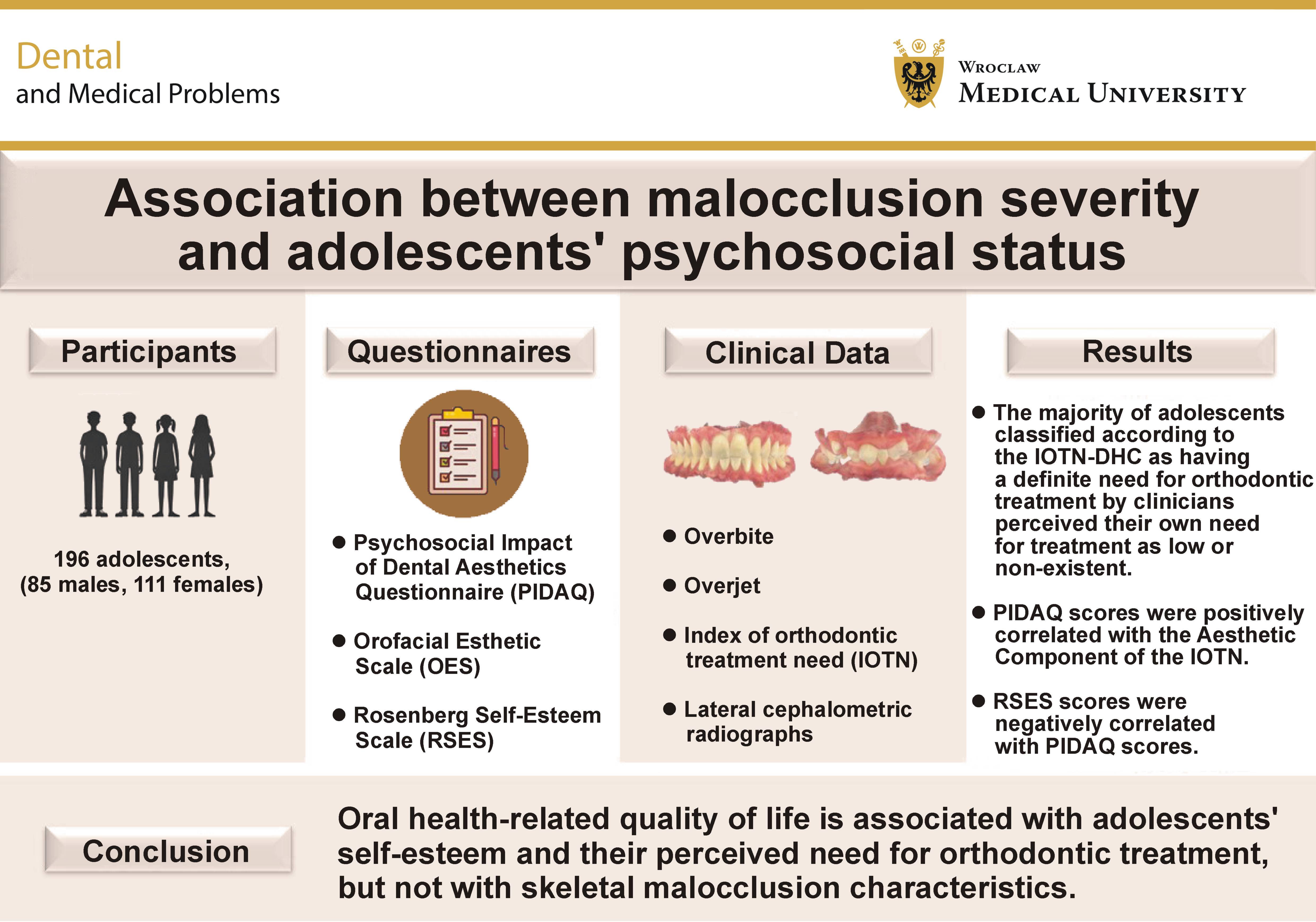
Material and methods. Adolescent patients (aged 10–18 years) seeking orthodontic treatment in a hospital clinic were recruited for the study. The Psychosocial Impact of Dental Aesthetics Questionnaire (PIDAQ), the Orofacial Esthetic Scale (OES), the Rosenberg Self-Esteem Scale (RSES), and the Aesthetic Component of the index of orthodontic treatment need (IOTN-AC) were administered during the first consultation. Overbite (OVB), overjet (OVJ) and the Dental Health Component of the IOTN (IOTN-DHC) were measured by a trained operator on digital models. Lateral cephalometric radiographs were used to evaluate skeletal malocclusions in the sagittal and vertical planes. Comparisons between the groups were performed using analysis of variance (ANOVA), the Kruskal–Wallis test or the χ2 test. Correlations between variables were assessed using Pearson’s or Spearman’s correlation tests.
Results. The majority of adolescents classified according to the IOTN-DSC as having a definite need for orthodontic treatment by clinicians perceived their own need for treatment as low or non-existent. No statistically significant differences were found in the PIDAQ, OES and RSES scores among different IOTN-DHC subgroups. Overjet was associated with self-esteem, while OVB was correlated with dental self-confidence and overall assessment of orofacial aesthetics. Skeletal variables were not associated with the studied domains. The PIDAQ was significantly positively correlated with the IOTN-AC and negatively correlated with the RSES.
Conclusions. The perception of malocclusion severity differs between patients and clinicians, highlighting the need to consider patients’ values when defining orthodontic goals. Overjet and OVB are clinical variables that can influence the psychosocial domain in adolescents.
Keywords: self-esteem, malocclusion, oral health-related quality of life, psychosocial impact, orofacial aesthetics
Introduction
In modern society, an attractive physical appearance has a positive impact on social relationships. Individuals who are considered more physically attractive tend to have more opportunities for social interaction and acceptance, which has a positive effect on their social life, both in terms of friendships, romantic encounters and professional opportunities.1, 2 Physical appearance and an attractive smile play an important role in the lives of adolescentsand young adults.3, 4 Adolescence is characterized by alterations in personality, psychological adaptability, as well as physical changes throughout pubertal development.5 As a result, adolescents may base their self-perception on physical characteristics such as weight and facial features.
Given the pivotal role of the dentition in smile aesthetics, it is reasonable to expect that severe malocclusion can influence an adolescent’s psychosocial status. Krekmanova et al. reported that adolescents seek orthodontic treatment mostly to enhance their aesthetic appearance and social acceptance.6 The perceived emotional and social effects of dental appearance in adolescents are closely linked to the severity of malocclusion.7 However, a notable difference exists between the aesthetic perceptions of clinical experts and patients, which can become a significant issue.8 Therefore, when clinicians decide on the necessity of orthodontic treatment, they should take into account patients’ perceptions of malocclusion severity and its impact on emotional and social well-being.9 The evaluation of psychosocial well-being frequently employs quality of life (QoL) assessment tools. According to the World Health Organization (WHO), QoL is defined as “an individual’s perception of their position in life in the context of the culture and value systems in which they live and in relation to their goals, expectations, standards and concerns”.10 In the realm of oral health, QoL is commonly referred to as oral health-related quality of life (OHRQoL), representing the effect of oral health on a person’s overall QoL.11
Various studies have reported that severe malocclusions have a negative impact on OHRQoL.8, 12 In particular, Dimberg et al. suggested that malocclusions in the aesthetic zone can have a negative impact on OHRQoL in children and adolescents, particularly on their emotional and social well-being.13 Previous literature has shown that the greater the deviation from average overjet (OVJ)14, 15 and overbite (OVB)15 values, the lower the OHRQoL perceived by adolescent patients. Moreover, perceptions of individuals with certain dental anomalies, such as a midline diastema and a gummy smile, change significantly before and after orthodontic treatment.16 In addition to dental malocclusions, skeletal malocclusions also significantly influence OHRQoL. In a pilot study conducted by Pereira et al., significant differences were found in the psychological discomfort domain of OHRQoL depending on the severity of skeletal malocclusion.17 Individuals with hyperdivergent facial types tend to report lower OHRQoL compared to those with normodivergent facial types, particularly in aspects related to social interactions.18 However, according to a recent systematic review, there is limited evidence that malocclusions in adolescents negatively affect their OHRQoL.19 Similarly, Kolawole and Ayodele-Oja found that malocclusion severity did not affect OHRQoL.20
Additionally, it has been reported that the severity of malocclusion moderately influences dental aesthetics-related OHRQoL, which indicates that malocclusion may not be the only determining factor in an individual’s perception of dental aesthetics.12 Spilker emphasized the importance of psychological factors in the evaluation of QoL as a primary outcome.21 Specifically, self-esteem has a significant impact on OHRQoL in adolescents.22, 23
In a longitudinal study by Benson et al., it was reported that adolescents with higher self-esteem experience the negative effects of their malocclusion less frequently, and any subsequent improvement in OHRQoL is linked to an increase in self-esteem.24 Thus, adolescents with both severe malocclusion and low self-esteem tend to express higher levels of concern regarding their appearance.25, 26 Therefore, orthodontic treatment may play an important role in improving self-esteem.24 Nevertheless, research has also shown that improving facial or dental aesthetics does not necessarily lead to higher self-esteem.26, 27
The present study aims to bridge the gap in understanding the nuanced relationships between orthodontic treatment needs and their psychosocial impact, specifically targeting self-esteem, self-perception of dentofacial aesthetics and OHRQoL among adolescents in relation to the severity of malocclusion.
Material and methods
The University of Naples Federico II Institutional Research Committee’s ethical standards, as well as the 1964 Declaration of Helsinki and its later amendments, were followed in all procedures involving human participants in this study. The study was approved by the Ethics Committee of University of Naples Federico II, Italy (protocol No. 146/2023).
The study was conducted on a sample of consecutive patients recruited from individuals who attended the Section of Orthodontics of the University of Naples Federico II for the first consultation between September 2022 and June 2023. The inclusion criteria were as follows: healthy individuals aged between 10 and 18 years; ability to correctly understand the questionnaires; and willingness of the patients and their parents to participate in the study. Patients undergoing orthodontic treatment or those with a history of previous orthodontic treatment, maxillofacial surgery and facial trauma, as well as individuals with genetic syndromes, craniofacial alterations and neurological diseases were excluded.
Data collection
Three questionnaires were administered to all patients who met the inclusion criteria using an online form before they were seated in the dental chair.
The Psychosocial Impact of Dental Aesthetics Questionnaire (PIDAQ) contains 23 questions distributed across 4 domains: Dental Self-Confidence (DSC) (6 items); Social impact (SI) (8 items); Psychological Impact (PI) (6 items); and Aesthetic Concern (AC) (3 items).28 For this study, the Italian version of the PIDAQ was used, adapted for adolescents and composed of 23 items distributed across 3 domains: AC (4 items); Psychosocial Impact (PSI) (13 items); and DSC (6 items).29 The total score of the questionnaire is calculated by summing the scores for all items, measured on a Likert scale from 0 to 4, as follows: 0 – “not at all”; 1 – “a little”; 2 – “moderate”; 3 – “severe”; and 4 – “very severe”. All items in the DSC domain that were formulated positively were scored inversely, bringing the direction of the score in line with the other subscales to facilitate the interpretation of the results and allow the total score to be calculated.28
The Orofacial Esthetic Scale (OES) is composed of 8 items, of which the first seven refer to the appearance of the face, mouth, teeth, and potential prosthetic replacements, and the 8th is an element of global evaluation. An 11-point numerical scale is used for each item (from 0 – “very dissatisfied” to 10 – “very satisfied”). The first seven items are combined into a summary score ranging from 0 to 70, while the 8th item provides an overall response regarding the patient’s global assessment of orofacial aesthetics and is not included in the total score.30 The translated and validated Italian version of the OES was used in this study.31
The Rosenberg Self-Esteem Scale (RSES) is a 10-item instrument designed to measure an individual’s perception of self-esteem. The questionnaire comprises 5 positively worded items and 5 negatively worded items.32 The Likert response scale ranges from 1 to 4 (1 – “strongly disagree”; 2 – “disagree”; 3 – “agree”; and 4 – “strongly agree”). The scoring is reversed for negatively worded items. The total score ranges from 10 to 40 points, and the sum of the scores provides an estimation of self-esteem. Scores below 15 suggest low self-esteem, those ranging between 15 and 25 indicate moderate self-esteem, and scores above 26 suggest high self-esteem. The translated and validated Italian version of the RSES was used in this study.33
A comprehensive medical and dental history, functional assessment, extraoral and intraoral photographs, an orthopantomogram, lateral cephalometric radiographs, and digital impressions were all part of the standardized first orthodontic visit. The collected clinical data was used to evaluate OVB, OVJ and the need for orthodontic treatment. The measurement of OVB and OVJ was conducted directly by 2 trained dentists on digital models. Overjet and OVB were categorized into 3 distinct groups: reduced; normal; and increased. The normal range for both OVJ and OVB was defined as 1–3 mm. The need for orthodontic treatment was evaluated using the index of orthodontic treatment need (IOTN).34 The IOTN has 2 separate components that are recorded independently: the Dental Health Component (DHC); and the Aesthetic Component (AC). The IOTN-DHC assesses the orthodontic treatment need in 5 categories, ranging from 1 (treatment is not necessary) to 5 (high treatment need), and taking into account multiple components of occlusion. The IOTN-AC evaluates the patient’s subjective dental situation using a series of intraoral photographs numbered from 1 to 10, which are shown to the patient. The patient is then asked to select the photograph that best reflects their smile. In order to facilitate comparison between self-perceived and objective malocclusion severity, the sample was divided into 3 groups according to orthodontic treatment need: no need/little need (IOTN-DHC 1–2/ IOTN-AC 1–4); moderate need (IOTN-DHC 3/IOTN-AC 5–7); and definite need (IOTN-DHC 4–5/ IOTN-AC 8–10).
The study also included a variety of orthodontic parameters obtained from cephalometric analysis, which assessed the anteroposterior and vertical relationships of the maxilla and mandible with the cranial base and with each other. The following parameters were measured: the sella–nasion–A point angle (SNA) (normal value: 82° ±3.5°); the sella–nasion–pogonion angle (SNPg) (normal value: 80° ±3.5°); the A point–nasion–pogonion angle (ANPg) (normal value: 2° ±2.5°); the angle between the sella–nasion plane and the anterior nasal spine–posterior nasal spine plane (SN/ANSPNS) (normal value: 8° ±3°); the angle between the sella–nasion plane and the gonion–gnathion mandibular plane (SN/GoGn) (normal value: 33° ±2.5°); and the angle between the palatal plane and the mandibular plane (ANSPNS/GoGn) (normal value: 25° ±6°). These parameters were selected because they comprehensively describe anteroposterior discrepancies (SNA, SNPg, ANPg) and vertical growth tendencies (SN/ANSPNS, SN/GoGn, ANSPNS/GoGn), both of which influence facial aesthetics and, consequently, self-perception. The parameters were divided into 3 categories, namely increased, normal and reduced. A description of these parameters and the classification of the subgroups are provided in the Supplementary Material (Supplementary Table 1 (available on request from the corresponding author)).
Statistical analysis
Categorical variables were reported as frequencies and percentages, whereas continuous variables were presented as means (M) and standard deviations (SDs) when normally distributed or as medians (Mes) and interquartile ranges (IQRs) when the data showed a skewed distribution. The Shapiro–Wilk test was used to assess normality.
The analysis of continuous variables and comparisons between groups (more than 2 for categorical variables) were performed using analysis of variance (ANOVA) or the Kruskal–Wallis test, depending on whether the continuous variable followed a normal or non-normal distribution. When comparisons were made between categorical variables, the χ2 test was used.
Correlations between continuous variables were assessed by calculating Pearson’s r or Spearman’s rho, depending on whether both variables were symmetrical or whether at least 1 variable was asymmetrical. Scatter plots were used to present the data graphically.
The association between a specific continuous variable (dependent variable) and the results of a psychological questionnaire was evaluated using univariable and multivariable linear regression models. Beta coefficients and 95% confidence intervals (CIs) were calculated for all models.
A p-value <0.05 was considered statistically significant. All analyses were performed using Stata 18 (StataCorp LLC, College Station, USA).
Results
The study included a total of 196 adolescents, comprising 85 males and 111 females. The mean age of the participants was 13.01 ±2.39 years. The values for the questionnaires used in the study, expressed as Me (IQR), were as follows: PIDAQ-DSC – 18.0 (13.0, 22.0); PIDAQ-PSI – 13.0 (6.0, 24.0); PIDAQ-AC – 6.0 (3.0, 8.0); PIDAQ total – 37.0 (24.5, 52.0); the Global Self-Assessment item of the OES – 6.0 (5.0, 8.0); OES total – 41.0 (31.0, 48.0). The M ±SD value for the RSES was 29.8 ±5.2.
The descriptive statistics of the orthodontic parameters and IOTN scores are shown in Table 1 and Table 2. More than half of the adolescent patients (58.2%) were classified as having a definite need for orthodontic treatment according to the clinician’s objective IOTN-DHC evaluation. However, the majority of these patients (64.3%) rated their own need for orthodontic treatment as non-existent of low according to the subjective IOTN-AC assessment. Most adolescent patients exhibited normal values of SNA (63.8%), SNPg (60.2%), ANPg (59.2%), SN/ANSPNS (68.9%), and ANSPNS/GoGn (76.5%). However, for SN/GoGn, the number of patients with decreased (33.7%), normal (36.7%) and increased (29.6%) values was nearly equal. Additionally, a substantial proportion of the adolescent patients exhibited increased OVJ (50.5%) and OVB (42.3%) values.
The results of the PIDAQ, OES and RSES in relation to the IOTN-DHC groups are presented in Table 3. No statistically significant differences were found between the IOTN-AC groups and the subdomains of the PIDAQ, OES and RSES, with respect to the IOTN-DHC groups. The overall and subdomain median scores of the PIDAQ and OES, as well as the mean RSES scores, showed minimal variation across the different IOTN-DHC subgroups.
Table 4 presents the results for the IOTN-AC subgroups, PIDAQ and OES subdomains, and RSES according to the subgroups of OVJ, OVB, and skeletal malocclusion.
There was a statistically significant difference between the RSES and OVJ (p = 0.042), with RSES scores increasing as OVJ values increased. Additionally, significant differences were identified between the OVB subgroups with respect to the PIDAQ-DSC (p = 0.040) and the Global Self-Assessment item of the OES (p = 0.028). The PIDAQ-DSC scores decreased with increasing OVJ values, whereas the Global Self-Assessment scores of the OES were lower in the normal OVJ group and higher in the increased OVJ group compared to the decreased OVJ group. Furthermore, a statistically significant difference was observed between the IOTN-AC subgroups and SN/ANSPNS. No statistically significant differences were identified between the orthodontic parameters SNA, ANPg, SNPg, SN/GoGn and ANSPNS/GoGn and the IOTN-AC subgroups, PIDAQ and OES subdomain and total scores, or RSES total scores.
The correlations between the subdomains and the total scores of the PIDAQ, OES, RSES, and IOTN-AC are shown in Table 5. All PIDAQ subdomain scores and the total PIDAQ score were positively correlated with the overall IOTN-AC scores, with correlation coefficients ranging from 0.149 to 0.313, and all correlations being statistically significant. A weak negative correlation was observed between the OES total score and the IOTN-AC, PIDAQ-DSC, PIDAQ-PSI, PIDAQ-AC, and total PIDAQ scores. However, no statistically significant differences were detected. The total RSES score demonstrated a negative correlation with all PIDAQ subdomain scores and the total PIDAQ score (p < 0.001). Additionally, a negative correlation was observed between the total RSES score and the IOTN-AC, although this association did not reach statistical significance. Furthermore, a positive but not statistically significant correlation was identified between the OES and the RSES. The scatter plot illustrating these correlations can be found in the Supplementary Materials (Supplementary Fig. 1).
A regression analysis was conducted to investigate whether the relationship between the total scores of the PIDAQ and IOTN-DHC was influenced by the RSES. The univariate model showed that there was no association between the IOTN-DHC and PIDAQ (no/little need vs. moderate need B = 0.13, 95% CI: −0.56–0.83, p = 0.789; no/little need vs. definite need B = 0.32, 95% CI: −0.29–0.94, p = 0.312). The multivariable model revealed that the RSES did not influence the relationship between the PIDAQ and IOTN-DHC (no/little need vs. moderate need B = 0.031, 95% CI: −0.548–0.611, p = 0.915; no/little need vs. definite need B = 0.205, 95% CI: −0.311–0.721, p = 0.434). These results suggest that the RSES did not have a significant influence on the relationships between these variables.
Discussion
The objective of this study was to investigate the intricate relationship between malocclusion severity and adolescents’ self-perception of dentofacial aesthetics, OHRQoL and self-esteem. In this study, adolescents exhibited a lower perceived need for orthodontic treatment compared with the objective assessment of clinicians. Additionally, a significant correlation was identified between the psychosocial impact of dental aesthetics on OHRQoL and subjective orthodontic treatment need, as well as self-esteem.
Among the instruments used in this study, the PIDAQ and RSES are reliable tools that have been successfully used in previous studies involving adolescents.29, 35 Although the OES was developed for adult patients,30, 31 the authors did not consider it necessary to adapt it for adolescents, as it consists of very simple and easily understandable questions. Self-perceived and normative orthodontic treatment need were evaluated using the IOTN-AC and IOTN-DHC, respectively, considering that IOTN is a widely used and validated index.36, 37
A significant proportion of adolescents classified by clinicians as having a definite need for orthodontic treatment according to the IOTN-DHC perceived their own need for treatment as low or non-existent based on the IOTN-AC. This discrepancy is noteworthy, especially considering that many healthcare systems base patient selection criteria on the IOTN-DHC, which may not accurately reflect adolescents’ perceptions of their orthodontic treatment needs. Furthermore, it emphasizes the significance of incorporating patients’ subjective evaluations into orthodontic treatment planning in addition to objective assessments. Similar to our findings, Chauhan et al. identified a statistically significant difference between the definite-need categories of the IOTN-DHC and IOTN-AC, with adolescents being less critical in their aesthetic evaluations.38 Conversely, Borzabadi-Farahani and Borzabadi-Farahani observed a moderate degree of agreement between normative and subjective orthodontic treatment needs, as determined by the IOTN components.39 The reason for this discrepancy may be that the IOTN-DHC evaluates specific occlusal traits, such as ectopic teeth, hypodontia, deep traumatic bites, or cross-bites, all of which have implications for dental health. However, these conditions do not necessarily correspond to high aesthetic concern. Therefore, IOTN-DHC encompasses a series of parameters that may not be readily understood by patients, particularly adolescents, resulting in these components being assigned less importance. The IOTN-AC evaluates the aesthetic aspects of malocclusion using a two-dimensional frontal view, thereby underscoring its subjective nature.39 In fact, the reliability of the IOTN-AC remains a matter of debate in the literature.40, 41, 42 In contrast to our findings, dos Santos et al. reported that children who self-declared a need for orthodontic treatment (IOTN-AC) were likewise diagnosed using the normative criterion (IOTN-DHC).43
Given the monocentric nature of this study, cultural and societal norms may play a crucial role in shaping self-perception and assessments of orthodontic treatment need. A study by Burden highlighted that an individual’s decision to undergo orthodontic treatment is influenced more by their peers’ familiarity with orthodontic appliances than by factors such as sex or socioeconomic status.44
Although the present study did not directly assess treatment adherence or uptake, the discrepancy between adolescents’ perceived and clinician-assessed orthodontic treatment need may affect their motivation and cooperation. Addressing this communication gap is crucial, as effective clinician engagement and clear discussions of treatment objectives may enhance adherence. Moreover, studies have demonstrated that tailored communication strategies play a key role in improving patient compliance.45, 46
These findings may also explain the absence of significant differences in self-esteem, the psychological impact of dental aesthetics and self-perceived orofacial aesthetics in relation to normative orthodontic treatment need. Since adolescents’ perceived orthodontic treatment need appears to be lower than their normative orthodontic need, objective treatment need may not negatively affect these psychosocial outcomes. Consistent with our findings, Gavric et al. reported only modest correlations between the IOTN-DHC and PIDAQ scores.12 Their results indicated that subjective perceptions of orthodontic treatment need exert a greater influence on OHRQoL than objective orthodontic treatment need.12 However, these outcomes contrast with those of Bellot-Arcís et al., who reported a significant linear association between PIDAQ scores and the grades of both IOTN components among Spanish adolescents.47 The relationship between self-esteem and normative orthodontic treatment need remains controversial. Similar to our findings, Akpasa et al. did not report any significant associations between self-esteem and normative orthodontic treatment need.48 However, other studies have identified a significant relationship between self-esteem and normative orthodontic treatment need.12
In line with the findings of Dallé et al.,49 there was no relationship between skeletal malocclusion characteristics and OHRQoL in our study. Conversely, Pereira et al. reported that OHRQoL was significantly impacted by the severity of skeletal malocclusion.17 The lack of a significant correlation between the characteristics of skeletal malocclusion and OHRQoL in this study can be partially attributed to the predominance of normal skeletal cephalometric measurements among adolescent patients. Specifically, 63.8% of participants exhibited normal SNA values, 60.2% demonstrated normal SNPg values, 59.2% presented normal ANPg values, 68.9% had normal SN/ANSPNS values, and 76.5% presented normal ANSPNS/GoGn values. These figures suggest that the majority of the sample did not present with severe skeletal discrepancies, which are more likely to have a pronounced impact on facial aesthetics and psychosocial well-being.
This result may also be due to the reduced aesthetic impact of the facial profile when viewed from the front, which is the perspective from which people typically perceive themselves in daily life.50 A reduced OVB, indicative of an anterior open bite and more evident in the frontal view, may possibly account for the lower OHRQoL observed in patients with reduced OVB. However, Fabian et al. found a minimal impact of OVB variations on OHRQoL.14 Additionally, poorer self-esteem was observed in adolescents with reduced OVJ, which may indicate the presence of an inverse (negative) OVJ that can be more evident from the frontal view than a normal or increased OVJ.
The impact of OVJ and OVB on psychosocial well-being is also likely influenced by their high visibility in social interactions. Malocclusions affecting the anterior dentition are more noticeable and can influence self-perception, peer interactions and social acceptance, thereby affecting self-esteem and OHRQoL.14, 51 Additionally, individuals with severe deviations in OVJ or OVB may experience functional difficulties, such as speech alterations or difficulty biting,52 which may further contribute to psychological distress.
In line with previous research,24, 53 our findings showed that adolescents who perceived a greater need for orthodontic treatment also reported lower OHRQoL related to the psychosocial impact of dental aesthetics. Therefore, irrespective of the objective severity of malocclusion, an individual’s subjective assessment of their dental aesthetics may negative affect their OHRQoL.49 Furthermore, the current research demonstrated a relationship between the psychosocial impact of dental aesthetics on OHRQoL and self-esteem, with adolescents reporting poorer OHRQoL as their self-esteem decreased. This outcome is consistent with previous reports in the literature,22, 54, 55 and this relationship may be explained by the vital role of self-esteem in mediating the effects of psychological and physical conditions, as it can act as a protective factor against the adverse effects of various conditions.23, 56, 57 Therefore, high levels of self-esteem in adolescents may protect them from the negative effects of malocclusion on their OHRQoL.
One of the objectives of the study was to examine whether self-esteem moderates the association between normative orthodontic treatment need and OHRQoL. The results of previous studies are consistent with our finding, indicating that self-esteem does not exert a moderating effect on the relationship between OHRQoL and normative orthodontic treatment need.54, 58, 59 However, Herkrath et al. reported that self-esteem had a moderating influence on the association between OHRQoL and the severity of malocclusion in the aesthetic zone.59
Only a limited number of studies have used the OES in adolescent populations. A study by Kovacevic Pavicic et al. involving young adults reported no association between the PIDAQ and OES scores,60 which is consistent with the findings of this study. Further research is required to investigate the relationship between self-perceived orofacial appearance, normative and subjective orthodontic treatment need and self-esteem. Additionally, longitudinal studies assessing changes in self-esteem and OHRQoL before and after treatment would provide valuable insights.
As prior research has mainly evaluated the dental components of malocclusion, one of the strengths of the present study was the evaluation of the relationship between self-esteem, OHRQoL, and self-perception of malocclusion and dentofacial aesthetics with skeletal malocclusions using cephalometric parameters that assessed maxillary and mandibular position in both the sagittal and vertical planes.
A limitation of this study was the absence of an evaluation of the socioeconomic status of the patients, which could have influenced their awareness of their oral condition or the perceived need for orthodontic care. Furthermore, the study did not address potential sex differences in the perception of dental aesthetics, despite evidence suggesting that aesthetic concerns may vary between males and females.61, 62 It is recommended that future studies include socioeconomic status and sex as variables to provide a more comprehensive understanding of their impact on orthodontic treatment perceptions and outcomes.
Although the study included adolescents aged 10–18 years, the analysis did not divide participants into younger (10–13 years) and older (14–18 years) groups to investigate potential differences in psychosocial outcomes. This approach was chosen to maintain a sufficient sample size for statistical power. However, the authors acknowledge that differences between these age groups could provide valuable insights, as younger and older adolescents may face unique psychosocial challenges and self-esteem dynamics. To address this limitation, future research should consider stratifying participants by age group to better capture these distinctions and their clinical relevance.
As this was a monocentric study involving adolescents seeking orthodontic treatment, the results may not be representative of other geographic regions with different cultural and social backgrounds, and may not fully reflect perceptions of oral health in the general population. To reduce potential selection bias, future research should include more diverse samples comprising adolescents from various settings, including those who are not actively seeking orthodontic treatment.
Another limitation of the present study is the absence of a pilot study evaluating the applicability of the OES in an adolescent population. Although the questionnaire was originally developed for adults and no comprehension difficulties were reported by participants, the authors recommend that future research include a formal validation of the OES specifically for adolescent patients.
The findings of this study highlight the importance of clearly communicating treatment objectives to adolescent patients while offering alternative options to encourage their engagement throughout the treatment process. Shared decision-making may facilitate this process by actively involving patients and their families in treatment planning. Furthermore, the use of digital visual aids and patient-reported outcome measures may help align clinical recommendations with patients’ expectations and concerns.
Additionally, given that OVJ and OVB were identified as key clinical factors associated with the psychological impact of dental aesthetics, self-esteem and self-perceived orofacial aesthetics, an early intervention approach aimed at addressing these occlusal discrepancies may be beneficial in mitigating their psychosocial consequences.
Conclusions
The use of objective indices, such as the IOTN-DHC, to assess orthodontic treatment need does not correspond closely to adolescents’ self-perceived need for treatment. Therefore, before initiating orthodontic treatment, it is important to understand patients’ expectations and treatment objectives, as they may not always coincide with those of the orthodontist. Clinicians may employ shared decision-making approaches, including patient-reported outcome measures and digital visual aids, to help address this discrepancy.
Oral health-related quality of life is associated with adolescents’ self-esteem and their perceived need for orthodontic treatment, but not with skeletal malocclusion characteristics. Furthermore, addressing psychosocial factors during orthodontic consultations is particularly important in adolescents with significant OVJ or OVB deviations, as these malocclusion traits may substantially influence the psychological impact of dental aesthetics, self-esteem and self-perceived orofacial aesthetics.
Ethics approval and consent to participate
This study followed ethical standards and guidelines for research involving human participants, including the 1964 Helsinki Declaration and its later amendments. The research was approved by the Ethics Committee of the University of Naples Federico II, Italy (protocol No. 146/2023). Written informed consent was obtained from all study participants.
Data availability
The datasets generated and/or analyzed during the current study are available from the corresponding author on reasonable request.
Consent for publication
Not applicable.
Use of AI and AI-assisted technologies
Not applicable.