Abstract
Background. Periodontal health is increasingly recognized as an integral component of systemic homeostasis. However, whether its disruption contributes to the development of autoimmune diseases (ADs) remains unclear in prospective settings.
Objectives. The aim of this study was to prospectively evaluate the association between periodontal symptoms and the risk of ADs, with particular attention to immunometabolic pathways and shared disease clusters.
Material and methods. A total of 465,454 participants from the UK Biobank were included. Cox proportional hazards models were employed to evaluate the association between periodontal symptoms and the incidence of 20 ADs. Sensitivity and subgroup analyses were conducted to assess the robustness of the results. Mediation analyses explored the potential mediating roles of 6 immunometabolic biomarkers. To address inter-disease correlations and reduce multicollinearity, factor analysis was applied to identify latent clusters of ADs.
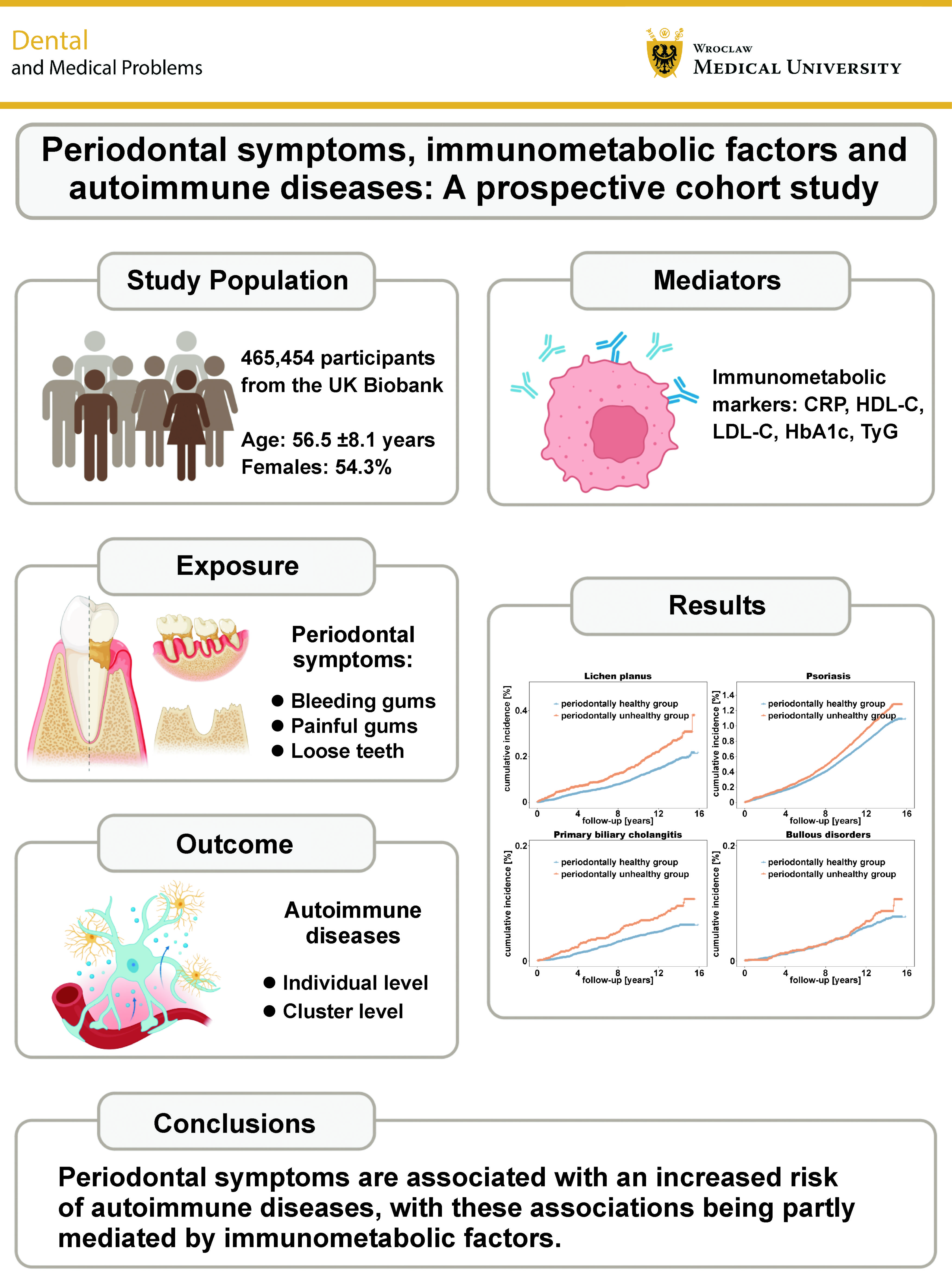
Results. During a median follow-up of 13.3 years, 33,895 participants developed at least 1 AD. Periodontal symptoms were linked to a higher risk of several ADs, with significant associations observed for bullous disorders, lichen planus, primary biliary cholangitis (PBC), and psoriasis. Mediation analyses revealed modest but statistically significant contributions of immunometabolic markers, particularly C-reactive protein (CRP). Factor analysis identified 3 AD clusters – autoantibody-mediated, autoimmune inflammatory and autoimmune metabolic diseases – all of which were significantly associated with poor periodontal health.
Conclusions. Periodontal symptoms were positively associated with multiple ADs and latent clusters, with these correlations being partly mediated by immunometabolic factors. The findings highlight the role of periodontal–systemic interactions in autoimmune pathogenesis.
Keywords: C-reactive protein, autoimmune disease, periodontal health, prospective cohort, periodontal symptoms
Introduction
Autoimmune diseases (ADs) comprise a heterogeneous group of immune-mediated disorders characterized by the loss of self-tolerance and progressive tissue damage.1 Affecting approx. 10% of the global population, ADs represent a growing public health concern due to their considerable morbidity, long-term functional impairment and escalating healthcare burden.2 Although the etiology of ADs is multifactorial, emerging evidence highlights the critical role of environmental exposures and immunometabolic disturbances in autoimmune pathogenesis.3 Low-grade systemic inflammation, aberrant immune activation and metabolic dysregulation collectively disrupt immune homeostasis and contribute to autoimmunity.4 However, the upstream drivers and modifiable risk factors underlying these mechanisms remain incompletely understood.
Periodontitis, ranked as the 6th most prevalent disease worldwide, is a chronic inflammatory condition triggered by oral microbiota dysbiosis and sustained by dysfunctional host immune responses.5 Numerous epidemiological studies have demonstrated associations between periodontitis and systemic conditions, including cardiovascular disease (CVD), cognitive impairment, cancer, and iodine deficiency.6, 7, 8, 9, 10 Increasingly recognized as a systemic condition rather than a localized oral pathology, periodontitis exerts far-reaching effects on immune regulation and metabolic balance.11 Through the oral–systemic axis, translocation of pathogenic microbes and persistent periodontal inflammation foster chronic immune activation, which may lead to insulin resistance, lipid abnormalities and impaired glucose regulation.12 These convergent disruptions define a state of immunometabolic dysregulation – a central pathway increasingly implicated in the development of various systemic diseases, including ADs.13
A growing body of epidemiological research has reported correlations between periodontal disease and an increased risk of ADs. Meta-analyses have reported that periodontitis is associated with both increased prevalence and higher incidence of ADs.14, 15 This link is thought to be driven, at least in part, by shared immunometabolic pathways: chronic periodontal inflammation may disturb systemic immune–metabolic equilibrium and promote autoreactive responses.16, 17 Moreover, the relationship appears to be bidirectional, as autoimmune activity may also exacerbate periodontal breakdown via overlapping inflammatory cascades.18, 19 Supporting this, clinical trials have demonstrated that periodontal therapy can reduce systemic inflammatory markers and disease activity in patients with ADs.20
Periodontal symptoms, often the primary reason for dental consultations, reflect not only local disease but also systemic health status, as they are associated with inflammation, nutritional status and cardiometabolic disorders.21, 22 Notably, these symptoms represent modifiable and controllable factors, making them promising targets for preventive strategies against ADs. However, most existing evidence is derived from cross-sectional studies, leaving causal relationships and underlying mechanisms insufficiently defined. To address this gap, we conducted a large-scale prospective cohort study to (1) evaluate the association between periodontal symptoms and incident ADs, (2) assess the potential mediating role of immunometabolic pathways, and (3) identify clusters of ADs associated with periodontal symptoms. These findings may enhance understanding of oral–systemic interactions and support the early identification and prevention of ADs.
Material and methods
Study design
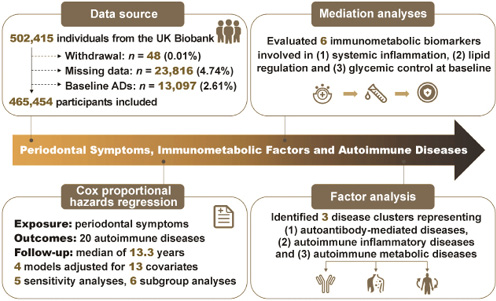
This study was based on the data obtained from the UK Biobank, a prospective cohort comprising over 500,000 participants aged 40–69 years who were recruited through the National Health Service (NHS).23 The UK Biobank received ethics approval from the North West Multi-centre Research Ethics Committee (approval No. 11/NW/0382), and written informed consent was obtained from all participants. The present analysis was conducted in accordance with the STROBE (Strengthening the Reporting of Observational Studies in Epidemiology) guidelines.24 Of the 502,415 participants enrolled in the UK Biobank, individuals who had withdrawn consent (n = 48), had missing data (n = 23,816) or had been diagnosed with an AD prior to baseline (n = 13,097) were excluded, resulting in a final analytical sample of 465,454 participants. Primarily, the association between periodontal symptoms and the incidence of 20 ADs was examined. Subgroup and sensitivity analyses were performed to evaluate the robustness of the results. For ADs with significant associations, the potential mediating roles of 6 representative immunometabolic biomarkers were further investigated. Finally, factor analysis was applied to identify latent clusters within the AD spectrum (Figure 1).
Assessment of periodontal symptoms
Baseline periodontal symptoms were defined using self-reported oral symptoms collected through a touchscreen questionnaire administered during the initial assessment visit. Participants were asked the following question: “Do you have any of the following? (select all that apply)”, with response options including “bleeding gums”, “painful gums” and “loose teeth”. These patient-reported outcomes are widely used in epidemiological research and are considered clinically meaningful proxies for periodontal health.25, 26, 27 Hospital-diagnosed periodontal disease, defined as a recorded diagnosis of gingivitis or periodontitis at study entry based on the International Classification of Diseases, Ninth or Tenth Revision (ICD-9/10) codes, was used as a supplementary measure. As the UK Biobank does not collect direct clinical measures of periodontal status (e.g., clinical attachment loss or pocket depth), the dual-source definition of both self-reported and clinically diagnosed data may help minimize misclassification and strengthen the validity of periodontal health assessment (Table S1 (available on request from the corresponding author)).
Assessment of autoimmune diseases
Autoimmune diseases were identified from the UK Biobank hospital records using the ICD-9/10 codes, with composite definitions applied to capture clinically relevant phenotypes (Table S2). Follow-up spanned from baseline until the first AD diagnosis, death, loss to follow-up, or the end of the follow-up period (April 2024), whichever occurred first. The present analysis included 20 conditions: ankylosing spondylitis; autoimmune hepatitis; autoimmune thyroiditis; bullous disorders; celiac disease; Crohn’s disease; immune thrombocytopenic purpura (ITP); lichen planus; multiple sclerosis; myasthenia gravis; myositis; primary biliary cholangitis (PBC); psoriasis; rheumatoid arthritis; rheumatic heart disease (RHD); sarcoidosis; sicca syndrome; systemic lupus erythematosus (SLE); type 1 diabetes; and ulcerative colitis.
Measurement of mediators
Baseline blood samples were processed for biochemical analysis to quantify 6 immunometabolic markers involved in inflammation, lipid metabolism and glucose regulation: C-reactive protein (CRP), an acute-phase marker of systemic inflammation; triglycerides and high-density lipoprotein cholesterol (HDL-C), representing opposing lipid effects on cardiometabolic risk; low-density lipoprotein cholesterol (LDL-C), an atherogenic lipid associated with inflammation and metabolic dysfunction; glycated hemoglobin (HbA1c), a marker of long-term glycemic control; and the triglyceride–glucose (TyG) index, a surrogate marker of insulin resistance integrating lipid and glucose metabolism (Table S3). These markers were chosen as potential mediators linking periodontal disease to autoimmune outcomes due to their established roles in modulating immune responses and disease progression through systemic inflammation, lipid regulation and glycemic control.28, 29, 30
Measurement of covariates
Baseline covariates included age, sex, ethnicity, body mass index (BMI), Townsend deprivation index (TDI), smoking status, alcohol consumption, physical activity, healthy diet score, and a history of CVD, diabetes, hypertension, and depression (Table S3). Body mass index was calculated as body weight in kilograms divided by height in meters square (kg/m2). The TDI was used as an area-level indicator of socioeconomic status, with higher values indicating greater socioeconomic deprivation. Smoking status, alcohol intake and physical activity were self-reported using baseline questionnaires. The healthy diet score was constructed according to dietary guidelines from the American Heart Association (AHA), with higher scores reflecting greater adherence to recommended dietary patterns.
Statistical analysis
The association between baseline periodontal symptoms and incident ADs was assessed using Cox proportional hazards regression models. Model 1 was the absolute risk model, while model 2 adjusted for demographic variables, including age, sex and ethnicity. Model 3 further adjusted for socioeconomic and lifestyle factors, including educational attainment, TDI, BMI, smoking status, alcohol intake, physical activity, and healthy diet score. Model 4 additionally adjusted for baseline comorbidities, including CVD, type 2 diabetes mellitus, hypertension, depression, cancer history, and medication use. Hazard ratios (HRs) and 95% confidence intervals (CIs) were calculated to estimate relative risk. Person-time was computed from baseline to the earliest occurrence of AD diagnosis, death, loss to follow-up, or the end of follow-up.
Sensitivity analyses excluded participants diagnosed with ADs within the first 2 years of follow-up, individuals of non-European ancestry, and those with comorbidities at baseline. To examine the influence of periodontal disease severity, bleeding gums were considered as a surrogate marker of mild disease, whereas loose teeth or painful gums served as surrogate markers of severe disease. Subgroup analyses were stratified by sex (male/female), age group (<50, 50–60, >60 years), physical activity (regular/irregular), smoking status (never, former, current), alcohol intake (never, former, current), and BMI category (underweight/normal: <25 kg/m2, overweight: 25–30 kg/m2, obese: >30 kg/m2).
Mediation effects were estimated using counterfactual-based models with 1,000 bootstrap resamples. The average causal mediation effect (ACME) quantified the indirect effect mediated by the variable, whereas the average direct effect (ADE) represented the remaining direct effect. The proportion mediated (Prop) indicated the share of the total effect explained by the mediator.
To address multicollinearity among ADs, factor analysis was performed using a tetrachoric correlation matrix. Sampling adequacy was assessed with Bartlett’s test of sphericity and the Kaiser–Meyer–Olkin (KMO) statistic. Latent factors were extracted via principal axis factoring, and the optimal number of factors was determined through parallel analysis and scree plot inspection. Clinically interpretable factor scores were converted into regression scores and analyzed as continuous outcomes in Cox proportional hazards regression models to capture underlying disease patterns.
All analyses were performed using R software (v. 4.4.3; R Foundation for Statistical Computing, Vienna, Austria). Two-sided p-values <0.05 adjusted for false discovery rate (FDR) were considered statistically significant.
Results
After excluding individuals with missing data (4.74%), a prior history of ADs (2.61%), and those who withdrew from the study (0.01%), 465,454 participants were included in this prospective cohort study. The mean age at baseline was 56.46 ±8.09 years; 54.3% of participants were female and 95.0% were of European ancestry. During a median follow-up of 13.3 years, 33,895 participants (7.3%) developed at least 1 AD of interest. Compared with those who remained free of ADs, affected individuals were older, had higher educational attainment, and were more likely to reside in socioeconomically deprived areas. In contrast, individuals without ADs exhibited a more favorable baseline health and lifestyle profiles, including lower rates of smoking, more frequent alcohol consumption, and greater engagement in regular physical activity. Notably, periodontal health at baseline was significantly better among participants who did not develop ADs (Table 1).
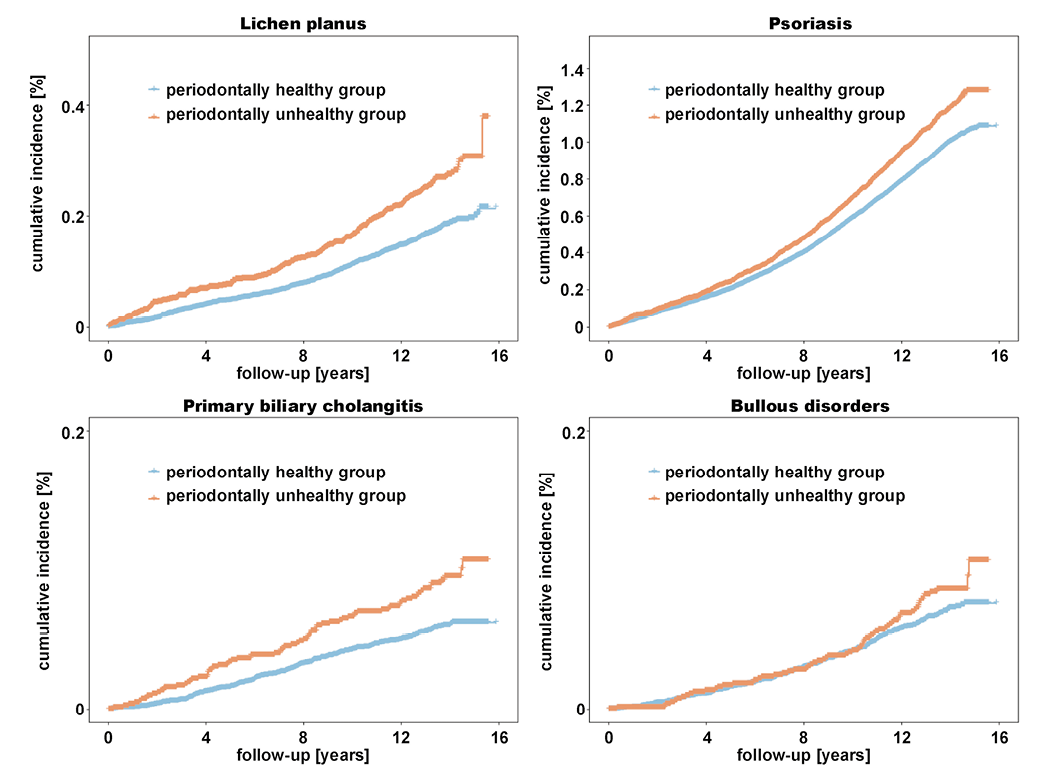
In absolute risk models, periodontal symptoms were associated with increased risks of 6 ADs, namely autoimmune thyroiditis, lichen planus, PBC, psoriasis, RHD, and sicca syndrome. After adjustment for demographic variables, significant associations were observed for 10 ADs: ankylosing spondylitis; bullous disorders; ITP; lichen planus; PBC; psoriasis; RHD; rheumatoid arthritis; sicca syndrome; and type 1 diabetes. Following further adjustment for socioeconomic and lifestyle factors, 6 associations remained statistically significant. Periodontal symptoms were associated with increased risks of bullous disorders (HR = 1.42, 95% CI: 1.08–1.86, pFDR = 0.022), ITP (HR = 1.27, 95% CI: 1.05–1.55, pFDR = 0.029), lichen planus (HR = 1.55, 95% CI: 1.33–1.81, pFDR < 0.001), PBC (HR = 1.51, 95% CI: 1.16–1.97, pFDR = 0.006), psoriasis (HR = 1.18, 95% CI: 1.10–1.27, pFDR < 0.001), and RHD (HR = 1.07, 95% CI: 1.01–1.13, pFDR = 0.026). After adjusting for baseline comorbidities, some associations were attenuated; however, 4 remained statistically significant: bullous disorders (HR = 1.40, 95% CI: 1.07–1.84, pFDR = 0.035); lichen planus (HR = 1.55, 95% CI: 1.32–1.81, pFDR < 0.001); PBC (HR = 1.50, 95% CI: 1.15–1.96, pFDR = 0.008); and psoriasis (HR = 1.17, 95% CI: 1.09–1.26, pFDR < 0.001), suggesting that these correlations were robust and largely independent of baseline health conditions (Table 2). The cumulative hazard remained consistently higher among participants with poor periodontal health than among those with healthy periodontal status. However, for bullous disorders, this difference became apparent only after 10 years of follow-up, indicating a delayed association (Figure 2).
Sensitivity analyses excluding participants of non-European ancestry (Table S4) and those diagnosed with ADs within the first 2 years of follow-up (Table S5) yielded similar findings. However, when analyses were restricted to individuals without baseline comorbidities (Table S6), only the correlation between periodontal symptoms and lichen planus remained statistically significant (HR = 1.60, 95% CI: 1.29–1.99, pFDR < 0.001). The association profiles of ADs differed according to periodontal disease severity. Bleeding gums were used as a proxy for mild disease, while loose teeth or painful gums were considered surrogate markers of severe disease. The former were primarily associated with bullous disorders, ITP, lichen planus, PBC, and psoriasis (Table S7), whereas the latter showed stronger associations with a broader spectrum of conditions, including ankylosing spondylitis, lichen planus, PBC, psoriasis, RHD, rheumatoid arthritis, sicca syndrome, SLE, and type 1 diabetes (Table S8).
Subgroup analyses indicated significant age-related heterogeneity, particularly for the associations between periodontal symptoms and PBC (p for heterogeneity = 0.004) and rheumatoid arthritis (p = 0.003) (Table S9), with attenuated effect estimates observed in older age groups. Stratified analyses also suggested potential modification by alcohol intake and smoking status, with associations largely absent among never or former drinkers and among current or former smokers. In contrast, no significant effect modification was observed according to sex, BMI or physical activity, which may be attributable to limited statistical power within these subgroups (Table S10–S15).
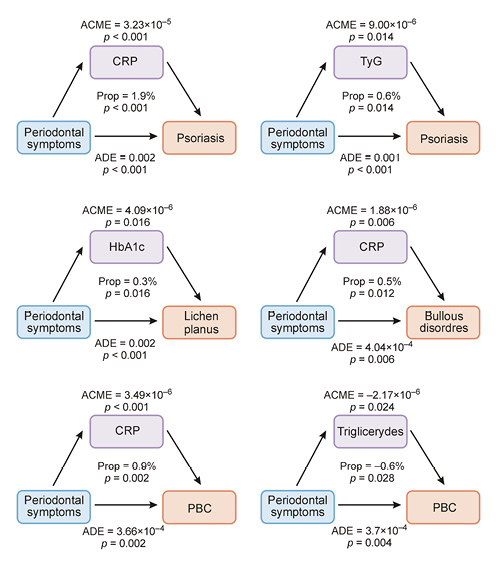
To explore potential mechanisms, we assessed the mediating roles of 6 immunometabolic markers – CRP, HbA1c, HDL-C, LDL-C, triglycerides, and TyG – in the 4 robust periodontal–autoimmune associations. Overall, these biomarkers explained up to 1.9% of the observed associations, indicating modest but statistically significant mediation (Table S16). C-reactive protein consistently exhibited broad mediating effects, contributing to the associations between periodontal symptoms and bullous disorders (ACME: 1.88 × 10⁻⁶, p = 0.006; Prop: 0.005, p = 0.012), PBC (ACME: 3.49 × 10⁻⁶, p < 0.001; Prop: 0.009, p = 0.002) and psoriasis (ACME: 3.23 × 10⁻⁵, p < 0.001; Prop: 0.019, p < 0.001). In addition, HbA1c significantly mediated the association between periodontal symptoms and lichen planus (ACME: 4.09 × 10⁻⁶, p = 0.016; Prop: 0.003, p = 0.016). Triglycerides mediated a small proportion of the association between periodontal symptoms and PBC (ACME: −2.17 × 10⁻⁶, p = 0.024; Prop: −0.006, p = 0.028), while TyG contributed to the association between periodontal symptoms and psoriasis (ACME: 9.00 × 10⁻⁶, p = 0.014; Prop: 0.006, p = 0.014) (Figure 3).
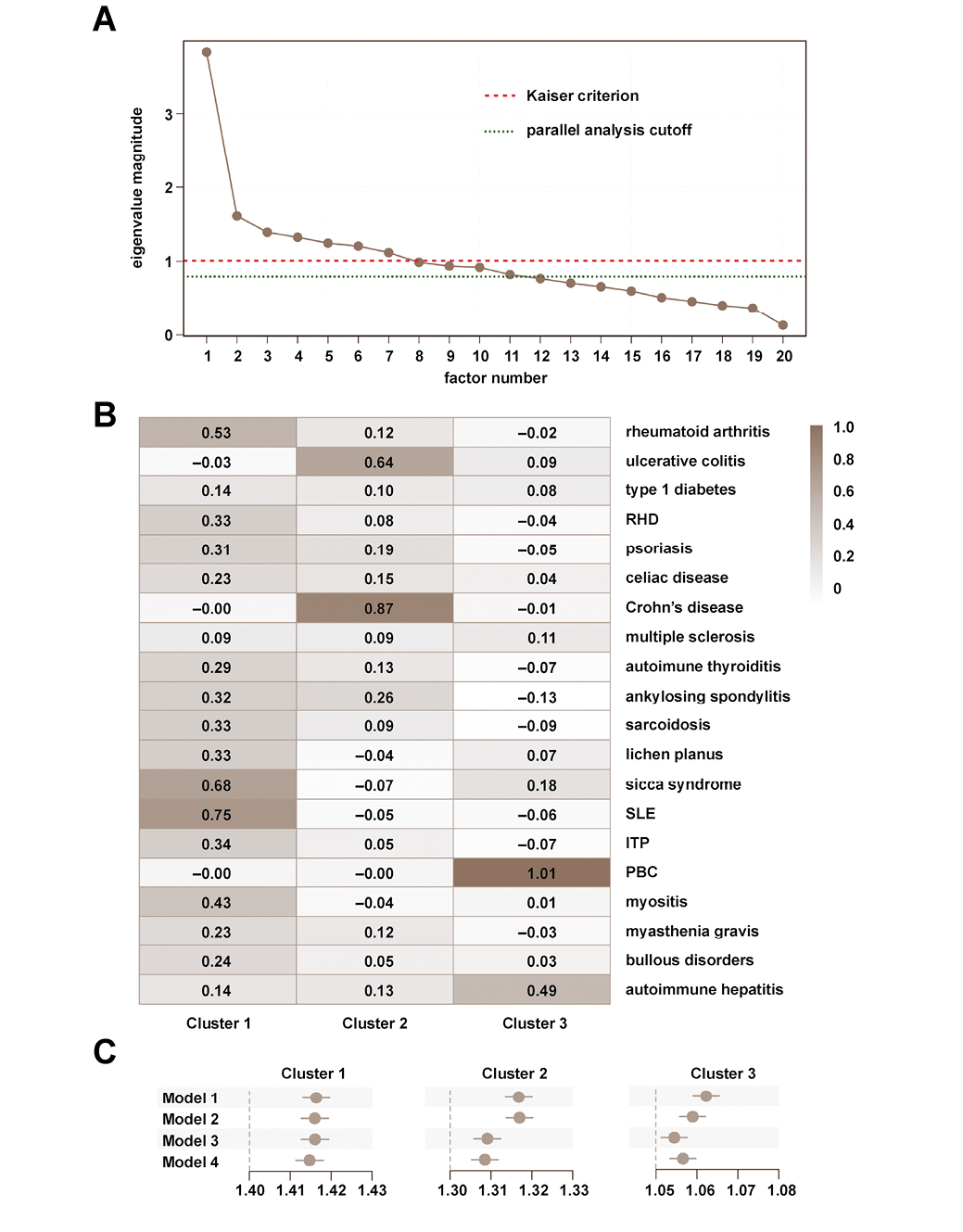
To address potential interactions and multicollinearity among ADs, factor analysis was performed for dimensionality reduction. Tetrachoric correlation matrices were computed to accommodate the binary nature of the outcomes. Bartlett’s test of sphericity (χ2 = 397.9, p < 0.001) and a KMO statistic of 0.57, although marginal, met the requirements for factor analysis. Parallel analysis and scree plot inspection supported a three-factor solution (Figure 4A), yielding clusters representing (1) autoantibody-mediated diseases (e.g., SLE, sicca syndrome, rheumatoid arthritis), (2) autoimmune inflammatory diseases (e.g., Crohn’s disease, ulcerative colitis) and (3) autoimmune metabolic diseases (e.g., PBC, autoimmune hepatitis) (Figure 4B). Poor periodontal health was significantly associated with all 3 clusters (Figure 4C). Sensitivity analyses using a two-factor model – primarily combining autoantibody-mediated and autoimmune inflammatory diseases – yielded comparable results (Fig. S1, Table S17). To enhance model stability, 4 diseases with KMO values <0.5 were excluded, increasing the overall KMO to 0.71. This refined analysis identified an additional cluster of autoimmune muscle disorders. Associations between periodontal symptoms and all identified clusters remained significant (Fig. S2,S3, Table S18).
Discussion
Building on our previous research employing multi-omic genetic analyses to identify gene-level associations between ADs and specific oral manifestations, this study further investigated the immune-mediated oral–systemic axis.31 In this large-scale prospective cohort study, we systematically evaluated the associations between periodontal symptoms and the incidence of 20 ADs among nearly half a million participants over a median follow-up of 13.3 years.
Our findings suggest a prospective association between poor periodontal health and an increased risk of several ADs. Although contemporary epidemiological research increasingly moves beyond a sole focus on statistical significance, 4 ADs – bullous disorders, lichen planus, PBC, and psoriasis – remained consistently and robustly associated with poor periodontal health across all adjusted models, warranting particular attention.32 Mediation analyses revealed modest but statistically significant contributions from immunometabolic markers, particularly CRP, indicating that systemic inflammation may partially mediate the relationship between periodontal symptoms and autoimmune pathogenesis. In addition, factor analysis was applied to reduce dimensionality and cluster diseases, revealing a detrimental association between poor periodontal health and ADs.
The association between periodontal health and psoriasis has received considerable attention in both preclinical and clinical research. A meta-analysis of 13 studies reported a pooled odds ratio (OR) of 2.87 (95% CI: 1.75–4.69), indicating a strong association between periodontitis and psoriasis; however, the observational nature of these studies limits causal interpretation.15 A recent randomized clinical trial further demonstrated that non-surgical periodontal therapy provided additional benefits beyond conventional dermatologic treatment in alleviating the severity of psoriasis.33 Experimental studies in murine models support these findings, showing that induced periodontitis can trigger and sustain psoriasiform inflammation through systemic immune pathways.34
In addition, we identified significant associations between periodontal symptoms and several less-studied ADs, including bullous disorders, lichen planus and PBC. A systematic review has linked poor periodontal health with oral pemphigus vulgaris and mucous membrane pemphigoid, with improvements observed following oral hygiene interventions.35 Similarly, a meta-analysis demonstrated that patients with oral lichen planus exhibited worse periodontal parameters.36 However, these studies have been constrained by small sample sizes, heterogeneity and cross-sectional designs. By validating these associations in a large prospective cohort, our study provides stronger evidence supporting the potential relevance of periodontal health in systemic autoimmunity.
Inflammation is widely recognized as a key biological pathway potentially linking periodontitis to systemic disorders. Epidemiological studies have consistently reported associations between periodontitis and conditions such as prostatitis and gastroesophageal reflux disease, with chronic inflammation thought to mediate these relationships.37, 38 Initiated by persistent microbial exposure and dysregulated host responses, periodontitis promotes the release of pro-inflammatory cytokines that contribute to both local tissue destruction and systemic inflammation.39, 40 C-reactive protein, a sensitive biomarker of systemic inflammation, has been consistently associated with both autoimmune and cardiometabolic diseases.41 Previous studies have shown that CRP levels are elevated in individuals with periodontitis and decrease following periodontal treatment.42, 43 A cross-sectional analysis further reported that the association between periodontitis and systemic diseases was amplified among individuals with elevated CRP levels.44 Our findings support a partial mediating role of CRP in the associations between poor periodontal health and selected ADs, offering new insight into inflammation-driven oral–systemic interactions.
Emerging evidence suggests that metabolic dysregulation may represent a pivotal intermediary in the cross talk between periodontal symptoms and ADs. Periodontitis has been associated with metabolic disturbances, including insulin resistance and dyslipidemia.45, 46 In a large population-based study, tooth loss correlated with elevated very-low-density lipoprotein (VLDL)-related lipid fractions and triglyceride levels.47 Similarly, a cross-sectional analysis reported a consistent association between the TyG index and periodontitis,48 while Boyapati et al. identified CRP, LDL-C and HDL-C as key metabolic biomarkers of periodontal disease.49 These metabolic abnormalities are not merely correlative but can actively reprogram immune responses by altering antigen presentation, impairing immune tolerance and fostering autoreactive phenotypes.50, 51 Moreover, among individuals with periodontitis, obesity has been associated with elevated serum leptin and decreased adiponectin levels.52 Collectively, these findings support an emerging immunometabolic paradigm in which markers such as HbA1c, triglycerides and the TyG index may partially mediate the relationship between adverse periodontal profiles and increased AD risk.
Although epidemiological associations between periodontal health and ADs have been increasingly recognized, our study offers several novel contributions. First, by leveraging the UK Biobank, a large population-based prospective cohort comprising nearly 500,000 participants, we evaluated prospective associations between periodontal symptoms and ADs, providing evidence that may strengthen causal inference. Second, by acknowledging interrelated mechanisms underlying multiple ADs, we applied factor analysis to identify disease clusters and evaluate their aggregate associations beyond the level of individual diseases. Finally, given the limited understanding of the underlying mechanisms, we performed preliminary analyses of immunometabolic pathways, highlighting the potential role of immunometabolic factors in autoimmune pathogenesis.
Limitations
Several limitations should be considered when interpreting the findings. First, since the UK Biobank does not include direct clinical assessments of periodontal status (e.g., probing depth, attachment loss), we relied on self-reported symptoms, which are widely used and informative in large-scale studies.25, 26, 27 Nevertheless, clinical dental examinations would provide greater diagnostic precision. Future studies should incorporate standardized periodontal assessments or interventional designs to strengthen causal inference and clinical applicability. Second, AD diagnoses relied on hospital ICD codes, a standard approach in epidemiological research; however, this method may fail to capture milder or undiagnosed cases that do not result in hospital-based care. Third, given the slow progression, shared genetic liability, complex pathophysiology, and frequent diagnostic delays characteristic of many ADs, reverse causality cannot be entirely excluded. Finally, although 6 representative immunometabolic biomarkers were included, they may not fully reflect the complexity of immune–metabolic interactions. The observed mediation effects were modest and should therefore be interpreted with caution, particularly in light of potential confounding from shared environmental or genetic factors.
Conclusions
Periodontal symptoms were positively associated with multiple ADs and their latent clusters, with particularly strong associations observed for bullous disorders, lichen planus, PBC, and psoriasis. These correlations were partly mediated by immunometabolic markers such as CRP, TyG, HbA1c, and triglycerides. Our findings suggest that periodontal health may represent a modifiable risk factor for ADs and underscore the importance of integrating oral health into broader public health strategies aimed at early prevention.
Ethics approval and consent to participate
The UK Biobank received ethics approval from the North West Multi-centre Research Ethics Committee (approval No. 11/NW/0382), and written informed consent was obtained from all participants.
Data availability
The original data can be obtained from the UK Biobank upon application (https://www.ukbiobank.ac.uk). The datasets supporting the findings of the current study, including supplementary materials, are available from the corresponding author on reasonable request.
Consent for publication
Not applicable.
Use of AI and AI-assisted technologies
Not applicable.