



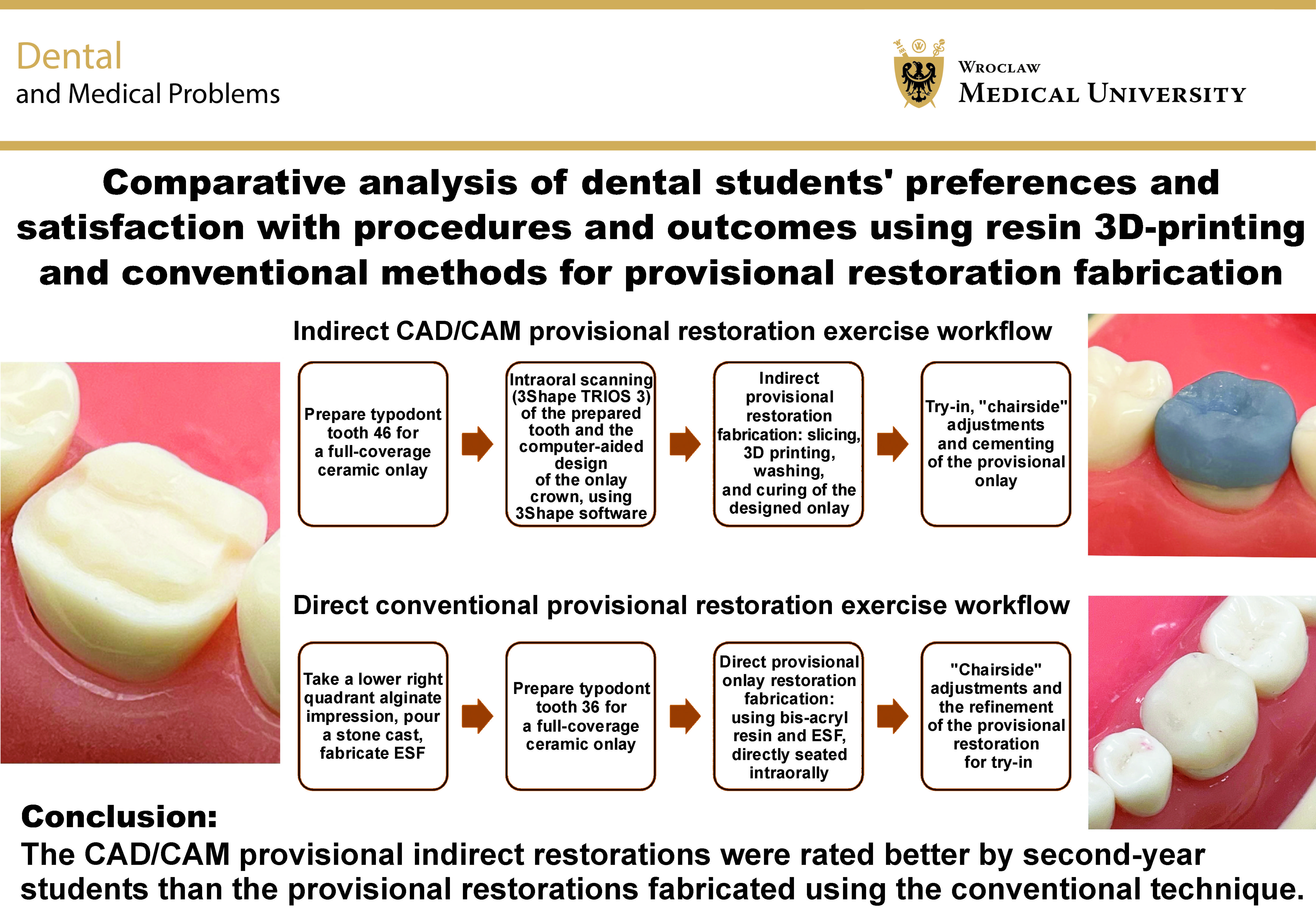
Abstract
Background. The integration of computer-aided design/computer-aided manufacturing (CAD/CAM) into dental curricula has enabled students to learn crown preparation using both CAD/CAM technology and the conventional methods, as well as to compare the accuracy of onlay designs and the overall quality of restorations.
Objectives. The aim of the present study was to investigate the impact of a comprehensive CAD/CAM exercise on second-year dental students’ perceptions of the digital workflow for provisional indirect restoration fabrication as compared to the conventional provisional restoration fabrication techniques.
Material and methods. The inclusion criteria comprised second-year dental students who completed both the practical activity and the survey. Students who did not complete either the practical activity or the survey were excluded. The exercise simulated a clinical scenario in a pre-clinical simulation laboratory, using a typodont model. Students prepared 2 first molar teeth for a non-metallic onlay restoration – tooth 36, using the conventional method, and tooth 46, using a three-dimensional (3D) printer. A seven-item questionnaire was developed to evaluate areas of interest, including technique preference, satisfaction with the fit of the restoration, its anatomy, interproximal contacts, the intaglio surface, occlusal adjustments, and the ease of polishing.
Results. A total of 125 students (52.74%) completed the proposed activity. Among the variables examined, only the interproximal contacts of the 3D-printed onlays demonstrated statistical significance (p = 0.0178). Significant differences between the conventional and 3D-printing methods were observed across several survey parameters, including preference, fit, anatomy, interproximal contacts (within each cohort), the intaglio surface, and occlusal aspects (p < 0.001).
Conclusions. The CAD/CAM provisional indirect restorations were rated better by second-year students than the provisional restorations fabricated using the conventional method.
Keywords: CAD/CAM, practice management, dental students, technology, digital dentistry
Introduction
Rehabilitation and esthetics are important parameters widely analyzed in contemporary dentistry.1, 2, 3 These factors, combined with technological advances, have increased the precision and acceptance of dental treatment.4, 5 The emergence of digital dentistry, including computer-aided design/computer-aided manufacturing (CAD/CAM) technology, reflects this evolution.6, 7 In this context, CAD/CAM composite restorative materials have become increasingly accessible for subtractive fabrication procedures.8
In modern dentistry, provisional indirect restorations play a crucial role in protecting the prepared teeth while maintaining function and esthetics during treatment. However, the conventional fabrication methods are often time-consuming and highly dependent on the operator’s skill. With the advent of three-dimensional (3D) printing, there has been a shift toward more efficient and precise restorative solutions. In parallel, the implementation of CAD/CAM technology in dental curricula has been increasingly reported across institutions, with studies demonstrating that many dental schools recognize the importance of incorporating this technology into their educational programs.4, 9, 10 A survey revealed that 76% of dental schools in the United States have integrated CAD/CAM into their preclinical courses, while 58% also provide clinical experience related to CAD/CAM restorations.11 This transition toward digital dentistry is essential, as it prepares students for the demands of contemporary dental practice, where CAD/CAM technology is increasingly adopted.10, 12
Despite the increasing presence and use of CAD/CAM technology, a notable gap remains in students’ knowledge and confidence regarding these systems. A national survey reported that many predoctoral dental students demonstrated limited understanding of CAD/CAM technology, restoration design, and the materials used in these procedures.7 This lack of familiarity is concerning, particularly because CAD/CAM systems play a central role in the fabrication of indirect restorations, which are among the most commonly performed dental restorations.13, 14 Furthermore, although students are exposed to CAD/CAM technology during training, their practical experience and proficiency with these systems vary considerably, emphasizing the need for more comprehensive instruction and hands-on practice.15, 16
Research has shown that students who engage with CAD/CAM technology tend to perform better indirect restoration preparations than those trained exclusively with the conventional methods.17, 18 The use of CAD/CAM improves the accuracy of restoration design and enhances the overall quality of restorations produced by students.19 In addition, this technology enables immediate feedback and assessment, which are important components of the learning process.18 As dental schools continue to adapt their curricula to incorporate CAD/CAM training, it is essential to address the educational gaps identified in students’ knowledge and skills to maximize the benefits of this technology.9, 10
Although previous studies have investigated the mechanical properties of 3D-printed and conventionally fabricated restorations, limited attention has been given to dental students’ perspectives regarding these techniques, particularly in relation to the ease of use, efficiency and clinical outcomes. Understanding students’ preferences and satisfaction is important for guiding future curricular development and improving clinical training. Therefore, the aim of this study was to investigate and compare the satisfaction and preferences of second-year dental students through a survey and practical activity involving provisional onlays fabricated using CAD/CAM and the conventional techniques. The hypothesis was that CAD/CAM exercises would positively influence students’ performance and perceptions.
Material and methods
This study was submitted to the Ethics Committee of The Ohio State University, Columbus, USA, received an exemption approval (No. 20220799), and was conducted in accordance with the Strengthening the Reporting of Observational Studies in Epidemiology (STROBE) guidelines. The second-year dental curriculum at the College of Dentistry includes fixed restorative and prosthodontic dentistry. During their preclinical education, students are introduced to digital impression acquisition (scanning) and computer-aided design (CAD), while computer-aided manufacturing (CAM) is currently being implemented into the curriculum. As part of efforts to enhance the educational program, a comprehensive CAD/CAM exercise was incorporated into the 4th course of the restorative curriculum for second-year dental students.
Sample selection and eligibility criteria
The study sample consisted of dental students enrolled in the 4th course of the restorative curriculum during 2022 and 2023. Participation was voluntary, and all second-year dental students enrolled in the operative dentistry course were eligible to participate. Students were required to complete the proposed activity and respond to the survey.
The inclusion criteria were enrollment as a second-year student at the College of Dentistry and the completion of both the activity and the survey. The exclusion criteria consisted of failure to complete either the activity or the survey.
Activity proposed
The exercise simulated a clinical scenario in a preclinical simulation laboratory, using a typodont mannequin. Dental students prepared 2 ivorine molar teeth for a non-metallic onlay restoration – tooth 36 (mandibular left first molar) and tooth 46 (mandibular right first molar) (Nissin Dental Products, Kyoto, Japan). The prepared teeth were mounted in the mannequin throughout the simulation.
A digital impression of tooth 46 was obtained using the TRIOS 3 intraoral scanner (3Shape, Copenhagen, Denmark). With the support of blended learning resources, tutorial videos and faculty guidance, students completed the CAD design of their onlays, using the 3Shape Design Studio software. The designed restorations were exported in the Standard Tessellation Language (STL) format and imported into the AnyCubic Workshop software (Anycubic Technology, Shenzhen, China) for slicing and 3D printing preparation. Using the Photon M2 DLP 3D printer (Anycubic), students fabricated individualized 3D-printed resin restorations corresponding to their prepared teeth. The restorations were subsequently processed and light-cured in a 3D-printing laboratory. The simulation concluded with students seating, adjusting (the occlusal, proximal and intaglio surfaces) and cementing the 3D-printed restorations with the use of the Temp-Bond™ NE provisional cement (KaVo Kerr, Brea, USA). The hands-on exercise was complemented by CAD/CAM lectures and a collaborative session with the College of Engineering, providing a multidisciplinary educational approach.
In the second part of the exercise, students fabricated a provisional onlay, using the direct technique with the Provisa® Plus bis-acryl material (Benco Dental, Pittston, USA), which was molded in an external surface form (ESF) fabricated from vacuum-formed polypropylene sheets over stone casts. This procedure was performed on the contralateral typodont tooth 36, which had been prepared using the same design as tooth 46. Students then polished, finished and adjusted the occlusion of the provisional restorations.
The consistency between both exercises allowed students to gain firsthand experience with both the conventional direct bis-acryl technique and the CAD/CAM workflow for the fabrication of indirect resin provisional restorations.
For both activities (3D-printed and resin provisional restorations), 6 parameters were evaluated: (1) crown fit; (2) anatomy; (3) interproximal contacts; (4) the intaglio surface, (5) occlusion; and (6) polishability. The evaluation criteria for all parameters were presented during the class activities to guide students toward achieving a standardized outcome.
Survey applied
This study aimed to investigate the impact of the proposed exercise on students’ perceptions of the digital workflow for provisional indirect restoration fabrication in comparison with the conventional techniques, given the importance of CAD/CAM dentistry in the predoctoral academic setting. To address these objectives, a survey was administered to the intervention group in both cohorts (second-year dental students) after the completion of the comprehensive CAD/CAM exercise to evaluate their perceptions of the quality of restorations obtained through the 2 workflows.4 The survey was anonymous and clearly stated that responses would not affect students’ academic evaluation or interfere with their educational experience.
Seven survey questions were designed to evaluate the areas of interest: the comparison of technique preference; satisfaction with the restoration fit; satisfaction with the restoration anatomy; satisfaction with interproximal adjustment; satisfaction with intaglio surface adjustment; satisfaction with occlusal adjustment; and satisfaction with restoration polishability. The responses were recorded using a Likert scale ranging from 1 (lowest) to 10 (highest). The questions were as follows:
– (Question 1A) Please rate your preference for the 3D-printed provisional indirect restoration fabrication technique;
– (Question 1B) Please rate your preference for the conventional resin provisional restoration fabrication technique (ESF + Provisa);
– (Question 2A) Please rate your satisfaction with the fit of the 3D-printed provisional indirect restoration;
– (Question 2B) Please rate your satisfaction with the fit of the conventional resin provisional restoration (ESF + Provisa);
– (Question 3A) Please rate your satisfaction with the anatomy of the 3D-printed provisional indirect restoration;
– (Question 3B) Please rate your satisfaction with the anatomy of the conventional resin provisional restoration (ESF + Provisa);
– (Question 4A) Please rate your satisfaction with the interproximal adjustment required for the 3D-printed provisional indirect restoration;
– (Question 4B) Please rate your satisfaction with the interproximal adjustment required for the conventional resin provisional restoration (ESF + Provisa);
– (Question 5A) Please rate your satisfaction with the intaglio surface adjustment required for the 3D-printed provisional indirect restoration;
– (Question 5B) Please rate your satisfaction with the intaglio surface adjustment required for the conventional resin provisional restoration (ESF + Provisa);
– (Question 6A) Please rate your satisfaction with the occlusal adjustment required for the 3D-printed provisional indirect restoration;
– (Question 6B) Please rate your satisfaction with the occlusal adjustment required for the conventional resin provisional restoration (ESF + Provisa);
– (Question 7A) Please rate your satisfaction with the polishability of the 3D-printed provisional indirect restoration; and
– (Question 7B) Please rate your satisfaction with the polishability of the conventional resin provisional restoration (ESF + Provisa).
All scores provided by the students were recorded. Two authors (LMN and GVOF) evaluated both the activities and the submitted responses during the post-intervention phase. The post-intervention assessment consisted of evaluating the provisional restorations fabricated after the demonstration and analyzing the responses obtained from the survey. The authors classified the responses according to their reliability using the following scale: 1 = unreliable or missing response; 2 = somewhat reliable; 3 = moderately reliable; and 4 = highly reliable response.
Cohort groups
The invitation to participate in this study was sent to 118 second-year dental students (55 males and 63 females) in the 1st cohort and 119 students (55 males and 64 females) in the 2nd cohort, totaling 237 participants. The age range/mean age was 20–38/22 years and 19–41/22 years, respectively.
Following the instructional steps demonstrated by the faculty, students designed and printed 237 provisional indirect restorations and fabricated 237 conventional resin provisional restorations fitted to their prepared typodont teeth.
Statistical analysis
The collected data was organized in a spreadsheet for statistical analysis. Data normality was assessed using the Kolmogorov–Smirnov test. Subsequently, paired t tests were performed to compare the 3D-printing and conventional methods for each survey question. Descriptive analysis was also conducted. Logistic regression analysis was used to determine whether differences between cohorts were significant enough to justify separate analyses, aiming to identify potential cohort-related disparities. Statistical analyses were performed using the R software, v. 3.6.1 (R Core Team, 2021; https://www.r-project.org), with a significance level set at 0.05.
Results
Of the 118 students from the 1st cohort, 77 responded to the questionnaire (65.25%), whereas in the 2nd cohort, 48 of the 119 students responded (40.34%). Overall, 125 of the 237 invited dental students completed the survey, corresponding to a response rate of 52.74%. The collected results were summarized using means (M) and standard deviations (SD), and are presented in Table 1.
A logistic regression model was initially employed, with cohort used as the outcome variable (Table 2). Among the variables analyzed, only the interproximal contact parameter of the 3D-printed indirect restorations demonstrated statistical significance (p = 0.0178), indicating a notable difference between cohorts for this specific variable. Importantly, diagnostic assessments revealed no evidence of collinearity within the model.
All groups demonstrated normal distribution. Therefore, paired t tests were considered appropriate for comparing the resin and 3D-printing methods across the survey questions, as this is a parametric statistical test. Since the logistic regression analysis identified a significant association between the “interproximal contacts_3D” variable and the cohort status, separate t tests were performed within each cohort for this parameter (Table 3). The t test results revealed significant differences between the resin and 3D-printing methods across several survey parameters. Significant differences were observed for technique preference, fit, anatomy, interproximal contacts (analyzed separately within each cohort), the intaglio surface, and occlusion (p < 0.001), indicating distinct perceptions and outcomes between the 2 fabrication methods. However, no statistically significant difference was found between the resin and 3D-printing methods regarding polishability (p = 0.5540), suggesting similar performance for this parameter across cohorts.
Students’ scores for the Part A questions (3D-printed activity) are presented in Table 1. The average authors’ reliability scores for these questions were 3.02 (LMN) and 3.31 (GVOF), indicating moderately reliable student responses. For the Part B questions, the mean reliability scores were 3.44 (LMN) and 3.10 (GVOF), which also reflected a moderate level of reliability in the responses submitted by students.
Discussion
The aim of this study was to investigate the impact of a comprehensive CAD/CAM exercise on second-year dental students’ perceptions of the digital workflow for provisional indirect restoration fabrication in comparison with the conventional techniques. The findings demonstrated that, according to students’ perceptions, the digital workflow achieved better overall outcomes than traditional methods.
The integration of CAD/CAM technology into dental education has become increasingly important, particularly in indirect restoration preparation. This technology not only enhances the learning experience of dental students, but also aligns with the evolving demands of modern dental practice. CAD/CAM systems enable the digital design and fabrication of dental restorations, including crowns, bridges, onlays, and inlays.4 Since the 2010s, several studies have reported on the impact of CAD/CAM technology on academic performance and educational outcomes. Dehghan et al. described the introduction of CAD/CAM technology at the University of Tennessee College of Dentistry, the first dental school in the United States to integrate it into the fourth-year curriculum.20 The authors concluded that CAD/CAM technology served as a valuable educational tool for dental students, offering cost-effective improvement alongside exceptional patient care.20
In a study by Lam et al., the preferences and perceptions of final-year dental students regarding intraoral scanning and the conventional impression-making techniques were investigated.21 Data collected through an online questionnaire showed that although many students preferred intraoral scanning, some continued to favor conventional impression-making because of its perceived efficiency. Both groups recognized the advantages of intraoral scanning, particularly in defect identification and infection control. Notably, the “pro-scanning” group reported that intraoral scanning required less chairside assistance, was easier for beginners to learn, and allowed more efficient use of scanner software. Regression analysis indicated that students tended to prefer techniques they perceived as more efficient, leading the authors to conclude that, despite its advantages, conventional impression-making remained preferable for some students.21
In contrast, the present study evaluated dental students’ perceptions of the digital workflow for provisional restoration fabrication in 2 cohorts participating in a comprehensive CAD/CAM exercise. The exercise included CAD design, 3D printing and provisional onlay seating, and survey responses were used to compare preferences between the 3D-printed and conventionally fabricated resin restorations. In the first stage of the analysis, a logistic regression model was applied to assess differences between the cohorts. Among the evaluated variables, “interproximal contacts_3D” was the only statistically significant factor (p = 0.0178), indicating differences in interproximal perceptions between the cohorts. Importantly, no collinearity issues were detected, supporting the robustness of the regression model.
Moreover, significant differences were observed between the resin and 3D-printing methods across several parameters, including the overall preference, the restoration fit, anatomy, interproximal adjustment (within each cohort), intaglio adjustment, and occlusal adjustment (p < 0.001), as well as factors that may influence color, translucency or whiteness.22 These findings indicate distinct perceptions and outcomes associated with each fabrication method. The results further underscore the importance of integrating CAD/CAM exercises into dental curricula, as students demonstrated a preference for 3D printing in multiple aspects of the provisional fabrication process. However, no significant differences were identified between the 2 methods regarding polishability (p = 0.5540), suggesting comparable performance in this domain across cohorts.
Research indicates that CAD/CAM provisional restorations exhibit superior mechanical properties, particularly in terms of fracture resistance and flexural strength. It is important to highlight that 3D-printable materials may also display varying mechanical properties, which can directly influence the outcomes obtained.23, 24, 25 Pantea et al. demonstrated that both 3D-printed and CAD/CAM-milled provisional prostheses outperformed conventionally fabricated restorations by achieving higher fracture resistance values.26 Similarly, Alam et al. reported that CAD/CAM provisional crowns exhibited enhanced physical properties, supporting their indication for long-term provisional restorations.27 Furthermore, a systematic review conducted by Jain et al. concluded that CAD/CAM technology improved the overall quality of provisional crowns, demonstrating superior mechanical and physical properties in comparison with conventional alternatives.28 These enhanced properties suggest that CAD/CAM techniques may be better suited for environments subjected to mechanical stress, thereby contributing to the longevity and stability of provisional restorations.
Regarding fit, studies have consistently shown that CAD/CAM provisional restorations provide superior marginal and internal adaptation compared with manually fabricated ones. Abdullah et al. reported that CAD/CAM-fabricated crowns exhibited smaller marginal gaps than directly fabricated restorations, thereby reducing the potential for bacterial contamination and improving the protection of the underlying tooth structure.29 These findings are supported by additional studies published in 201730 and 2019,31 which demonstrated that CAD/CAM crowns achieved superior internal fit when evaluated using different measurement techniques. Reduced marginal discrepancies are critical for minimizing microleakage and enhancing the overall clinical performance of provisional restorations, which is fundamental to successful restorative dentistry.
Moreover, the benefits of using of CAD/CAM technology extend to color stability and esthetic outcomes. Rayyan et al. reported that CAD/CAM interim restorations demonstrated superior color stability and marginal quality, representing a significant advantage for esthetic restorations.32 In addition, advances in CAD/CAM materials, including highly biocompatible resins, suggest that CAD/CAM-fabricated restorations are capable of fulfilling both functional and esthetic requirements more effectively than conventional materials.33
Despite the well-documented advantages of CAD/CAM techniques, the conventional methods remain widely used because of their simplicity and ease of repair. As noted by Pantea et al., direct techniques utilizing composite resins may facilitate immediate chairside adjustments and repairs when necessary.26 Nevertheless, the growing body of evidence suggests that the long-term benefits of CAD/CAM provisional restorations, including enhanced durability, superior fit and improved esthetic outcomes, make them a more favorable option for contemporary dental practice.
A study by Douglas et al. examined students’ performance in crown design using CAD/CAM vs. conventional wax methods.17 While students demonstrated a strong preference for CAD/CAM, their morphological evaluations were comparable between the 2 techniques, suggesting that CAD/CAM, despite its appeal, may not offer a definitive advantage in terms of anatomical accuracy.17 In line with these findings, the present study found no significant difference between resin and 3D-printed provisional onlays regarding anatomical fidelity and polishability. These outcomes suggest that while CAD/CAM offers numerous advantages in workflow efficiency and student engagement, its ability to produce superior morphology remains limited. Together, these studies underscore the need for a balanced approach in dental education, recognizing both the advantages and constraints of the emerging technologies like CAD/CAM.
Nassani et al. demonstrated that all groups showed a high level of interest in digital dentistry,4 a finding consistent with another study.34 As a result, more than 60% of the students contributed to the sample size in their research.4 A similar trend was observed in the present study, with an average participation rate of 52.74% (65.25% in the 1st cohort and 40.34% in the 2nd cohort). This variation raises questions regarding the consistency of students’ actual interest. However, the appropriate and timely integration of digital technologies into predoctoral education remains essential for optimizing the learning environment.35
The present findings also support previous research. Another study by Nassani et al. reported satisfaction among dental professionals regarding the marginal accuracy and anatomical detail of CAD/CAM restorations,36 while Refeis et al.’s study demonstrated high student satisfaction with the fit and adaptation of CAD/CAM crowns.37
Study limitations and insights
The fact that the 2 cohorts were significantly different with regard to the “interproximal contact_3D” variable, together with the single-institution design, a small convenience sample and a low response rate, may introduce bias into the results. In addition, the study relied exclusively on subjective outcome measures based on Likert-scale questions, without incorporating qualitative data or the assessment of clinical competence. As such, it reflects only students’ perceptions of the exercise and does not evaluate actual performance or meaningful learning outcomes.
Furthermore, 2 teeth were prepared (36 and 46) instead of a single standardized tooth, which may have improved comparative control by reducing the confounding variables, such as side preference and differences in preparation quality. The use of typodont teeth for provisional restorations also limits the direct extrapolation of the findings to clinical settings involving definitive restorations. In addition, the difference in the materials used for the 2 types of temporary crowns may have had a significant influence on the results obtained. Finally, the questionnaire employed was not validated, as no content validity assessment or confirmatory factor analysis (CFA) was performed.
These limitations should be taken into account when interpreting the results and in the design of future studies on CAD/CAM integration into dental education.
Future research recommendations
Future research should investigate the long-term effects of CAD/CAM exercises on students’ learning outcomes and clinical performance. In addition, evaluating the complexity of design software and the chairside efficiency associated with each technique would provide a more comprehensive understanding of the role of digital technology in dental education, thereby enabling educators to further refine curricula in accordance with the ongoing technological advancements. Furthermore, comparing the results obtained in this study with those of experienced dental professionals may help identify potential differences between students and clinicians regarding the perception and application of CAD/CAM workflows.
Conclusions
This study demonstrated that the CAD/CAM exercise achieved more favorable outcomes than the conventional restoration fabrication techniques, significantly influencing dental students’ perceptions of digital workflows for provisional restorations and supporting the proposed positive hypothesis. Students showed a preference for 3D-printed restorations, particularly regarding fit and marginal adaptation, in agreement with the findings reported in the existing literature. The integration of such exercises into dental curricula may help prepare future dentists with the knowledge and skills required to navigate the evolving field of digital dentistry. Nevertheless, further research is needed to investigate long-term educational outcomes and broader clinical applications.
Ethics approval and consent to participate
This study was approved by the Ethics Committee of The Ohio State University, Columbus, USA (No. of approval: 20220799). Written informed consent was obtained from all the participants.
Data availability
The datasets supporting the findings of the current study are available from the corresponding author on reasonable request.
Consent for publication
Not applicable.
Use of AI and AI-assisted technologies
Not applicable.