



Abstract
Background. Tooth loss is highly prevalent among older adults and may contribute to frailty and functional decline, yet population-based data from Central and Eastern Europe remains limited.
Objectives. The aim of the study was to investigate the association of dental status and denture use with 2 indicators of vulnerability – frailty and functional impairment – in a nationally representative sample of older adults in Poland.
Material and methods. Cross-sectional data from 5,457 participants aged ≥60 years who were enrolled in the PolSenior2 study (2018–2019) was analyzed. Dental status was categorized as functional dentition (≥20 teeth), partial dentition (1–19 teeth) or edentulism (0 teeth), with or without denture use. Outcomes included frailty (Fried phenotype ≥3) and functional vulnerability (Vulnerable Elders Survey-13 (VES-13) score ≥3). Descriptive analyses were performed and weighted multivariable logistic regression models were applied, with adjustment for age, sex, body mass index (BMI), education level, place of residence, and smoking status.
Results. Edentulism was independently associated with increased odds of frailty (odds ratio (OR) = 1.47, 95% confidence interval (95% CI): 1.08–2.01) and functional vulnerability (OR = 1.38, 95% CI: 1.10–1.74). Denture use was correlated with lower odds of these outcomes. Partial dentition showed a weaker association, which was statistically significant only for functional vulnerability (VES-13). Male sex was associated with lower odds of both outcomes. A clear gradient was observed across dental categories, from functional dentition to untreated edentulism.
Conclusions. Tooth loss, particularly when uncorrected by dentures, is a strong, independent marker of frailty and functional vulnerability in older adults. Denture use is associated with lower odds of these conditions but does not fully restore the benefits of natural dentition. Oral health assessment and access to prosthetic rehabilitation should be integrated into geriatric care and public health strategies to support healthy aging.
Keywords: frailty, dental status, edentulism, VES-13, elderly
Introduction
Population aging poses a growing public health challenge. Globally, individuals aged ≥65 years accounted for 9.3% of the population in 2020, with this proportion projected to reach 16.0% by 2050.1 In Europe, the share of older adults has more than doubled since 1960, reflecting a rapid demographic transition.2 Oral diseases are increasingly important in this context. In 2021, more than 353 million people worldwide were edentulous, and this number is expected to exceed 660 million by 2050, making edentulism a major contributor to years lived with disability (YLDs).3 Compared with the global average (22.7%), the prevalence of edentulism in the World Health Organization (WHO) European Region is higher (31.3%), and it reaches 36.1% in Poland, placing the country among the most affected in Europe.1, 4, 5 These differences highlight both international and regional inequalities in oral health and underline the urgent need for research on the determinants and consequences of tooth loss in aging populations.
Tooth loss is primarily caused by caries and periodontal disease, with smoking recognized as a major modifiable risk factor.6, 7, 8, 9 However, socioeconomic status, education level and access to dental care strongly influence its prevalence, with a higher risk consistently observed among women, individuals with lower levels of education, and residents of rural areas.10 Socioeconomic and health-related factors have also been shown to significantly influence oral health, with lower economic status and smoking associated with a greater number of untreated decayed teeth and poorer oral hygiene.11
Edentulism is not only a medical but also a social condition. When left untreated, it impairs chewing, restricts dietary variety, and contributes to malnutrition and chronic disease.12, 13, 14 Beyond nutritional limitations, tooth loss has far-reaching psychosocial consequences, including reduced self-esteem, difficulties with speech and communication, social withdrawal, and an increased risk of depression and anxiety.15, 16, 17 These outcomes may contribute to functional decline in older adults.
Frailty, characterized by reduced physiological reserve and increased vulnerability to stressors, is closely linked to tooth loss. It is associated with falls, disability, hospitalization, and mortality.18 Standardized tools such as the Fried frailty phenotype and the Vulnerable Elders Survey-13 (VES-13) are widely used for the assessment of frailty and vulnerability. Each instrument, however, has its limitations: the Fried frailty phenotype captures objective deficits but may underrepresent psychosocial aspects, while the VES-13 emphasizes self-reported functioning and may be influenced by subjective perceptions of health. Their combined use allows for a more comprehensive assessment of vulnerability in older populations, yet their specific role in oral health research remains underexplored.19, 20
Despite growing international evidence, data from Central and Eastern Europe remain scarce. To address this gap, we used nationally representative data from the PolSenior2 study to examine the associations of dental status and denture use with frailty and functional vulnerability among older adults in Poland.
Material and methods
Study design and population
This cross-sectional study used data from the PolSenior2 project, a nationally representative survey conducted between September 2018 and December 2019. A three-stage stratified random sampling strategy was applied to select community-dwelling individuals aged ≥60 years across Poland. Participants were drawn from the personal identification number (PESEL) registry, maintained by the Polish Ministry of the Interior and Administration. Medical data, including dental examination data, was collected by trained healthcare professionals as part of the PolSenior2 protocol and not by the authors of this paper.5, 21 The study was approved by the Independent Bioethics Committee of the Medical University of Gdańsk, Poland (approval No. NKBBN/257/2017). Written informed consent was obtained from all participants.
Key measures
Frailty was measured using the Fried frailty phenotype, which includes 5 components: (1) unintentional weight loss; (2) self-reported exhaustion; (3) weakness (grip strength); (4) slowness (gait speed); and (5) low physical activity. Participants were classified as non-frail (0), pre-frail (1–2) or frail (≥3) based on validated cut-off points.18, 19
Functional vulnerability was assessed using the VES-13, a validated tool for the evaluation of the risk of health deterioration and disability. A total score ≥3 was considered indicative of vulnerability. The tool covers self-reported age, health status, functional limitations, and disability in activities of daily living.20
Oral examinations were conducted by trained professionals, and participants were categorized into the following groups based on the dentition status (the number of natural teeth):
• functional dentition (≥20 teeth);
• partial dentition (1–19 teeth);
• edentulism (0 teeth).
Additionally, denture use was recorded and classified as “no denture use” or “partial/complete denture use”. All oral examinations were conducted by trained professionals according to a standardized protocol.21
Based on the theoretical rationale and the existing literature, the following covariates were included in the analysis: age (per 5-year increase); sex (male/female); place of residence (rural, urban with <50,000 residents, urban with 50,000–200,000 residents, or urban with >200,000 residents); education level (primary/incomplete, vocational, secondary/post-secondary or higher); body mass index (BMI) (<18.5, 18.5–24.99 or ≥25.00); and self-reported smoking status (current smoker, former smoker or non-smoker).
Statistical analysis
Descriptive statistics were calculated for baseline characteristics using unweighted data. Group comparisons were performed using weighted χ2 tests for categorical variables. Both unadjusted and multivariable-adjusted logistic regression models were fitted. Sampling weights from the PolSenior2 dataset were applied to ensure national representativeness.
Univariate logistic regression was used to assess crude associations between dental status and the 2 primary outcomes: (1) frailty, defined as a Fried score ≥3; and (2) functional vulnerability, defined as a VES-13 score ≥3. Variables that were statistically significant (p < 0.05) in univariate analyses were included in the multivariable regression models. Results were reported as odds ratios (ORs) with 95% confidence intervals (95% CIs). A p-value <0.05 was considered statistically significant. For categorical variables, effect sizes were reported as Cramér’s V, with thresholds of 0.1 (small), 0.3 (medium) and 0.5 (large). For continuous variables compared using analysis of variance (ANOVA), effect sizes were reported as eta squared (η2), with thresholds of 0.01 (small), 0.06 (medium) and 0.14 (large). All analyses were performed using R v. 3.6.3 statistical software (R Foundation for Statistical Computing, Vienna, Austria; https://cran.mi2.ai) and SAS®9.4 TS1M5 (SAS Institute, Inc., Cary, USA).
Results
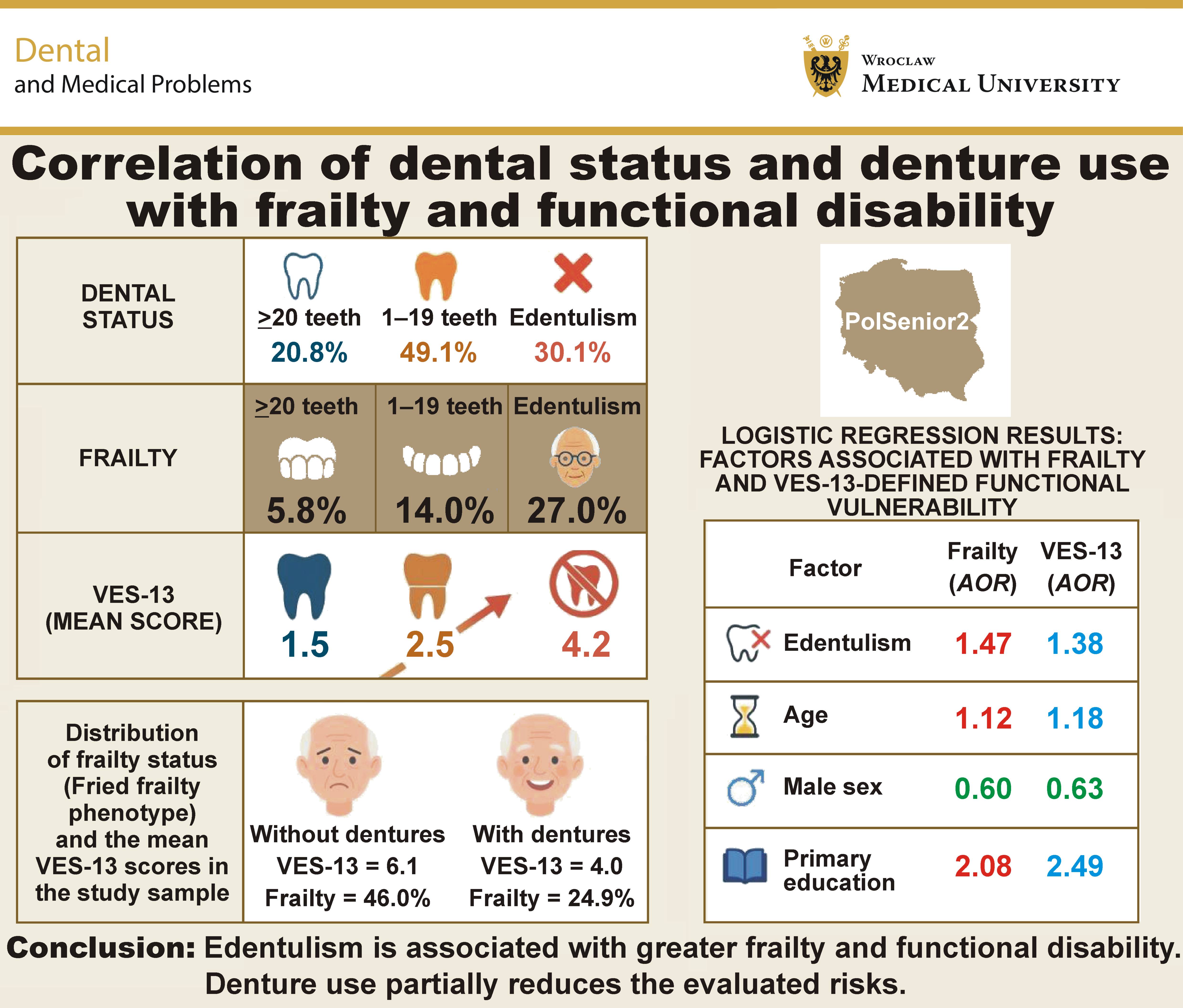
Table 1 presents the relationship between dental status and frailty/functional vulnerability. A clear gradient was observed across dentition categories. The prevalence of frailty increased from 5.8% among individuals with ≥20 teeth to 27.0% among edentulous individuals. Similarly, the mean VES-13 score increased from 1.5 to 4.2 across these groups, indicating worsening functional status with increasing tooth loss. The association with frailty was of moderate strength, and a similar moderate effect was observed for functional vulnerability as measured by the VES-13.
Participants with functional dentition (≥20 teeth) were generally younger, more educated, and more likely to live in large urban areas than those with partial dentition or edentulism. For example, among individuals aged 60–64 years, 34.7% had ≥20 teeth, compared with only 15.9% among edentulous individuals in the same age group. In contrast, edentulism was most prevalent among those aged 85 years and older (62.9–70.2%).
Higher education was strongly associated with better dental status: 43.4% of participants with ≥20 teeth had higher education, compared with only 14.0% in the edentulous group. Edentulous individuals were also more likely to reside in rural areas and had a mean BMI of 29.1 kg/m2 compared with 28.8 kg/m2 among participants with ≥20 teeth. The partial dentition group represented the largest proportion across all smoking categories (47.8% of current smokers, 50.6% of former smokers and 49.9% of non-smokers).
Table 2 presents the associations between dental status, denture use, and 2 indicators of vulnerability – frailty syndrome according to the Fried frailty phenotype and functional vulnerability measured using the VES-13. Marked differences in frailty status and functional vulnerability were observed across dentition and denture use categories. Among participants with ≥20 natural teeth, only 5.8% met the criteria for frailty, and the mean VES-13 score was the lowest (1.5, 95% CI: 1.4–1.7). In contrast, edentulous individuals who were not using dentures had the highest prevalence of frailty (46.0%, 95% CI: 36.6–55.4) and the highest average VES-13 score of 6.1 (5.5–6.7). Denture use was associated with better outcomes across all categories. For example, among edentulous individuals, those using dentures had a substantially lower prevalence of frailty (24.9% vs. 46.0%) and better functional status, as reflected by a lower mean VES-13 score (4.0 vs. 6.1). Similarly, among those with 1–19 teeth, denture wearers presented a lower prevalence of frailty (12.9% vs. 17.7%) and poorer functional status. Effect size analyses indicated that the association with frailty was of moderate strength, whereas the association with functional vulnerability was large.
Univariate logistic regression analyses revealed a strong associations of dental status with frailty and functional vulnerability, as determined by the VES-13 (Table 3). Compared with participants with functional dentition, individuals with 1–19 teeth had approx. 2.5-fold higher ORs, and edentulous patients almost 7-fold higher ORs regarding frailty and functional vulnerability. Among the other covariates analyzed, age, sex, BMI, education level, and smoking status were associated with both frailty and functional vulnerability. Regarding place of residence, a statistically significant association was observed for frailty among participants living in urban areas with <50,000 residents compared with those living in cities with >200,000 residents. No significant associations with VES-13-defined functional vulnerability were observed.
In multivariable logistic regression models that included covariates significant in the univariate analyses, edentulism was independently associated with significantly higher odds of both frailty (OR = 1.47) and functional vulnerability (OR = 1.38). Partial dentition (1–19 teeth) did not show a significant association with either outcome. Increasing age was a strong predictor of both frailty (OR = 1.12) and vulnerability (OR = 1.18) (p < 0.001). Male sex was associated with lower odds of frailty (OR = 0.60) and VES-13-defined vulnerability (OR = 0.63). Lower education levels were consistently associated with higher odds; individuals with primary education had more than twice the odds of both frailty and vulnerability compared to those with higher education. Residence in rural areas was associated with a reduced risk of frailty (OR = 0.65), but was not significantly associated with VES-13-defined vulnerability. Finally, smoking was not significantly linked to frailty but was associated with higher odds of functional vulnerability (OR = 1.31).
Discussion
This nationally representative study of older adults in Poland demonstrates a robust association between edentulism and increased odds of both physical frailty and functional vulnerability, independent of sociodemographic and clinical covariates. Participants with functional dentition had the most favorable health profiles, whereas edentulous individuals, especially those without dentures, showed the highest prevalence of functional deterioration and vulnerability. Effect size analyses indicated that these associations were not only statistically significant but also clinically meaningful. The relationship between dental status and frailty showed a moderate effect (Cramér’s V = 0.20), as did the relationship between dental status and functional vulnerability (η2 = 0.11), while the association between dentition/denture use and functional vulnerability, as measured by the VES-13, was large (η2 = 0.14).
Our findings are consistent with international studies conducted in the UK, China and Brazil, which have reported higher frailty rates among older adults with few teeth and no dentures than among those retaining functional dentition.22, 23, 24, 25, 26 By confirming these associations in a Central European population, our study adds important regional evidence to the existing literature.
Tobacco smoking is a well-established risk factor for periodontal disease and tooth loss, contributing to poor oral health outcomes and compounding the effects of edentulism on overall health and frailty.27, 28 Tooth loss compromises mastication and limits dietary variety, reducing the intake of fruits, vegetables and protein-rich foods – factors linked to malnutrition, sarcopenia and impaired immune function, all of which are relevant to frailty.29, 30, 31 Inflammatory processes associated with oral disease may further contribute to systemic aging, and recent evidence indicates that periodontal parameters such as the gingival index (GI) and clinical attachment level (CAL) are significantly associated with mild cognitive impairment in adults aged ≥55 years, independent of education level or sex.32, 33 Chronic diseases may further exacerbate oral health deterioration in older adults. For example, patients with Parkinson’s disease are at increased risk of tooth wear, which is associated with impaired quality of life, bruxism and temporomandibular disorders.34 Moreover, salivary biomarkers have been investigated as potential predictors of systemic aging and frailty, linking oral and general health through biological pathways.35 The psychosocial impact of edentulism, including impaired speech, social withdrawal and reduced self-esteem, may also contribute to functional decline.36, 37, 38 Chronic pain, which disproportionately affects older adults, may interact with oral disease, further reducing quality of life and accelerating functional decline.39
Denture use appeared to attenuate the observed risks of both physical frailty and functional vulnerability. Among edentulous participants, individuals who did not use dentures had the highest prevalence of frailty and a higher VES-13 score (6.1) than denture users (4.0). The apparent discrepancy between the prevalence of frailty and VES-13-defined vulnerability likely reflects differences between the tools. The Fried frailty phenotype captures objective deficits, while the VES-13 emphasizes subjective health and independence. Similar findings from Asia support the beneficial role of prosthetic rehabilitation.40 Nonetheless, denture users had less favorable outcomes than those with natural dentition, underscoring the importance of tooth retention as a primary goal for healthy aging.41
Male sex was inversely associated with frailty and functional vulnerability. This may reflect a combination of biological resilience and behavioral differences, such as men’s tendency to underreport limitations, which can influence self-reported measures like the VES-13.42
Finally, frailty and functional vulnerability were, as expected, related to sociodemographic factors such as age, BMI and education, supporting the contribution of both biological and social determinants to age-related vulnerability.43 Lower education was strongly associated with both frailty and functional vulnerability, underlining the importance of social determinants and health literacy in late-life trajectories. Rural and small-town residence appeared to be associated with lower odds of frailty, which may reflect greater physical activity or traditional dietary patterns, although further research is required. The BMI showed a complex pattern, consistent with the so-called “obesity paradox”, in which underweight was linked to higher vulnerability, whereas overweight did not increase the odds after adjustment.44
Strengths and limitations
This study is among the first in Central Europe to investigate the relationship between dental status and frailty/functional vulnerability using a large, nationally representative dataset of older adults. The combined application of the Fried frailty phenotype and the VES-13 provided a multidimensional perspective, capturing both objective deficits and self-reported vulnerability.
Nevertheless, several limitations should be noted. First, the cross-sectional design precludes causal inference, and longitudinal studies are needed to clarify the temporal sequence of the observed associations. Second, comorbidities were not included in the analyses, and these may have confounded the observed associations. Third, important clinical variables such as denture fit, prosthesis type and masticatory performance were not captured, limiting the ability to assess the protective role of prosthetic rehabilitation. Fourth, dietary intake and physical activity were not directly assessed, although they represent key pathways linking oral health to frailty and disability. Fifth, some variables were based on self-reported data, which may have introduced recall or reporting bias. Although regression models were adjusted for sex, education and place of residence, unequal group sizes may have introduced residual confounding.
Conclusions
This study demonstrates that edentulism is a strong and independent predictor of both physical frailty and functional vulnerability in older adults. The associations persisted after adjustment for key demographic and clinical factors, highlighting the role of oral health as a critical, yet often overlooked, determinant of aging outcomes. Denture use appears to be correlated with more favorable outcomes but does not fully compensate for the loss of natural dentition. Given the high prevalence of tooth loss in aging populations, oral health assessments should be integrated into geriatric screening protocols, and efforts to promote lifelong oral care and access to prosthetic rehabilitation should be prioritized in public health strategies.
Ethics approval and consent to participate
The study was approved by the Independent Bioethics Committee of the Medical University of Gdańsk, Poland (approval No. NKBBN/257/2017). Written informed consent was obtained from all participants.
Data availability
The datasets generated and/or analyzed during the current study are available from the corresponding author on reasonable request.
Consent for publication
Not applicable.
Use of AI and AI-assisted technologies
ChatGPT (OpenAI, San Francisco, USA) was used for language support and linguistic editing.