


Abstract
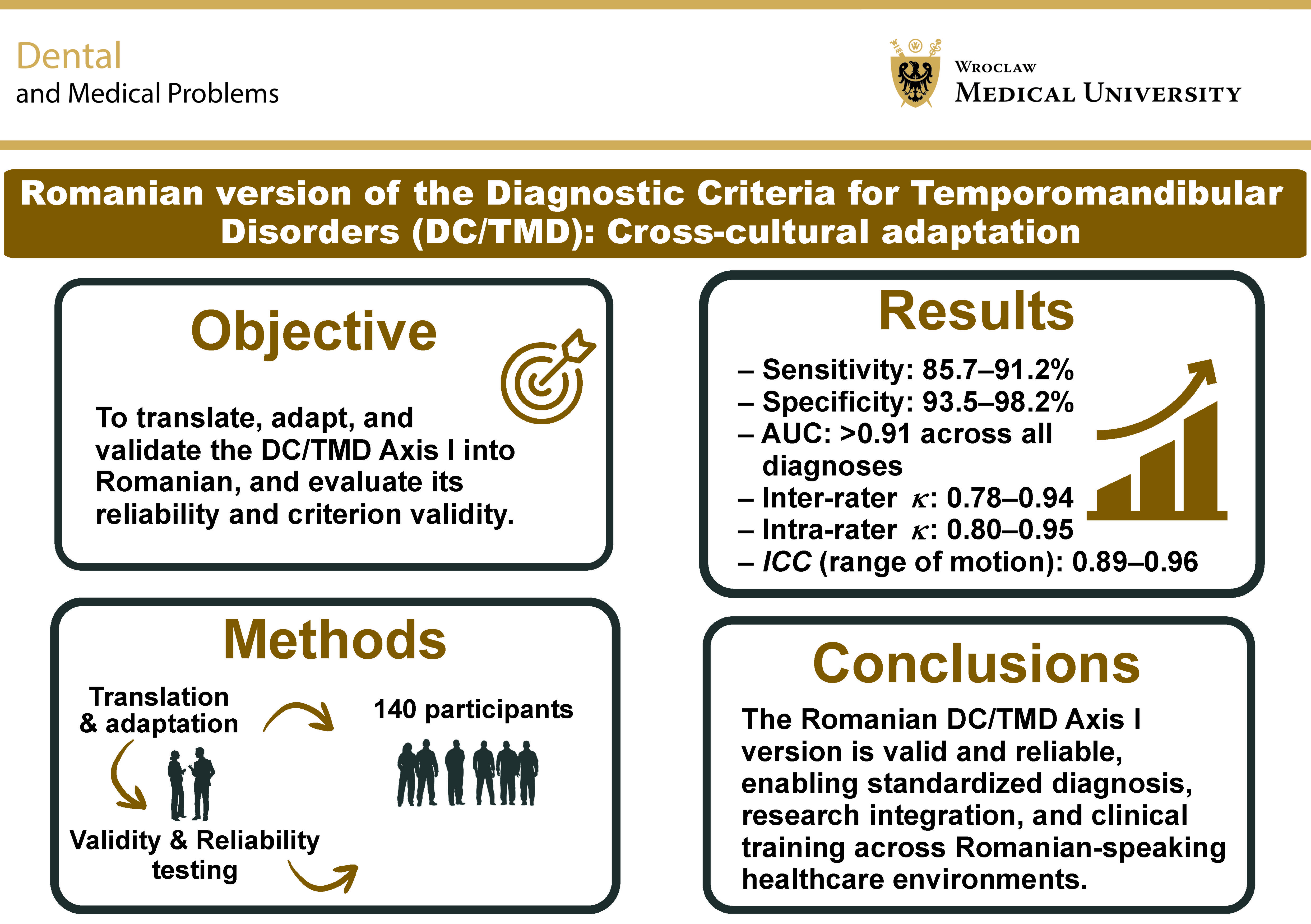
Background. Temporomandibular disorders (TMD) are the most common cause of non-dental orofacial pain, affecting about 1/3 of the population worldwide. The Diagnostic Criteria for Temporomandibular Disorders (DC/TMD) Axis I is recognized as the international gold standard for the clinical and research diagnosis of TMD; however, no validated Romanian version has been available to date.
Objectives. The aim of the present study was to translate and culturally adapt the DC/TMD Axis I into Romanian, and to evaluate its criterion validity and inter- and intra-examiner reliability.
Material and methods. This cross-sectional methodological study followed the Beaton et al. and DC/TMD translation guidelines. The process included forward–backward translation, an expert panel review, and pre-testing on 20 patients to ensure semantic and conceptual equivalence. A total of 140 Romanian-speaking adults (mean age: 34.7 ±12.1 years; 70.7% women) were examined by 2 calibrated clinicians. Criterion validity was assessed against an expert-consensus reference diagnosis. Inter- and intra-examiner reliability for categorical variables was analyzed using Cohen’s κ, and for continuous measurements using intraclass correlation coefficients (ICCs). The Bland–Altman plots and demographic analyses further evaluated measurement consistency.
Results. The Romanian DC/TMD Axis I showed excellent diagnostic performance, with sensitivity ranging from 85.7% (for disc displacement without reduction) to 91.2% (for myalgia), specificity of 93.5–98.2%, and AUC (the area under the receiver operating characteristic (ROC) curve) ≥ 0.91 for all diagnostic categories. Inter-examiner agreement was substantial to almost perfect (κ = 0.78–0.94), and intra-examiner agreement similarly high (κ = 0.80–0.95). Continuous mandibular measurements demonstrated excellent reproducibility (ICC = 0.89–0.96). Slightly lower sensitivity for disc displacement without reduction indicates an area for further refinement of diagnostic criteria.
Conclusions. The Romanian version of the DC/TMD Axis I is a valid, reliable and culturally equivalent tool for diagnosing TMD. Its adoption will standardize clinical assessment, enhance interdisciplinary communication, and enable Romanian participation in multicenter and educational initiatives across Central and Eastern Europe.
Keywords: Romania, reproducibility of results, temporomandibular disorders, validation study, cross-cultural comparison
Introduction
Temporomandibular disorders (TMD) comprise a heterogenous group of musculoskeletal and neuromuscular conditions that affect the temporomandibular joints (TMJs), masticatory muscles, and related structures.1, 2 They are the most common cause of non-dental orofacial pain, affecting approx. 34% of the population worldwide, with geographical variations.3 They are frequently associated with pain, functional limitation and reduced quality of life (QoL).4, 5 Since TMD have a multifactorial etiology involving biological, psychological and social components, their manifestations often overlap and vary between individuals. Factors such as occlusal and musculoskeletal dysfunctions, emotional stress, parafunctional behaviors, and central sensitization have all been implicated in TMD pathophysiology.6, 7, 8, 9, 10, 11, 12, 13 Therefore, standardized diagnostic criteria are essential to ensure accurate classification, facilitate interdisciplinary management, and enable meaningful comparisons across clinical and research settings.
The Diagnostic Criteria for Temporomandibular Disorders (DC/TMD) published in 2014 are considered the international gold standard for the clinical and research diagnosis of TMD.6 They comprise 2 complementary axes: Axis I, which provides standardized clinical assessment procedures and decision rules for the most common TMD subtypes (e.g., myalgia, arthralgia, disc displacement); and Axis II, which evaluates psychosocial factors and pain-related disability. Axis II includes validated questionnaires that assess domains such as pain intensity (Graded Chronic Pain Scale – GCPS), depressive and anxiety symptoms (Patient Health Questionnaire-9 – PHQ-9, Generalized Anxiety Disorder-7 – GAD-7), and pain catastrophizing. The inclusion of these measures enables a biopsychosocial approach, improving diagnostic accuracy and supporting interdisciplinary treatment planning. Axis I has demonstrated robust psychometric properties, including high reliability and validity across multiple populations.14
The cross-cultural adaptation of diagnostic instruments is critical to maintain semantic, idiomatic, experiential, and conceptual equivalence between the original and target versions.15 Proper adaptation enables clinicians to accurately capture patient-reported symptoms and apply standardized diagnostic procedures in a culturally sensitive manner.15 Several validated translations of the DC/TMD Axis I have been published, including Brazilian Portuguese, Turkish, and Polish versions, all of which report high inter- and intra-examiner reliability (Cohen’s κ > 0.75) and excellent criterion validity (AUC (the area under the receiver operating characteristic (ROC) curve) ≥ 0.85).16, 17, 18, 19
However, no validated Romanian version of the DC/TMD Axis I has been available to date, which limits standardized clinical practice, hinders multicenter collaboration and constrains epidemiological surveillance in Romania. Therefore, the present study aims to fill this gap by translating and culturally adapting the DC/TMD Axis I into Romanian in accordance with the internationally accepted guidelines, evaluating its criterion validity against an expert-consensus reference diagnosis, and determining the inter- and intra-examiner reliability of the clinical examination procedures and continuous measurements.
Material and methods
Study design
This was a cross-sectional methodological study designed to translate, culturally adapt, and validate the DC/TMD Axis I for use in Romanian clinical and research settings. The study adhered to the internationally accepted guidelines for the cross-cultural adaptation of clinical instruments, including those outlined by Beaton et al.,20 and the DC/TMD translation project.6
Setting and participants
Participants were recruited between March and September 2024 from the dental clinics and outpatient services affiliated with the Osteo Performance Clinic in Bucharest, Romania, within the framework of the Doctor of Physical Therapy program at the University of Medical Sciences Arizona (UMSAZ), Honolulu, USA. The eligibility criteria included adults aged 18 years or older who were fluent in Romanian and able to provide written informed consent. The exclusion criteria comprised systemic rheumatic diseases, a history of maxillofacial surgery, acute trauma, cognitive or communication impairment that could interfere with the completion of the protocol, alcohol and/or drug addiction, severe mental illness, active neoplasms, and pregnancy.
The final study group consisted of 140 participants (99 women, 41 men; mean age: 34.7 ±12.1 years; range: 18–65 years), representing a broad cross-section of Romanian adults seeking dental and orofacial care. The pre-test phase included 20 participants who met the same eligibility criteria; it was meant to evaluate the comprehensibility and applicability of the adapted version. Inter-examiner reliability during this phase demonstrated excellent agreement for the diagnostic categories, with an intraclass correlation coefficient (ICC) of 0.91, confirming the stability and consistency of the assessment process prior to clinical validation.
The sample size was determined according to methodological recommendations for the reliability and validity studies of clinical diagnostic tools, which suggest that at least 100 participants are required to obtain stable estimates of the κ and ICC values with acceptable precision.21, 22, 23 Accordingly, a cohort of 140 participants was considered adequate to ensure sufficient statistical power for detecting reliability coefficients ≥0.80 and for robust criterion validity analysis across diagnostic subgroups. The study protocol was reviewed and approved by the Research Ethics Committee of the National University of Physical Education and Sports, Bucharest, Romania (approval No. 1170/SF/23.09.2025). Written informed consent was obtained from all participants prior to enrollment, and all procedures were conducted in accordance with the ethical principles outlined in the Declaration of Helsinki. The data was anonymized prior to analysis to ensure confidentiality. Participation was entirely voluntary, and refusal to participate did not affect access to care. The University of Medical Sciences Arizona (UMSAZ) reviewed the protocol and formally acknowledged the Romanian ethics committee approval as sufficient ethical oversight for this project.
Translation and cross-cultural adaptation
The translation and cultural adaptation of the DC/TMD Axis I followed the DC/TMD guidelines,6 and included the following steps:
1. Forward translation: Two independent bilingual translators with medical backgrounds translated the original English version into Romanian to ensure the accurate rendering of clinical terminology.
2. Synthesis: The 2 forward translations were reconciled into a single synthesized version to resolve discrepancies and achieve linguistic consistency.
3. Back translation: Two native English speakers, blinded to the original version, back-translated the synthesized Romanian version into English. This step verified semantic and conceptual equivalence between the original and translated versions.
4. Expert committee review: A multidisciplinary expert panel, consisting of the authors themselves (AM, DGB, AP, TS), reviewed all versions to ensure semantic, idiomatic, experiential, and conceptual equivalence, and to confirm that clinical terms were culturally appropriate for Romanian practice.
5. Pre-testing: The pre-final version was tested on 20 patients to evaluate clarity, cultural relevance and comprehension. Minor adjustments were made as needed, primarily involving phrasing and terminology changes to enhance clarity and cultural relevance (e.g., replacing dental jargon with commonly used Romanian equivalents). This stage ensured that the adapted version was easily understood by patients and consistent with everyday language use.
6. Finalization: The expert panel approved the final Romanian version after confirming that all adaptations preserved the intent and diagnostic meaning of the original DC/TMD Axis I.
Reference standard diagnosis
The reference diagnosis was determined by a consensus panel of 3 TMD specialists (AM, MI and AP), who independently reviewed all available clinical information and, when indicated, imaging findings. The panel members were blinded to the Romanian DC/TMD results. Discrepancies were resolved through discussion until consensus was reached.
Clinical examination procedures
Two examiners (DGB and TS) were trained and calibrated according to the DC/TMD guidelines prior to data collection.6 Calibration included joint training sessions involving clinical demonstrations, supervised practice, and consensus discussions with a senior DC/TMD instructor (TG) until complete agreement was reached on all diagnostic procedures. Inter- and intra-examiner reliability was confirmed in pilot assessments before the main study. Any diagnostic discrepancies during data collection were resolved through re-examination and discussion, with final decisions determined by consensus within the expert panel. Examinations followed the standardized DC/TMD Axis I protocol, including a structured patient history, the clinical palpation of the masticatory muscles and TMJs, joint noise assessment, and the measurement of the mandibular range of motion.
Reliability assessment
Inter-examiner reliability was evaluated by having both examiners independently assess each participant on the same day, with each examiner blinded to the other’s findings. Intra-examiner reliability was determined by having one examiner repeat the complete assessment after 7–10 days under comparable conditions, blinded to their initial results.
Statistical analysis
All data was analyzed using IBM SPSS Statistics for Windows, v. 29 (IBM Corp., Armonk, USA). Inter- and intra-examiner agreement for categorical diagnostic variables was evaluated using Cohen’s κ with 95% confidence intervals (CIs), interpreted according to the Landis and Koch benchmarks (κ = 0.61–0.80 indicating substantial agreement; κ = 0.81–1.00 indicating almost perfect agreement). The reliability of continuous mandibular mobility measurements was assessed using ICCs (two-way mixed-effects model, absolute agreement) with 95% CI, with ICC values greater than 0.75 considered excellent.
To provide a more comprehensive assessment of measurement consistency, the Bland–Altman plots were generated for continuous mandibular movement data to visualize agreement and potential systematic bias between the examiners. Additionally, the potential influence of demographic variables (age and sex) on inter-examiner agreement was explored using correlation and subgroup analyses.
Criterion validity was determined by calculating sensitivity, specificity and AUC, comparing Romanian DC/TMD diagnoses against the expert-consensus reference standard.
Results
Participant characteristics
A total of 140 participants were included (99 women (70.7%), 41 men (29.3%)), with a mean age of 34.7 ±12.1 years (range: 18–65 years). The mean symptom duration was 26.4 ±18.7 months. Myalgia was the most frequent diagnosis (38.6%), followed by arthralgia (22.1%) and disc displacement with reduction (20.7%). Disc displacement without reduction and degenerative joint disease were less common (10.7% and 7.9%, respectively).
Criterion validity
The Romanian DC/TMD Axis I demonstrated excellent criterion validity when compared with the expert-consensus reference diagnosis. Sensitivity ranged from 85.7% for disc displacement without reduction to 91.2% for myalgia, with specificity from 93.5% to 98.2% and AUC values ≥0.91 for all diagnostic categories (Table 1). Although all diagnostic values were high, the slightly lower sensitivity for disc displacement without reduction suggests potential variability in the clinical recognition of this condition, and indicates an area that may warrant further research to optimize diagnostic criteria and examiner calibration.
Inter- and intra-examiner reliability
Inter-examiner reliability was substantial to almost perfect across all diagnostic categories (κ = 0.78–0.94), with similar results for intra-examiner reliability (κ = 0.80–0.95) (Table 2).
Reliability of continuous measures
Mandibular mobility measurements demonstrated excellent reproducibility. Inter-examiner ICCs ranged from 0.89 for maximum protrusion to 0.94 for maximum unassisted mouth opening. Intra-examiner ICCs ranged from 0.92 to 0.96, confirming high consistency across the repeated measurements.
Discussion
This study translated, culturally adapted, and validated the DC/TMD Axis I for use in Romanian clinical and research settings. Our findings demonstrate that the Romanian version possesses excellent criterion validity and high inter- and intra-examiner reliability for all major diagnostic categories, confirming that it is a robust tool for diagnosing TMD in Romania.
The high sensitivity (85.7–91.2%), specificity (93.5–98.2%) and AUC values (≥0.91) observed in this study are consistent with those reported in other validated translations of the DC/TMD Axis I.16, 17, 18 Antunes Da Cunha et al. (the Brazilian Portuguese version) reported similar diagnostic accuracy, with AUC values above 0.85 for most categories.18 Our reliability coefficients (κ = 0.78–0.95) were comparable to or slightly higher than those reported in the Brazilian and Turkish adaptations,17, 18 which also found substantial to almost perfect inter- and intra-examiner agreement.
In relation to the Polish study, our findings closely mirror those reported by Osiewicz et al., who demonstrated high criterion validity and substantial to almost perfect agreement for the Polish version of the DC/TMD Axis I.16 In our sample, sensitivity and specificity were slightly higher across several diagnostic categories, with AUC values consistently ≥0.91 in comparison with their somewhat wider range. Similarly, our inter- and intra-examiner κ coefficients (0.78–0.94 and 0.80–0.95, respectively) were comparable to or marginally higher than those observed in the Polish validation, particularly for disc displacement categories. These findings suggest that examiner calibration and balanced diagnostic representation in our cohort may have contributed to the slightly stronger reliability estimates. Together with the Brazilian, Turkish and Polish validations, our results reinforce the robustness of the DC/TMD Axis I, and support its applicability across diverse cultural and linguistic contexts.
Our ICC values for continuous measurements (0.89–0.96) also align closely with those reported in previous studies, including the original English version by Schiffman et al.,6 indicating excellent reproducibility for mandibular range-of-motion measurements. Notably, our sample included a balanced distribution of common TMD diagnoses, which likely contributed to the stable reliability estimates across categories, even for less prevalent conditions such as disc displacement without reduction and degenerative joint disease.
Clinical implications
The availability of the validated Romanian DC/TMD Axis I enables standardized diagnosis of TMD in dental, physical therapy, and multidisciplinary pain clinics across Romania. The use of uniform diagnostic criteria can shorten diagnostic time by providing clear decision rules, reducing the likelihood of misdiagnosis through consistent clinical definitions, and supporting timely referral decisions to appropriate specialists, such as physical therapists, orofacial pain experts, or psychologists. This standardization will also facilitate better patient stratification, more efficient treatment planning and improved communication among healthcare providers. Moreover, its integration into research will allow Romanian data to be reliably compared with international findings, fostering multicenter collaboration and epidemiological surveillance.
Limitations
The study has several limitations. The participants were recruited using convenience sampling from a single metropolitan area, which may limit the representativeness of the findings and their generalizability to other regions of Romania, as well as to individuals from different age groups or socioeconomic backgrounds. Although the overall sample size was adequate for reliability and validity analyses, it may not fully capture the demographic diversity of the national population.
Imaging procedures were not systematically applied across all the participants, particularly for the suspected cases of degenerative joint disease, which may have reduced the precision of the diagnostic reference standard. This limitation reflects the pragmatic design of the study, which followed the DC/TMD clinical protocol used in routine clinical practice. Future studies should incorporate consistent imaging protocols (e.g., magnetic resonance imaging (MRI) or cone-beam computed tomography (CBCT)) to strengthen diagnostic confirmation, especially for joint-related disorders.
Finally, the study was cross-sectional and did not assess the instrument’s responsiveness to clinical change over time.
Future directions
Future studies should aim to improve the representativeness of the sample through multicenter recruitment across diverse Romanian regions, including both urban and rural populations. In addition, longitudinal follow-up studies are needed to evaluate the responsiveness and longitudinal validity of the Romanian DC/TMD Axis I, assessing its ability to detect clinically meaningful changes following treatment. Further research should also examine its applicability in pediatric and geriatric populations. Moreover, the Romanian version could serve as a standardized tool for multicenter studies across Central and Eastern Europe, enhancing regional collaboration and the comparability of diagnostic data. Finally, the translation and validation of the Axis II psychosocial assessment into Romanian would further support a comprehensive biopsychosocial approach to the management of TMD.
Conclusions
The Romanian version of the DC/TMD Axis I is a valid and reliable diagnostic tool for TMD. Its implementation is recommended for both clinical practice and research in Romania, as it will harmonize diagnostic standards and facilitate international collaboration. In addition, the availability of a standardized and validated instrument provides an important educational resource for dentists, physical therapists, and other healthcare professionals, enabling training to be based on uniform, evidence-based diagnostic criteria.
Ethics approval and consent to participate
The study protocol was reviewed and approved by the Research Ethics Committee of the National University of Physical Education and Sports, Bucharest, Romania (approval No. 1170/SF/23.09.2025). Written informed consent was obtained from all participants prior to enrollment, and all procedures were conducted in accordance with the ethical principles outlined in the Declaration of Helsinki. The data was anonymized prior to analysis to ensure confidentiality. Participation was entirely voluntary, and refusal to participate did not affect access to care. The University of Medical Sciences Arizona (UMSAZ), Honolulu, USA, reviewed the protocol and formally acknowledged the Romanian ethics committee approval as sufficient ethical oversight for this project.
Data availability
The datasets supporting the findings of the current study are available from the corresponding author on reasonable request.
Consent for publication
Not applicable.
Use of AI and AI-assisted technologies
AI-assisted technology (ChatGPT, OpenAI) was used solely for improving the English language and manuscript readability. No AI tools were used for study design, data collection, statistical analysis, the interpretation of results, or scientific conclusions. All scientific content, as well as the final approval of the manuscript, were the responsibility of the authors.