Abstract
Systemic enzyme therapy (SET) has emerged as a potential anti-inflammatory intervention, either as monotherapy or in combination with non-steroidal anti-inflammatory drugs (NSAIDs). Despite its increasing clinical application, the comparative efficacy of SET in various inflammatory conditions remains insufficiently explored.
A systematic review was conducted in accordance with the PRISMA (Preferred Reporting Items for Systematic reviews and Meta-Analyses) guidelines to evaluate the effectiveness of SET as an anti-inflammatory therapy. Databases were searched for studies meeting predefined eligibility criteria, including randomized and non-randomized trials. Study characteristics, intervention protocols and outcomes were extracted and analyzed. The risk of bias was assessed using the ROBINS-I (Risk Of Bias In Non-randomized Studies of Interventions) and Cochrane risk-of-bias (RoB) 2.0 tools.
Eleven studies with sample sizes ranging from 30 to 487,372 participants were included. Systemic enzyme therapy demonstrated comparable efficacy to diclofenac in terms of pain relief and functional improvement across various conditions, including joint disorders and temporomandibular disorders (TMD). Combination therapy resulted in significantly greater pain reduction (p < 0.05) and improved functional outcomes, as reported in several studies. In most cases, adverse effects were mild, and the safety profile of SET was more favorable than that of NSAIDs. One study reported that the concomitant use of NSAIDs and antihypertensive medications was associated with a 31% increased risk of acute kidney injury during the first 30 days.
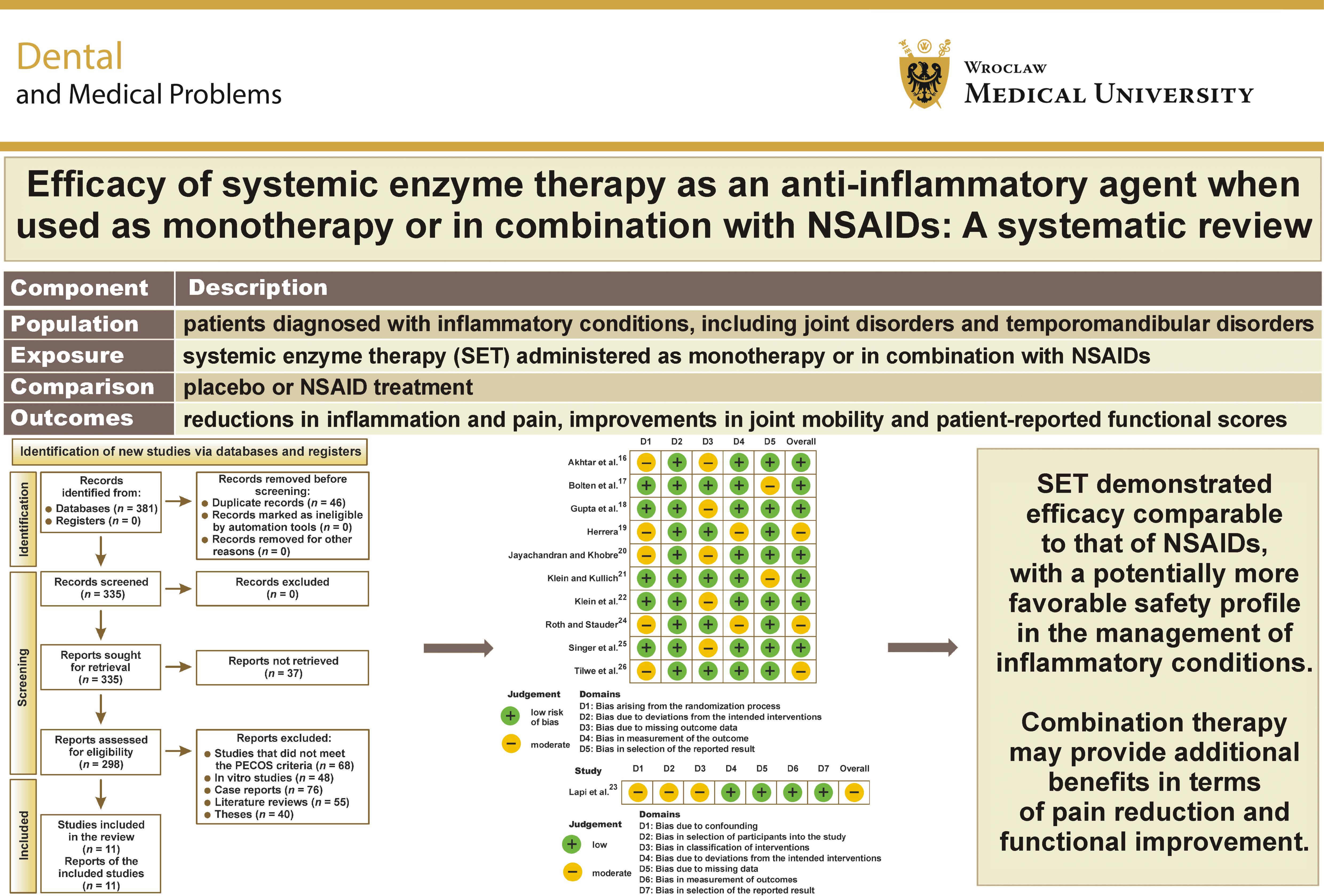
Systemic enzyme therapy demonstrated efficacy comparable to that of NSAIDs, with a potentially more favorable safety profile in the management of inflammatory conditions. Combination therapy may provide additional benefits in terms of pain reduction and functional improvement. However, the heterogeneity of study designs and the limited number of large-scale trials warrant further research.
Keywords: systemic enzyme therapy, anti-inflammatory therapy, NSAIDs, combination therapy, pain relief
Introduction
Systemic enzyme therapy (SET) has attracted considerable interest for its potential anti-inflammatory effects, both as monotherapy and as an adjunct to conventional non-steroidal anti-inflammatory drugs (NSAIDs).1 Systemic enzyme preparations, consisting of combinations of proteolytic enzymes and other active agents, such as trypsin, bromelain and the flavonoid rutin, are thought to act through multiple mechanisms, including fibrinolysis, the reduction of pro-inflammatory cytokines and the promotion of tissue repair.2 Unlike NSAIDs, which primarily work by inhibiting cyclooxygenase enzymes and thereby reducing prostaglandin synthesis, SET may exert its effects through multiple pathways involving inflammatory mediators, potentially avoiding some of the gastrointestinal and cardiovascular adverse effects associated with chronic use of NSAIDs.3
The inflammatory response plays a central role in various acute and chronic conditions, including musculoskeletal injuries and autoimmune disorders. Although widely regarded as a cornerstone of anti-inflammatory therapy, long-term NSAID use is often limited by adverse effects, including gastric ulceration, renal dysfunction and an increased risk of thrombotic events.4, 5 These limitations have prompted interest in complementary or alternative therapies, particularly those that may provide anti-inflammatory benefits with a more favorable safety profile. The proposed systemic absorption of proteolytic enzymes and their potential biochemical activities make SET a possible therapeutic approach for reducing inflammation while potentially minimizing the adverse effects associated with conventional anti-inflammatory medications.6
Several recently published studies indicate growing interest in SET for various inflammatory conditions, such as osteoarthritis (OA), rheumatoid arthritis and postoperative inflammation.7 Preliminary evidence also suggests that SET may act by degrading circulating immune complexes, modulating vascular permeability, and reducing leukocyte adhesion and migration.8 However, these proposed benefits have not been conclusively established, as inconsistencies in study design, sample size and outcome measures have resulted in conflicting findings regarding the efficacy of SET. Furthermore, questions related to the bioavailability of systemic enzymes and their ability to reach inflammatory sites at therapeutically relevant concentrations continue to limit their widespread adoption in clinical practice.9, 10, 11
When used in combination therapy with NSAIDs, SET is thought to enhance their anti-inflammatory effect or allow for dose reductions.9, 10, 11, 12 These outcomes could potentially reduce the incidence of adverse events. However, the potential additive or synergistic effects of SET in combination with NSAIDs remain poorly understood, and high-quality evidence is insufficient to draw definite conclusions. Furthermore, the lack of standardized protocols regarding enzyme formulations, dosages and treatment duration complicates direct comparisons across studies and highlights the need for strict evaluation. Given these knowledge gaps, this systematic review aims to critically evaluate the available evidence regarding the efficacy of SET as an anti-inflammatory intervention, both as monotherapy and in combination with NSAIDs.
Material and methods
PECOS framework and PRISMA compliance
The PECOS framework for this review was developed based on the PRISMA (Preferred Reporting Items for Systematic reviews and Meta-Analyses) 2020 reporting guidelines,13 which ensure transparent and standardized reporting. The framework was defined as follows: Population (P) – patients diagnosed with inflammatory conditions, including joint disorders and temporomandibular disorders (TMD); Exposure (E) – SET administered as monotherapy or in combination with NSAIDs; Comparison (C) – placebo or NSAID treatment; Outcome (O) – reductions in inflammation and pain, improvements in joint mobility, and patient-reported functional scores; Study design (S): randomized controlled trials (RCTs), non-RCTs and cohort studies.
Inclusion and exclusion criteria
The inclusion criteria required studies to investigate patients with inflammatory conditions treated with SET as monotherapy or in combination with NSAIDs. Eligible studies included RCTs, non-RCTs and cohort studies involving human populations. Studies were required to report at least 1 measure of inflammation reduction, pain relief or functional improvement. Only full-text articles published in English were considered, with no restrictions on the year of publication.
Studies involving in vitro or animal models, non-inflammatory conditions or SET formulations that did not include trypsin, bromelain or rutoside were excluded. Reviews, editorials and articles lacking sufficient methodological details or reporting outcomes beyond the scope of this review were also excluded. Conference abstracts were excluded unless they reported sufficient methodological and outcome data. Studies published in languages other than English were not considered.
Database search
A systematic literature search was performed across 6 databases: PubMed; Embase; the Cochrane Library; Scopus; Web of Science; and CINAHL (Cumulative Index to Nursing and Allied Health Literature). The search terms included “systemic enzyme therapy”, “anti-inflammatory”, “diclofenac”, “bromelain”, “trypsin”, “rutoside”, “joint health”, “temporomandibular joint”, and “inflammation”. Boolean operators, such as AND, OR and NOT, were used to refine search results and identify relevant studies. MeSH terms were combined with free-text terms to improve search sensitivity (Table 1).
Data extraction protocol and items
The study used a predesigned template for data extraction. The following information was extracted: study characteristics, such as author names, publication year, country, and study design; population details, including sample size, demographics and the condition being treated; intervention details, such as formulation, dosage and treatment duration; comparator information; and outcome measures, including pain reduction, inflammatory markers, functional scores, and adverse events. Additional information included funding sources, disclosure of conflict of interest and risk-of-bias assessments.
Risk-of-bias assessment
The ROBINS-I (Risk Of Bias In Non-randomized Studies of Interventions)14 was used to assess the risk of bias in non-randomized studies, including bias due to confounding, selection of participants, classification of interventions, and measurement of outcomes. For RCTs, the Cochrane risk-of-bias (RoB) 2.0 tool15 was used to evaluate bias arising from the randomization process, deviations from the intended interventions, missing outcome data, and selective reporting. Risk-of-bias assessments were performed independently by 2 reviewers, and any disagreements were resolved through consensus.
Results
Study selection process
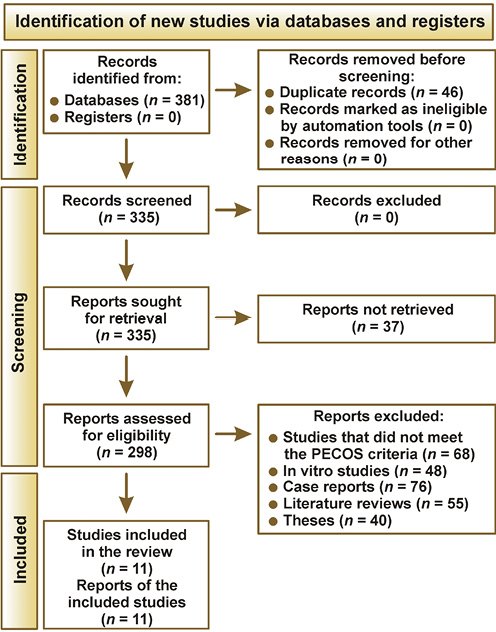
A total of 381 records were identified through database searches, of which 46 duplicates were removed before screening. The remaining 335 records were screened for relevance, and none were excluded at this stage. Subsequently, 37 reports could not be retrieved, leaving 298 reports for the assessment of eligibility. Of these, reports were excluded for the following reasons: failure to meet the PECOS eligibility criteria (n = 68); in vitro study design (n = 48); case reports (n = 76); literature reviews (n = 55); and theses (n = 40). Ultimately, 11 studies16, 17, 18, 19, 20, 21, 22, 23, 24, 25, 26 met the eligibility criteria and were included in the final review (Figure 1).
Publication year and geographical distribution
The studies covered a wide time span, ranging from 199819 to 2020 (Table 2).18 Regarding geographical distribution, a substantial proportion of studies were conducted in Germany,16, 17, 21, 22, 25, 26 reflecting considerable research activity in this country. Other countries represented were India,18, 20 Mexico19 and the UK.23 The geographical diversity provided insights into the application of SET across different patient populations and healthcare settings.
Study design
Most studies employed randomized, double-blind, parallel-group designs,16, 19, 21, 22, 25 which are generally considered the gold standard for minimizing bias in clinical trials. A placebo-controlled trial was conducted in 2015,17 while a retrospective cohort analysis was performed in the UK in 2013.23 Two studies employed single-blind or comparator-controlled designs,20, 26 with slight variations in methodology tailored to the specific clinical conditions investigated.
Sample size
Sample sizes varied considerably between studies, ranging from small cohorts of 30 participants in India18, 20 to a large retrospective cohort study involving 487,372 participants in the UK.23 Most of the randomized trials included between 50 and 268 participants,16, 17, 19, 21, 22, 25, 26 providing a reasonable balance between statistical power and feasibility.
Duration of interventions
Intervention durations and follow-up periods varied from 10 days20 to a follow-up of 5.9 years in a retrospective study.23 Most of the randomized trials lasted between 3 and 6 weeks,16, 19, 21, 22, 24, 25 while one extended to 12 weeks,17 and others included additional follow-up assessments.25, 26 These differences in duration reflected variations in the clinical conditions investigated and the study objectives.
Focus areas
The studies primarily focused on joint disorders, particularly those affecting the knee.16, 17, 19, 21, 24, 25, 26 One study also investigated hip-related conditions.22 Two studies targeted TMD, specifically internal derangement and OA of the temporomandibular joint (TMJ).18, 20 Another distinct area of investigation was the risk of acute kidney injury associated with the concomitant use of NSAIDs and antihypertensive medications.23 The diversity of conditions investigated reflects the broad range of clinical contexts in which SET has been evaluated.
Key findings
Several studies reported that SET demonstrated efficacy comparable to that of diclofenac in reducing pain and inflammation.16, 17, 20, 21, 22, 25, 26 Additional findings included a safety profile comparable to that of placebo17 and long-lasting therapeutic effects even after treatment.25 The combination of enzymes with diclofenac was associated with improved clinical outcomes, including greater pain reduction, enhanced joint function and improved masticatory function in patients with TMD.18, 20 A large retrospective study reported a 31% increased risk of acute kidney injury associated with triple therapy involving NSAIDs and antihypertensive agents, particularly during the first 30 days.23 Collectively, these findings suggest that SET is effective and may reduce the risk of adverse effects, particularly when used in combination with conventional anti-inflammatory therapy.
Risk-of-bias assessment
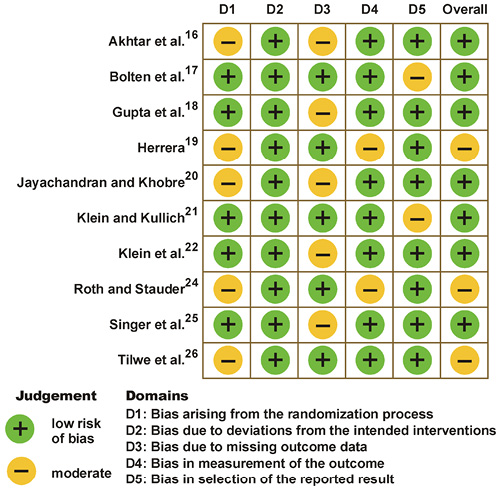
Most RCTs demonstrated a low risk of bias across several key domains, particularly those related to the randomization process, deviations from intended interventions and outcome measurement.17, 18, 21, 22, 25 Additionally, some concerns regarding outcome measurement and selective reporting influenced overall ratings.19, 24, 26 Despite these reservations, the vast majority of the RCTs were assessed as having an overall low risk of bias (Figure 2).
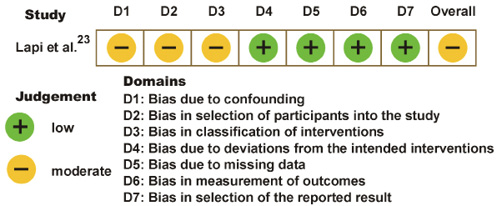
The non-randomized study23 was evaluated as having a moderate risk of bias, primarily due to limitations regarding confounding factors, participant selection and classification of interventions. Other domains, including deviations from the intended interventions and missing outcome data, were assessed as having a low risk of bias. Overall, the study reflected a moderate risk of bias, indicating methodological limitations associated with its design (Figure 3).
Discussion
Inflammatory conditions such as OA are usually treated with NSAIDs.27, 28, 29 Although widely used, long-term NSAID therapy is associated with adverse effects.30 The evidence suggests that the use of NSAIDs may be linked to the progression of radiographic knee OA.31 Moreover, NSAIDs can interfere with the natural mechanisms of inflammation resolution, such as tissue healing by inhibiting cyclooxygenase-2 activity, which subsequently suppresses the production of specialized pro-resolving mediators.32 Systemic enzyme therapy, also referred to as treatment with oral enzyme combinations (OECs), has also been studied as a complementary approach to managing inflammation. Evidence supporting the effectiveness of OECs in OA comes from 9 small clinical studies involving up to 268 patients and a systematic review incorporating a meta-analysis of 6 RCTs comparing OEC therapy with diclofenac in patients with knee OA.33
The studies included in this review demonstrated the potential efficacy of SET in the management of inflammation, with several papers reporting outcomes comparable to those of diclofenac and additional benefits in specific clinical contexts. Akhtar et al.16 and Bolten et al.17 showed that OECs were as effective as diclofenac in managing knee joint health, with the study by Bolten et al.17 reporting a more favorable safety profile and reduced need for rescue medication. These findings were consistent with those of Klein and Kullich21 and Singer et al.,25 who also reported comparable efficacy, although Singer et al.25 uniquely highlighted prolonged benefits of OEC therapy after treatment cessation.
Gupta et al.18 and Jayachandran and Khobre20 focused on TMD and noted improvements in pain, joint function and other clinical outcomes with combination therapy involving OECs and diclofenac. The outcomes of the studies complemented the broader applications of OECs reported in other investigations. These TMJ-specific findings, however, differed in their clinical focus from studies conducted solely on knee and hip joints. For example, Klein et al.22 reported comparable efficacy of OECs and diclofenac in hip OA, as assessed using functional indices such as the Western Ontario and McMaster Universities osteoarthritis index (WOMAC) and the Lequesne algofunctional index (LAFI).
Herrera reported findings that differed from the overall trend, as non-inferiority of OECs to diclofenac could not be established, potentially due to the inadequate sample size, although both treatments showed comparable functional results.19 Lapi et al. investigated a different outcome, focusing not on treatment efficacy but on the increased risk of acute kidney injury associated with combinations of NSAIDs and antihypertensive medications.23 Their findings highlighted safety concerns associated with NSAID use, although they did not directly establish the comparative safety of OECs reported by Bolten et al.17
Tilwe et al.26 provided further evidence suggesting that OECs were superior to diclofenac in reducing joint tenderness, consistent with the studies by Bolten et al.17 and Singer et al.25 Roth and Stauder reported that diclofenac was modestly superior on the LAFI, although the difference remained within the predefined non-inferiority margin.24 Overall, the majority of studies reported consistent efficacy and safety outcomes, although some discrepancies were observed, mainly due to differences in focus areas and methodological limitations, highlighting the need for more robust trials across various conditions.
The findings of our review, when compared with those of external studies, revealed both similarities and differences in the efficacy and safety of SET and NSAIDs. Bindu et al. highlighted the widespread use of NSAIDs in the management of pain and inflammation, emphasizing their analgesic and anti-inflammatory benefits alongside significant multiorgan adverse effects,34 which were not comprehensively addressed in our review. Szeto et al. proposed a practical framework for minimizing NSAID-related adverse effects through close patient monitoring and specific prescribing strategies,35 which were beyond the clinical scope of our review.
Henrotin et al. reported that OECs were as effective as NSAIDs in the management of OA, with fewer adverse effects.36 These findings are consistent with those of our review, which indicated comparable efficacy of OECs in terms of pain relief and functional outcomes. Furthermore, Ueberall et al. confirmed the comparable effectiveness of OECs and NSAIDs in reducing pain and improving physical function, with significantly more favorable safety and tolerability profiles for OECs than for NSAIDs.37 These findings were consistent with those of Bolten et al.17 and other knee OA trials included in our review. Shekhar et al. emphasized the benefits of combination therapy for TMJ osteoarthritis, consistent with our findings suggesting greater effectiveness of OECs combined with NSAIDs compared with NSAIDs alone.38 Our review and the available external studies reached similar conclusions regarding the efficacy and safety of SET. However, external studies addressed a broader range of safety concerns and provided practical recommendations for NSAID use, highlighting the need for further research in this area.
Limitations
This review was limited by heterogeneity in study designs, intervention durations and outcome measures. Several studies included small sample sizes, had limited statistical power and lacked comprehensive long-term follow-up. Considerable variation in SET dosing protocols and formulations further hindered direct comparisons between studies. Some studies were assessed as having a moderate risk of bias, particularly the non-randomized trial, which may have affected the validity of the findings. Lastly, the lack of uniform reporting standards across studies made it difficult to comprehensively synthesize the available data.
Future implications
Based on the available evidence, SET may be considered a potential adjunct to NSAIDs in the treatment of certain inflammatory conditions for better efficacy and safety. Establishing standardized SET dosing protocols and formulations may improve the consistency of therapeutic outcomes. Large-scale, long-term clinical trials are required to provide more robust evidence of the efficacy and safety of treatment across different patient populations. Furthermore, combination therapies involving SET and NSAIDs should be evaluated to determine optimal treatment regimens and investigate their potential to reduce reliance on conventional anti-inflammatory medications.
Conclusions
Systemic enzyme therapy demonstrated efficacy comparable to that of NSAIDs in several studies, with a potentially more favorable safety profile and a lower incidence of adverse effects. In some studies, combining SET with NSAIDs was associated with greater pain relief and improved functional outcomes compared with NSAID treatment alone. These findings suggest that SET may be a useful therapeutic option for selected inflammatory conditions, particularly when reducing treatment-related adverse effects is a clinical priority. However, the strength of the evidence remains limited by differences in study quality, highlighting the need for additional high-quality clinical trials.
Ethics approval and consent to participate
Not applicable.
Data availability
The analyzed data was obtained from publicly available peer-reviewed studies included in the review.
Consent for publication
Not applicable.
Use of AI and AI-assisted technologies
During the preparation of this manuscript, the authors used DeepL Translator (DeepL SE, Cologne, Germany) for language correction. After its use, the authors thoroughly reviewed, verified and revised all content to ensure accuracy and originality.